Immunotherapy Research Group, Translational and Clinical Research Institute, Faculty of Medical Sciences, Newcastle University, Newcastle Upon Tyne, United Kingdom.
Front Immunol. 2021 Jun 15;12:678757. doi: 10.3389/fimmu.2021.678757. eCollection 2021.
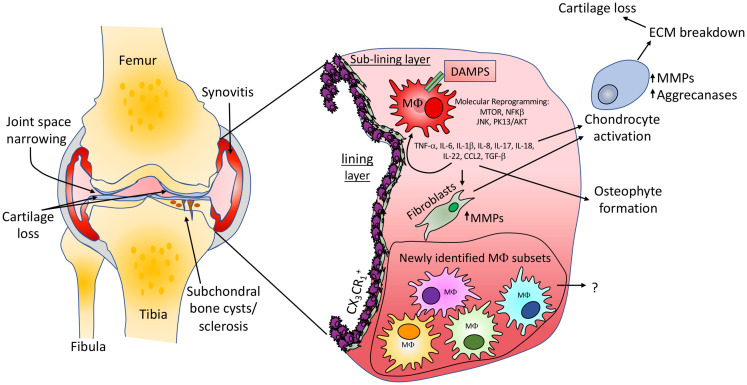
Effective treatment of osteoarthritis (OA) remains a huge clinical challenge despite major research efforts. Different tissues and cell-types within the joint contribute to disease pathogenesis, and there is great heterogeneity between patients in terms of clinical features, genetic characteristics and responses to treatment. Inflammation and the most abundant immune cell type within the joint, macrophages, have now been recognised as possible players in disease development and progression. Here we discuss recent findings on the involvement of synovial inflammation and particularly the role of synovial macrophages in OA pathogenesis. Understanding macrophage involvement may hold the key for improved OA treatments.
尽管进行了大量的研究,但骨关节炎(OA)的有效治疗仍然是一个巨大的临床挑战。关节内的不同组织和细胞类型都对疾病的发病机制有贡献,而且患者在临床特征、遗传特征和对治疗的反应方面存在很大的异质性。炎症和关节内最丰富的免疫细胞类型——巨噬细胞,现在已被认为是疾病发展和进展的可能参与者。在这里,我们讨论了滑膜炎症的最新发现,特别是滑膜巨噬细胞在 OA 发病机制中的作用。了解巨噬细胞的参与可能是改善 OA 治疗的关键。