ProScion, Herlev, Denmark.
University of Copenhagen, Faculty of Health and Medical Sciences, Copenhagen, Denmark.
PLoS One. 2019 Jul 24;14(7):e0219980. doi: 10.1371/journal.pone.0219980. eCollection 2019.
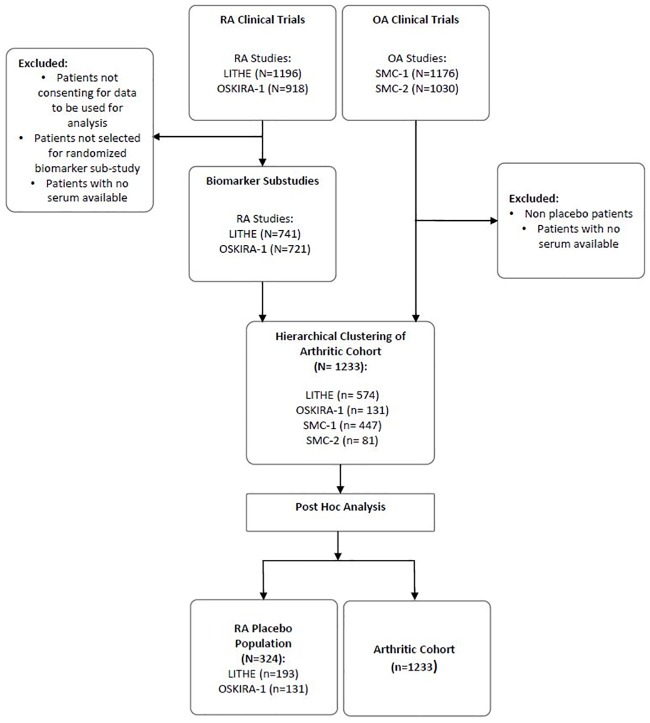
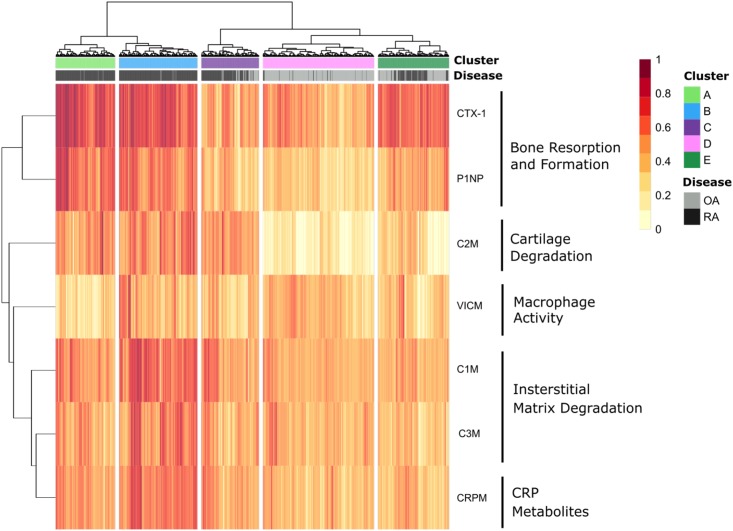
There is an increasing demand for accurate endotyping of patients according to their pathogenesis to allow more targeted treatment. We explore a combination of blood-based joint tissue metabolites (neoepitopes) to enable patient clustering through distinct disease profiles. We analysed data from two RA studies (LITHE (N = 574, follow-up 24 and 52 weeks), OSKIRA-1 (N = 131, follow-up 24 weeks)). Two osteoarthritis (OA) studies (SMC01 (N = 447), SMC02 (N = 81)) were included as non-RA comparators. Specific tissue-derived neoepitopes measured at baseline, included: C2M (cartilage degradation); CTX-I and PINP (bone turnover); C1M and C3M (interstitial matrix degradation); CRPM (CRP metabolite) and VICM (macrophage activity). Clustering was performed to identify putative endotypes. We identified five clusters (A-E). Clusters A and B were characterized by generally higher levels of biomarkers than other clusters, except VICM which was significantly higher in cluster B than in cluster A (p<0.001). Biomarker levels in Cluster C were all close to the median, whilst Cluster D was characterised by low levels of all biomarkers. Cluster E also had low levels of most biomarkers, but with significantly higher levels of CTX-I compared to cluster D. There was a significant difference in ΔSHP score observed at 52 weeks (p<0.05). We describe putative RA endotypes based on biomarkers reflecting joint tissue metabolism. These endotypes differ in their underlining pathogenesis, and may in the future have utility for patient treatment selection.
目前,人们越来越需要根据发病机制对患者进行准确的表型分型,以实现更有针对性的治疗。我们探索了一种联合血液中关节组织代谢物(新表位)的方法,以便通过不同的疾病特征对患者进行聚类。我们分析了两项 RA 研究(LITHE(N=574,随访 24 和 52 周),OSKIRA-1(N=131,随访 24 周))的数据。两项骨关节炎(OA)研究(SMC01(N=447),SMC02(N=81))被纳入作为非 RA 对照组。在基线时测量了特定的组织衍生的新表位,包括:C2M(软骨降解);CTX-I 和 PINP(骨转换);C1M 和 C3M(间质基质降解);CRPM(CRP 代谢物)和 VICM(巨噬细胞活性)。通过聚类来识别可能的表型。我们确定了五个聚类(A-E)。聚类 A 和 B 的特点是大多数生物标志物水平普遍高于其他聚类,除了 VICM,它在聚类 B 中明显高于聚类 A(p<0.001)。聚类 C 的生物标志物水平都接近中位数,而聚类 D 的特点是所有生物标志物水平都较低。聚类 E 也具有大多数生物标志物水平较低的特点,但与聚类 D 相比,CTX-I 水平明显更高。在 52 周时观察到 SHP 评分的差异有统计学意义(p<0.05)。我们根据反映关节组织代谢的生物标志物描述了潜在的 RA 表型。这些表型在发病机制上存在差异,将来可能对患者的治疗选择具有实用价值。