Jiang Yan, Zhao Li, Chen Qing, Zhou Lihong
School of Medicine, Hunan Normal University, Changsha, Hunan, China.
The First Affiliated Hospital, University of South China, Hengyang, Hunan, China.
Evid Based Complement Alternat Med. 2021 Jun 9;2021:9970240. doi: 10.1155/2021/9970240. eCollection 2021.
Ulcerative colitis (UC) is a chronic nonspecific inflammatory disease of the colon and rectum. Recent studies found that berberine had effects on inflammatory diseases and immune diseases.
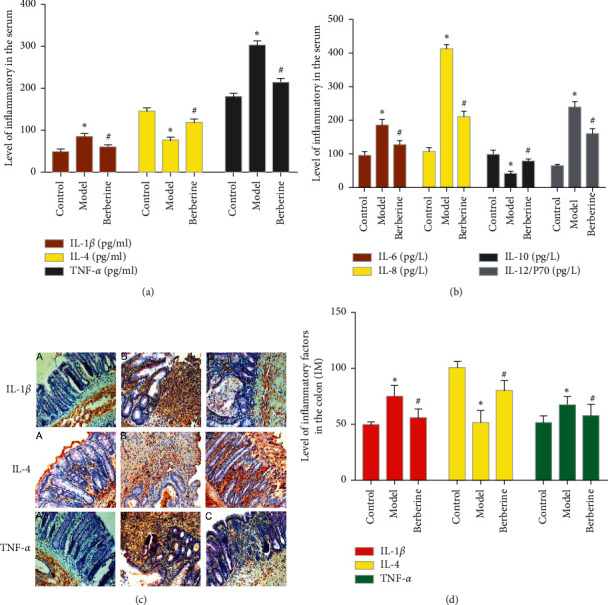
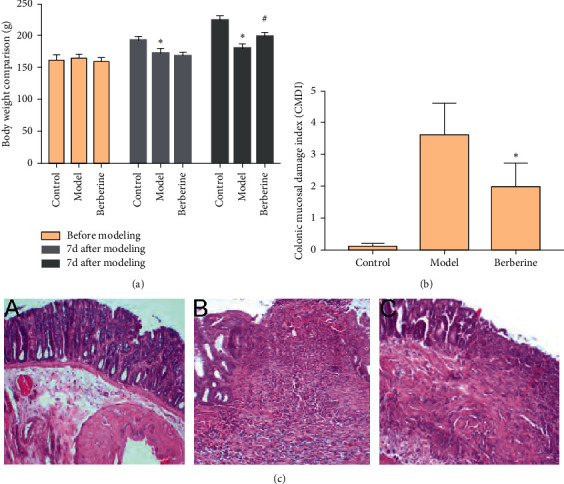
The PharmMapper database was used to predict the berberine potential target and GeneCards database and OMIM database were utilized to collect UC genes. The Cytoscape software was used to construct and analyze the networks and DAVID was utilized to perform enrichment analysis. Then, animal experiments were performed to validate the prediction results. The experimental rats were randomly divided into normal group (control group), model group, and berberine group. The general condition, body weight, gross morphology of colon tissue, and colonic mucosal damage index (CMDI) score were observed. The pathological changes of colon tissue were observed by H&E staining. The levels of serum interleukin-1 (IL-1), tumor necrosis factor- (TNF-), and IL-4 were detected by ELISA. The expressions of IL-1, TNF-, and IL-4 protein in colon tissue were detected by immunohistochemistry.
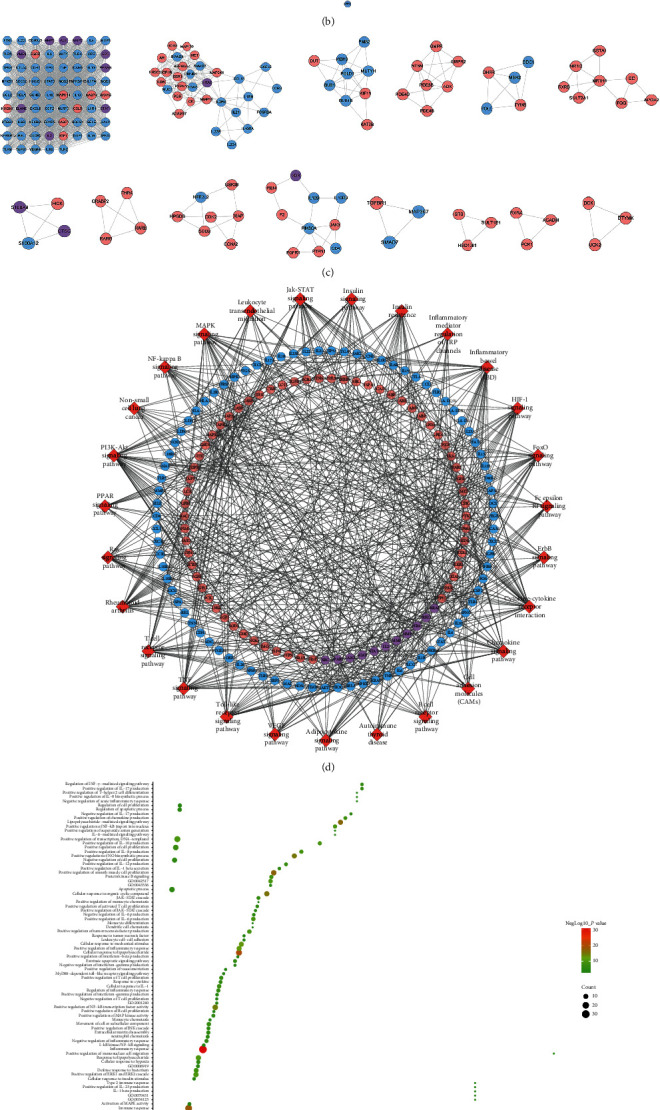
A total of 211 Berberine's potential targets and 210 UC genes were obtained. The enrichment analysis showed that berberine may regulate inflammation, inflammatory cytokines, and their mediated inflammation signal pathways such as inflammatory bowel disease (IBD), rheumatoid arthritis, cytokine-cytokine receptor interaction, TNF, T cell receptor, Toll-like receptor, and JAK/STAT signaling pathway. Compared with the model group, the body mass of rats in the berberine group was significantly increased ( < 0.05); the general morphology and pathological changes of colon tissue were significantly improved; CMDI score, serum and colon tissue IL-1, TNF- content, and protein expression were decreased significantly ( < 0.05); and IL-4 content and protein expression increased significantly ( < 0.05).
Berberine can interfere with UC through related biological processes and signal pathways related to inflammation and immunity. In-depth exploration of the mechanism of berberine in the treatment of UC will provide a basis for clinical application.
溃疡性结肠炎(UC)是一种结肠和直肠的慢性非特异性炎症性疾病。近期研究发现黄连素对炎症性疾病和免疫性疾病有作用。
利用PharmMapper数据库预测黄连素潜在靶点,运用GeneCards数据库和OMIM数据库收集UC相关基因。使用Cytoscape软件构建和分析网络,利用DAVID进行富集分析。随后进行动物实验验证预测结果。将实验大鼠随机分为正常组(对照组)、模型组和黄连素组。观察大鼠的一般状况、体重、结肠组织大体形态及结肠黏膜损伤指数(CMDI)评分。通过苏木精-伊红(H&E)染色观察结肠组织病理变化。采用酶联免疫吸附测定(ELISA)法检测血清白细胞介素-1(IL-1)、肿瘤坏死因子-α(TNF-α)和IL-4水平。通过免疫组织化学法检测结肠组织中IL-1、TNF-α和IL-4蛋白的表达。
共获得211个黄连素潜在靶点和210个UC相关基因。富集分析表明,黄连素可能调控炎症、炎性细胞因子及其介导的炎症信号通路,如炎症性肠病(IBD)、类风湿关节炎、细胞因子-细胞因子受体相互作用、TNF、T细胞受体、Toll样受体和JAK/STAT信号通路。与模型组相比,黄连素组大鼠体重显著增加(P<0.05);结肠组织大体形态和病理变化明显改善;CMDI评分、血清及结肠组织IL-1、TNF-α含量和蛋白表达显著降低(P<0.05);IL-4含量和蛋白表达显著增加(P<0.05)。
黄连素可通过与炎症和免疫相关的生物学过程及信号通路干预UC。深入探究黄连素治疗UC的机制将为临床应用提供依据。