Universidad Señor de Sipán, Escuela de Medicina, Chiclayo, Peru.
Hospital Nacional Almanzor Aguinaga Asenjo, EsSalud, Chiclayo, Peru.
F1000Res. 2021 Mar 19;10:224. doi: 10.12688/f1000research.51474.1. eCollection 2021.
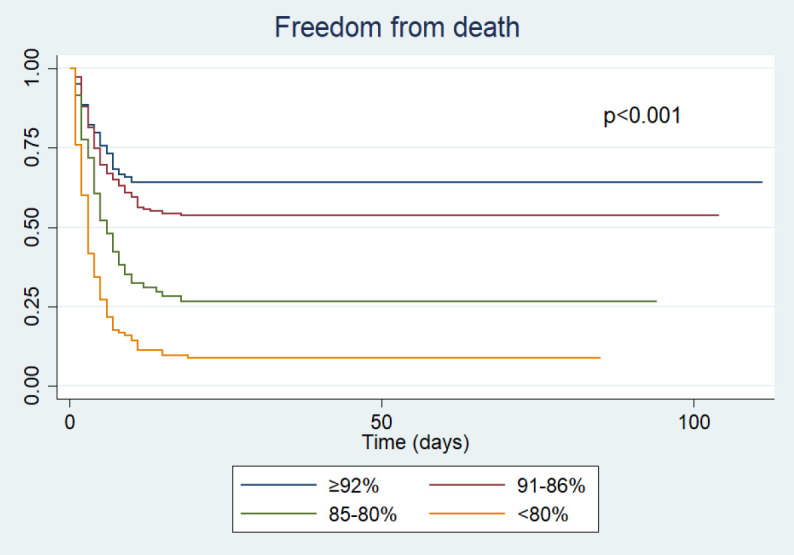
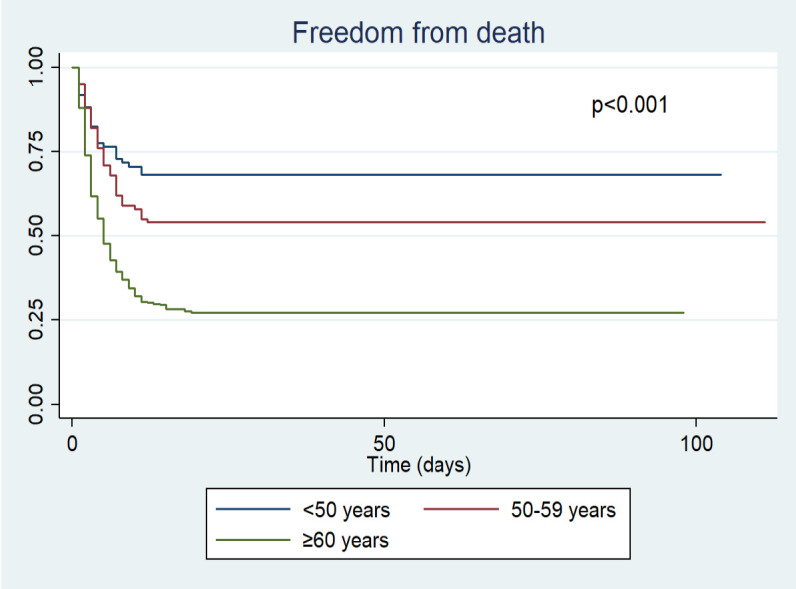
Peru was one of the countries with the highest COVID-19 mortality worldwide during the first stage of the pandemic. It is then relevant to evaluate the risk factors for mortality in patients hospitalized for COVID-19 in three hospitals in Peru in 2020, from March to May, 2020. Methods: We carried out a retrospective cohort study. The population consisted of patients from three Peruvian hospitals hospitalized for a diagnosis of COVID-19 during the March-May 2020 period. Independent sociodemographic variables, medical history, symptoms, vital functions, laboratory parameters and medical treatment were evaluated. In-hospital mortality was assessed as the outcome. We performed Cox regression models (crude and adjusted) to evaluate risk factors for in-hospital mortality. Hazard ratios (HR) with their respective 95% confidence intervals (95% CI) were calculated. Results: We analyzed 493 hospitalized adults; 72.8% (n=359) were male and the mean age was 63.3 ± 14.4 years. COVID-19 symptoms appeared on average 7.9 ± 4.0 days before admission to the hospital, and the mean oxygen saturation on admission was 82.6 ± 13.8. While 67.6% (n=333) required intensive care unit admission, only 3.3% (n=16) were admitted to this unit, and 60.2% (n=297) of the sample died. In the adjusted regression analysis, it was found that being 60 years old or older (HR=1.57; 95% CI: 1.14-2.15), having two or more comorbidities (HR=1.53; 95% CI: 1.10-2.14), oxygen saturation between 85-80% (HR=2.52; 95% CI: 1.58-4.02), less than 80% (HR=4.59; 95% CI: 3.01-7.00), and being in the middle (HR=1.65; 95% CI: 1.15-2.39) and higher tertile (HR=2.18; 95% CI: 1.51-3.15) of the neutrophil-to-lymphocyte ratio, increased the risk of mortality. Conclusions: The risk factors found agree with what has been described in the literature and allow the identification of vulnerable groups in whom monitoring and early identification of symptoms should be prioritized in order to reduce mortality.
秘鲁是大流行第一阶段全球 COVID-19 死亡率最高的国家之一。因此,有必要评估 2020 年 3 月至 5 月期间秘鲁三家医院 COVID-19 住院患者的死亡风险因素。
我们进行了一项回顾性队列研究。该人群由秘鲁三家医院在 2020 年 3 月至 5 月期间因 COVID-19 诊断而住院的患者组成。评估了独立的社会人口统计学变量、病史、症状、生命体征、实验室参数和治疗。住院死亡率作为结果进行评估。我们进行了 Cox 回归模型(未调整和调整)来评估住院死亡率的风险因素。计算了风险比(HR)及其各自的 95%置信区间(95%CI)。
我们分析了 493 名住院成年人;72.8%(n=359)为男性,平均年龄为 63.3±14.4 岁。COVID-19 症状平均在入院前 7.9±4.0 天出现,入院时平均血氧饱和度为 82.6±13.8。虽然 67.6%(n=333)需要入住重症监护病房,但只有 3.3%(n=16)入住该病房,样本中有 60.2%(n=297)死亡。在调整后的回归分析中,发现 60 岁或以上(HR=1.57;95%CI:1.14-2.15)、有两种或更多合并症(HR=1.53;95%CI:1.10-2.14)、血氧饱和度在 85-80%之间(HR=2.52;95%CI:1.58-4.02)、低于 80%(HR=4.59;95%CI:3.01-7.00)和处于中间(HR=1.65;95%CI:1.15-2.39)和较高三分位(HR=2.18;95%CI:1.51-3.15)的中性粒细胞与淋巴细胞比值增加了死亡风险。
发现的风险因素与文献中描述的一致,可识别弱势群体,应优先监测和及早识别这些群体的症状,以降低死亡率。