Lewis Gary D, Haque Waqar, Farach Andrew, Hatch Sandra S, Butler E Brian, Niravath Polly A, Schwartz Mary R, Bonefas Elizabeth, Teh Bin S
Department of Radiation Oncology, University of Arkansas for Medical Sciences, Little Rock, Arkansas, United States.
Department of Radiation Oncology, Houston Methodist Hospital, Houston, Texas, United States.
Rep Pract Oncol Radiother. 2021 Apr 14;26(2):179-187. doi: 10.5603/RPOR.a2021.0026. eCollection 2021.
In invasive breast cancer, HER2 is a well-established negative prognostic factor. However, its significance on the prognosis of ductal carcinoma in situ (DCIS) of the breast is unclear. As a result, the impact of HER2-directed therapy on HER2-positive DCIS is unknown and is currently the subject of ongoing clinical trials. In this study, we aim to determine the possible impact of HER 2-directed targeted therapy on survival outcomes for HER2-positive DCIS patients.
The National Cancer Data Base (NCDB) was used to retrieve patients with biopsy-proven DCIS diagnosed from 2004-2015. Patients were divided into two groups based on the adjuvant therapy they received: systemic HER2-directed targeted therapy or no systemic therapy. Statistics included multivariable logistic regression to determine factors predictive of receiving systemic therapy, Kaplan-Meier analysis to evaluate overall survival (OS), and Cox proportional hazards modeling to determine variables associated with OS.
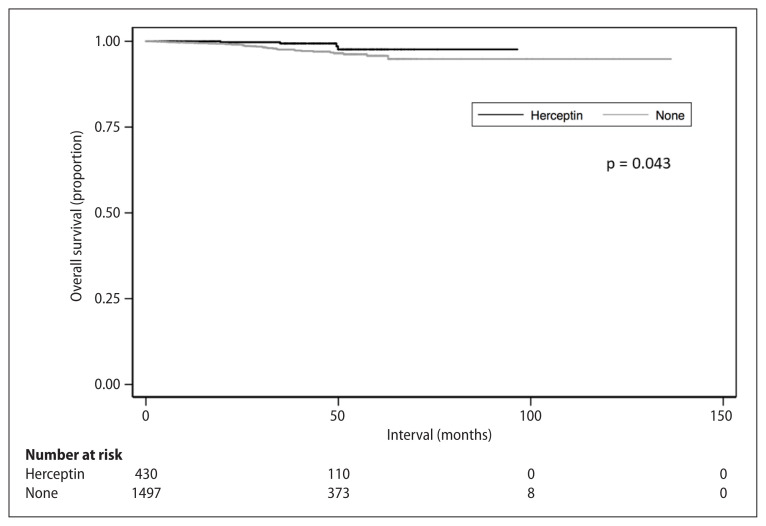
Altogether, 1927 patients met inclusion criteria; 430 (22.3%) received HER2-directed targeted therapy; 1497 (77.7%) did not. Patients who received HER2-directed targeted therapy had a higher 5-year OS compared to patients that did not (97.7% vs. 95.8%, p = 0.043). This survival benefit remained on multivariable analysis. Factors associated with worse OS on multivariable analysis included Charlson-Deyo Comorbidity Score ≥ 2 and no receipt of hormonal therapy.
In this large study evaluating HER2-positive DCIS patients, the receipt of HER2-directed targeted therapy was associated with an improvement in OS. The results of currently ongoing clinical trials are needed to confirm this finding.
在浸润性乳腺癌中,HER2是一个公认的不良预后因素。然而,其对乳腺导管原位癌(DCIS)预后的意义尚不清楚。因此,HER2靶向治疗对HER2阳性DCIS的影响尚不清楚,目前仍是正在进行的临床试验的主题。在本研究中,我们旨在确定HER2靶向治疗对HER2阳性DCIS患者生存结局的可能影响。
使用国家癌症数据库(NCDB)检索2004年至2015年经活检证实为DCIS的患者。根据患者接受的辅助治疗将其分为两组:全身性HER2靶向治疗或无全身治疗。统计分析包括多变量逻辑回归以确定接受全身治疗的预测因素、Kaplan-Meier分析以评估总生存期(OS),以及Cox比例风险模型以确定与OS相关的变量。
共有1927例患者符合纳入标准;430例(22.3%)接受了HER2靶向治疗;1497例(77.7%)未接受。接受HER2靶向治疗的患者5年总生存率高于未接受治疗的患者(97.7%对95.8%,p = 0.043)。多变量分析后这种生存获益仍然存在。多变量分析中与较差总生存期相关的因素包括Charlson-Deyo合并症评分≥2以及未接受激素治疗。
在这项评估HER2阳性DCIS患者的大型研究中,接受HER2靶向治疗与总生存期改善相关。需要目前正在进行的临床试验结果来证实这一发现。