Heart Research Institute, University of Sydney, Sydney, AU.
Leipzig Heart Institute, Leipzig, DE.
Glob Heart. 2021 May 27;16(1):41. doi: 10.5334/gh.1023.
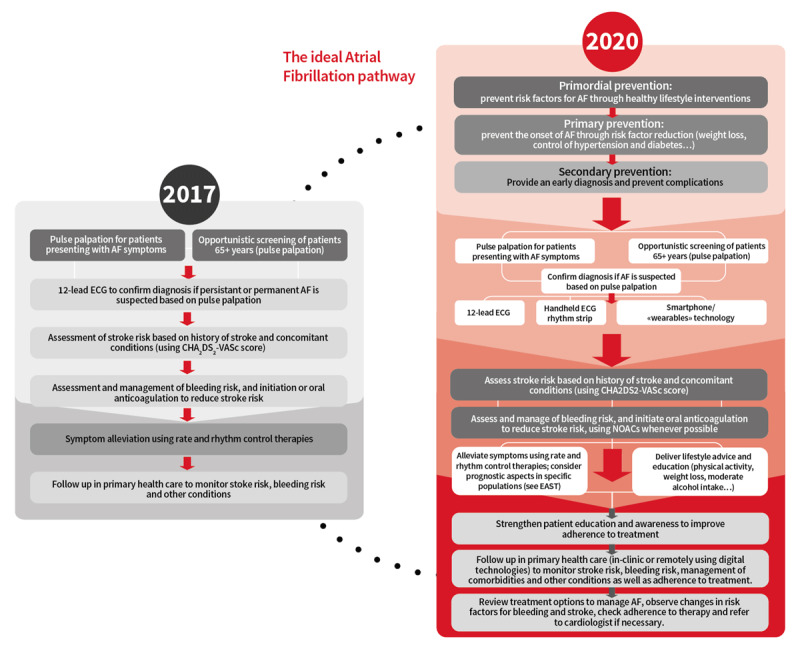
The World Heart Federation (WHF) commenced a Roadmap initiative in 2015 to reduce the global burden of cardiovascular disease and resultant burgeoning of healthcare costs. Roadmaps provide a blueprint for implementation of priority solutions for the principal cardiovascular diseases leading to death and disability. Atrial fibrillation (AF) is one of these conditions and is an increasing problem due to ageing of the world's population and an increase in cardiovascular risk factors that predispose to AF. The goal of the AF roadmap was to provide guidance on priority interventions that are feasible in multiple countries, and to identify roadblocks and potential strategies to overcome them. Since publication of the AF Roadmap in 2017, there have been many technological advances including devices and artificial intelligence for identification and prediction of unknown AF, better methods to achieve rhythm control, and widespread uptake of smartphones and apps that could facilitate new approaches to healthcare delivery and increasing community AF awareness. In addition, the World Health Organisation added the non-vitamin K antagonist oral anticoagulants (NOACs) to the Essential Medicines List, making it possible to increase advocacy for their widespread adoption as therapy to prevent stroke. These advances motivated the WHF to commission a 2020 AF Roadmap update. Three years after the original Roadmap publication, the identified barriers and solutions were judged still relevant, and progress has been slow. This 2020 Roadmap update reviews the significant changes since 2017 and identifies priority areas for achieving the goals of reducing death and disability related to AF, particularly targeted at low-middle income countries. These include advocacy to increase appreciation of the scope of the problem; plugging gaps in guideline management and prevention through physician education, increasing patient health literacy, and novel ways to increase access to integrated healthcare including mHealth and digital transformations; and greater emphasis on achieving practical solutions to national and regional entrenched barriers. Despite the advances reviewed in this update, the task will not be easy, but the health rewards of implementing solutions that are both innovative and practical will be great.
世界心脏联盟(WHF)于 2015 年启动了一项路线图计划,以减轻全球心血管疾病负担和随之而来的医疗保健成本的猛增。路线图为导致死亡和残疾的主要心血管疾病的优先解决方案的实施提供了蓝图。心房颤动(AF)就是其中一种情况,由于世界人口老龄化以及导致 AF 的心血管危险因素增加,这种情况越来越成为一个问题。AF 路线图的目标是为可行的多国优先干预措施提供指导,并确定障碍和潜在策略以克服这些障碍。自 2017 年发表 AF 路线图以来,已经有许多技术进步,包括用于识别和预测未知 AF 的设备和人工智能、更好的实现节律控制的方法,以及广泛采用智能手机和应用程序,这些都可以促进新的医疗保健提供方式并提高社区对 AF 的认识。此外,世界卫生组织将非维生素 K 拮抗剂口服抗凝剂(NOACs)列入基本药物清单,使得广泛倡导将其作为预防中风的治疗方法成为可能。这些进展促使 WHF 委托制定 2020 年 AF 路线图更新。在最初的路线图发布三年后,确定的障碍和解决方案仍被认为是相关的,进展缓慢。这份 2020 年路线图更新回顾了自 2017 年以来的重大变化,并确定了实现降低与 AF 相关的死亡和残疾目标的优先领域,特别是针对中低收入国家。这些领域包括倡导提高对问题范围的认识;通过医生教育、提高患者健康素养以及增加获取包括移动医疗和数字化转型在内的综合医疗保健的新途径来填补指南管理和预防方面的空白;更加注重实现国家和区域固有障碍的实际解决方案。尽管在本更新中审查了这些进展,但任务并不容易,但实施创新和实用的解决方案所带来的健康回报将是巨大的。