Comandini Danila, Catalano Fabio, Grassi Massimiliano, Pesola Guido, Bertulli Rossella, Guadagno Antonio, Spina Bruno, Mascherini Matteo, De Cian Franco, Pistoia Federico, Rebuzzi Sara Elena
Medical Oncology Unit 1, IRCCS Ospedale Policlinico San Martino, Genova, Italy.
Clinic of Medical Oncology, Oncology Institute of Southern Switzerland, Bellinzona, Switzerland.
Front Oncol. 2021 Jun 15;11:658327. doi: 10.3389/fonc.2021.658327. eCollection 2021.
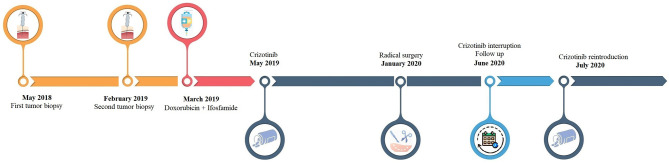
Inflammatory myofibroblastic tumor (IMT) is a very rare subtype of sarcoma, which frequently harbor chromosomal rearrangements, including anaplastic lymphoma kinase (ALK) rearrangements (almost 50% of the IMTs) and other kinase fusions such as ROS1. ROS1 fusions are present in about 10% of IMT, almost half of the ALK-negative IMT patients. Apart from radical surgery for resectable tumors, there is no standard-of-care therapy for advanced IMTs. Nonetheless, the use of tyrosine kinase inhibitors has shown promising efficacy in IMT patients with targetable genomic alterations. We report the case of a 24-year-old patient with chemotherapy-refractory metastatic IMT harboring ROS1 kinase fusion, who experienced a significant clinical and pathological response to crizotinib. This clinical case highlights the need to assess all patients with unresectable IMTs for chromosomal abnormalities and gene mutations and address them to targeted agents as well as clinical trials.
炎性肌纤维母细胞瘤(IMT)是一种非常罕见的肉瘤亚型,常伴有染色体重排,包括间变性淋巴瘤激酶(ALK)重排(几乎占IMT的50%)以及其他激酶融合,如ROS1。ROS1融合存在于约10%的IMT中,几乎占ALK阴性IMT患者的一半。除了对可切除肿瘤进行根治性手术外,晚期IMT尚无标准治疗方案。尽管如此,酪氨酸激酶抑制剂在具有可靶向基因组改变的IMT患者中已显示出有前景的疗效。我们报告了一例24岁化疗难治性转移性IMT患者,其携带ROS1激酶融合,对克唑替尼有显著的临床和病理反应。该临床病例强调了对所有不可切除IMT患者评估染色体异常和基因突变并使其接受靶向药物治疗以及临床试验的必要性。