Department of Comparative Plant and Fungal Biology, Royal Botanic Gardens, Kew, Wakehurst Place, Ardingly, RH17 6TN, West Sussex, UK.
Departamento de Biología de Organismos y Sistemas, Universidad de Oviedo, C/Catedrático Rodrigo Uría, 33006, Oviedo, Spain.
Protoplasma. 2022 May;259(3):595-614. doi: 10.1007/s00709-021-01678-2. Epub 2021 Jul 2.
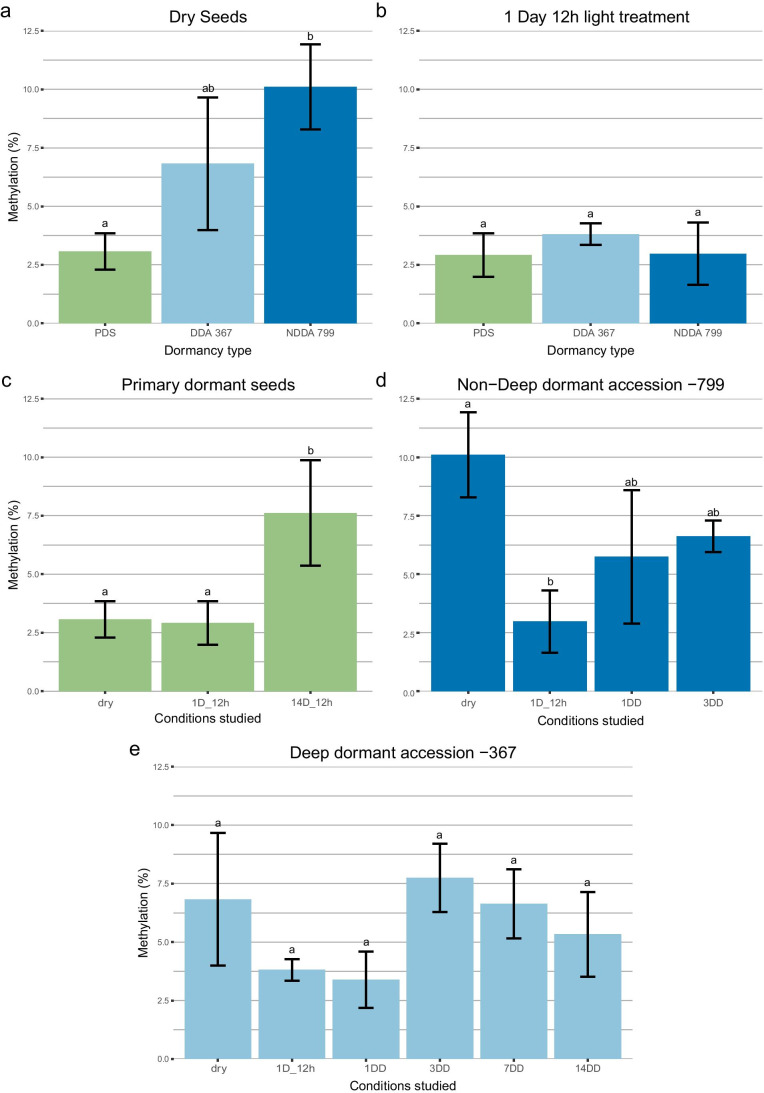
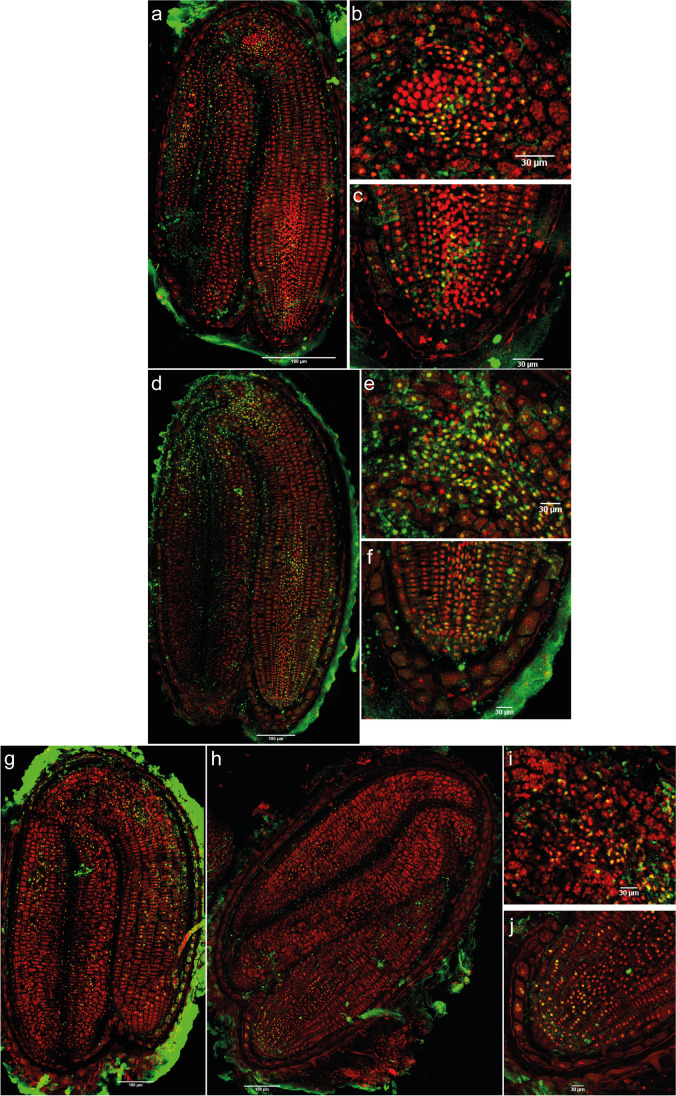
Despite the importance of dormancy and dormancy cycling for plants' fitness and life cycle phenology, a comprehensive characterization of the global and cellular epigenetic patterns across space and time in different seed dormancy states is lacking. Using Capsella bursa-pastoris (L.) Medik. (shepherd's purse) seeds with primary and secondary dormancy, we investigated the dynamics of global genomic DNA methylation and explored the spatio-temporal distribution of 5-methylcytosine (5-mC) and histone H4 acetylated (H4Ac) epigenetic marks. Seeds were imbibed at 30 °C in a light regime to maintain primary dormancy, or in darkness to induce secondary dormancy. An ELISA-based method was used to quantify DNA methylation, in relation to total genomic cytosines. Immunolocalization of 5-mC and H4Ac within whole seeds (i.e., including testa) was assessed with reference to embryo anatomy. Global DNA methylation levels were highest in prolonged (14 days) imbibed primary dormant seeds, with more 5-mC marked nuclei present only in specific parts of the seed (e.g., SAM and cotyledons). In secondary dormant seeds, global methylation levels and 5-mC signal where higher at 3 and 7 days than 1 or 14 days. With respect to acetylation, seeds had fewer H4Ac marked nuclei (e.g., SAM) in deeper dormant states, for both types of dormancy. However, the RAM still showed signal after 14 days of imbibition under dormancy-inducing conditions, suggesting a central role for the radicle/RAM in the response to perceived ambient changes and the adjustment of the seed dormancy state. Thus, we show that seed dormancy involves extensive cellular remodeling of DNA methylation and H4 acetylation.
尽管休眠和休眠循环对植物的适应性和生命周期物候具有重要意义,但缺乏对不同种子休眠状态下全球和细胞表观遗传模式的全面描述。本研究使用具有初级和次级休眠的荠菜(Capsella bursa-pastoris (L.) Medik.)种子,研究了全基因组 DNA 甲基化的动态变化,并探索了 5-甲基胞嘧啶(5-mC)和组蛋白 H4 乙酰化(H4Ac)表观遗传标记的时空分布。种子在 30°C 的光照条件下吸胀以维持初级休眠,或在黑暗中诱导次级休眠。采用基于 ELISA 的方法来量化与总基因组胞嘧啶相关的 DNA 甲基化。通过参考胚解剖结构,用免疫组织化学方法评估了 5-mC 和 H4Ac 在整个种子(即包括种皮)中的定位。在长时间(14 天)吸胀的初级休眠种子中,全基因组甲基化水平最高,只有在种子的特定部位(例如,分生组织和子叶)存在更多的 5-mC 标记核。在次级休眠种子中,在 3 天和 7 天时,全球甲基化水平和 5-mC 信号高于 1 天或 14 天。就乙酰化而言,在两种休眠类型下,处于更深休眠状态的种子具有更少的 H4Ac 标记核(例如,分生组织)。然而,在休眠诱导条件下,吸胀 14 天后 RAM 仍然显示信号,这表明根冠原(RAM)在感知环境变化和调整种子休眠状态的反应中起着核心作用。因此,我们表明种子休眠涉及 DNA 甲基化和 H4 乙酰化的广泛细胞重塑。