a:1:{s:5:"en_US";s:49:"Department of Cardiovascular Biology and Medicine";}.
.
Acta Biomed. 2021 Jul 1;92(3):e2021195. doi: 10.23750/abm.v92i3.9228.
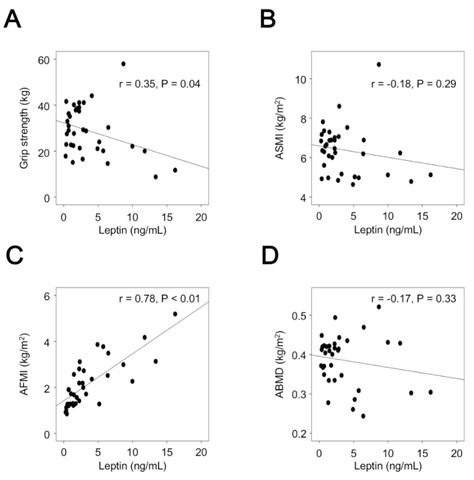
Background Frailty is a multifactorial physiological syndrome most often associated with age but which has received increasing recognition as a component of chronic illnesses such as heart failure. Patients with heart failure are likely to be frail, irrespective of their age. Adipokine dysregulation, which is associated with frailty, occurs in patients with heart failure. In this study, we tested the hypothesis that adipokines are associated with frailty in patients with heart failure. Methods Thirty-five patients with heart failure (age, 67 ± 14 years; 25 males; left ventricular ejection fraction, 45 ± 19%) were included. Serum adipokine levels, physical performance, and body composition were measured. Results Adiponectin and leptin were inversely correlated with grip strength. Adiponectin was inversely correlated with bone mineral density. Leptin was positively correlated with fat mass. Adipokines were not correlated with skeletal muscle mass. Conclusions Adipokines were associated with frailty in patients with heart failure. Adipokine dysregulation may play a role in the development of frailty in heart failure.
衰弱是一种多因素生理综合征,通常与年龄相关,但随着心力衰竭等慢性疾病的日益认识,衰弱也被认为是其组成部分之一。心力衰竭患者无论年龄大小,都有可能衰弱。与衰弱相关的脂肪因子失调发生在心力衰竭患者中。在这项研究中,我们检验了脂肪因子与心力衰竭患者衰弱相关的假设。
纳入 35 例心力衰竭患者(年龄 67 ± 14 岁;男性 25 例;左心室射血分数 45 ± 19%)。测量血清脂肪因子水平、身体表现和身体成分。
脂联素和瘦素与握力呈负相关。脂联素与骨密度呈负相关。瘦素与脂肪量呈正相关。脂肪因子与骨骼肌量无相关性。
脂肪因子与心力衰竭患者的衰弱相关。脂肪因子失调可能在心力衰竭衰弱的发生中起作用。