Lyu Wentao, Yang Hua, Li Na, Lu Lizhi, Yang Caimei, Jin Peihua, Xiao Yingping
State Key Laboratory for Managing Biotic and Chemical Threats to the Quality and Safety of Agro-products, Institute of Agro-product Safety and Nutrition, Zhejiang Academy of Agricultural Sciences, Hangzhou 310021, China.
State Key Laboratory for Managing Biotic and Chemical Threats to the Quality and Safety of Agro-products, Institute of Agro-product Safety and Nutrition, Zhejiang Academy of Agricultural Sciences, Hangzhou 310021, China; College of Animal Sciences & Technology, Zhejiang A & F University, Hangzhou 311300, China.
Poult Sci. 2021 Aug;100(8):101271. doi: 10.1016/j.psj.2021.101271. Epub 2021 May 21.
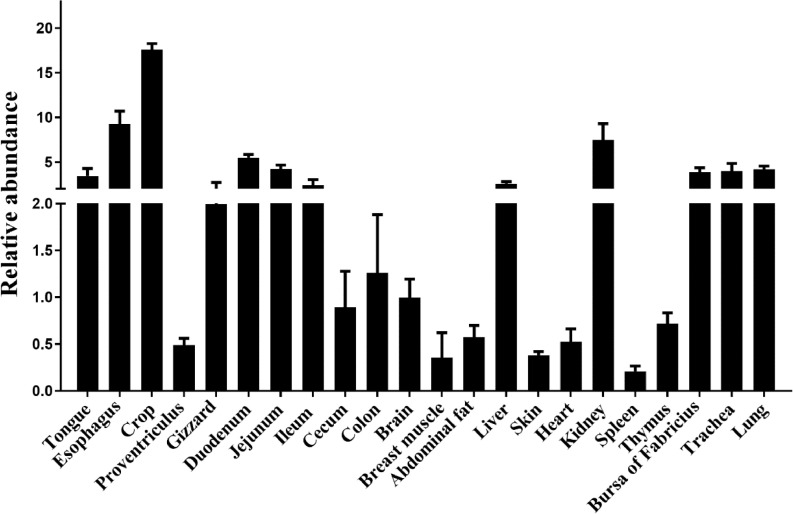
Occludin is an important component of tight junction proteins and has been extensively studied in animals such as mice, chickens, geese, and pigs. As one of the most important waterfowl species in China, Muscovy duck (Cairina moschata) is an important economic animal for meat. However, research on the occludin gene in Muscovy duck is lacking. In the present study, Muscovy duck occludin cDNA was cloned for the first time. The length of the cDNA was 1,699 bp, and it showed a high sequence similarity with the Anser cygnoides domesticus and Gallus gallus occludin genes. The occludin gene was differentially expressed in the tissues of healthy ducks. The highest and lowest expressions of occludin were observed in the crop and the spleen, respectively. After the oral administration of Clostridium butyricum (CB), the occludin expression in the ileum of 7-day-old Muscovy ducks was significantly upregulated and subsequently showed a decreasing trend in 14-day-old Muscovy ducks. Under the early intervention of CB, no significant difference was observed in the occludin expression of cecum between the control and CB group. Collectively, these results suggest that CB plays an important role in regulating the expression of the occludin gene in Muscovy ducks, and adding CB in feed may maintain the intestinal barrier of ducks by regulating the expression of occludin.
闭合蛋白是紧密连接蛋白的重要组成部分,已在小鼠、鸡、鹅和猪等动物中进行了广泛研究。番鸭(Cairina moschata)作为中国最重要的水禽品种之一,是一种重要的肉用经济动物。然而,关于番鸭闭合蛋白基因的研究尚属空白。在本研究中,首次克隆了番鸭闭合蛋白cDNA。该cDNA长度为1699 bp,与家鹅和家鸡的闭合蛋白基因具有较高的序列相似性。闭合蛋白基因在健康鸭的组织中存在差异表达,在嗉囊和脾脏中分别观察到闭合蛋白的最高和最低表达。口服丁酸梭菌(CB)后,7日龄番鸭回肠中的闭合蛋白表达显著上调,随后在14日龄番鸭中呈下降趋势。在CB早期干预下,对照组和CB组盲肠中闭合蛋白表达未观察到显著差异。总体而言,这些结果表明CB在调节番鸭闭合蛋白基因表达中起重要作用,在饲料中添加CB可能通过调节闭合蛋白表达来维持鸭的肠道屏障。