Taubner Svenja, Hauschild Sophie, Kasper Lea, Kaess Michael, Sobanski Esther, Gablonski Thorsten-Christian, Schröder-Pfeifer Paul, Volkert Jana
Institute for Psychosocial Prevention, University Hospital Heidelberg, University of Heidelberg, Bergheimer Str. 56, D-69115, Heidelberg, Germany.
Psychological Institute, University of Heidelberg, Heidelberg, Germany.
Pilot Feasibility Stud. 2021 Jul 2;7(1):139. doi: 10.1186/s40814-021-00876-2.
Conduct disorder (CD) is a complex mental disorder characterized by severe rule-breaking and aggressive behavior. While studies have shown that several therapeutic interventions are effective in treating CD symptoms, researchers call for treatments based on etiological knowledge and potential patho-mechanisms. Mentalization-based treatment (MBT) may represent such a treatment approach: Studies have shown that individuals with CD show mentalizing deficits and that mentalizing might represent a protective factor against the development of the disorder. As MBT focuses on the understanding of social behavior in terms of mental states, fostering mentalizing might help CD individuals to (re)gain an adaptive way of coping with negative emotions especially in social interactions and thus reduce aggressive behavior. For this purpose, MBT was adapted for adolescents with CD (MBT-CD). This is a protocol of a feasibility and pilot study to inform the planning of a prospective RCT. The primary aim is to estimate the feasibility of an RCT based on the acceptability of the intervention and the scientific assessments by CD individuals and their families indicated by quantitative and qualitative data, as well as based on necessary organizational resources to conduct an RCT. The secondary aim is to investigate the course of symptom severity and mentalizing skills.
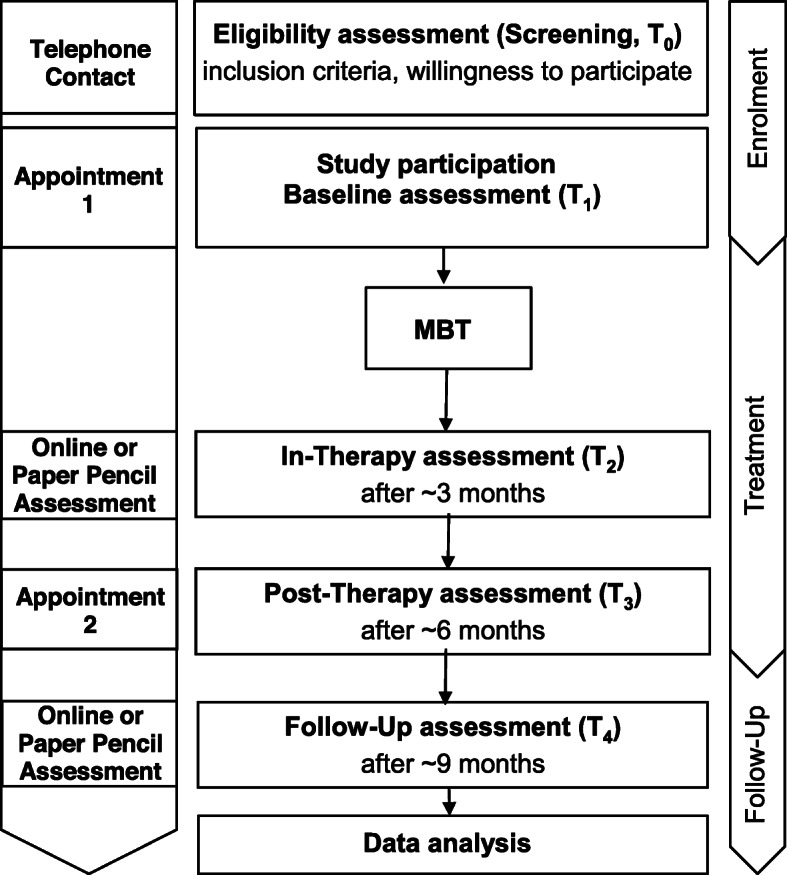
The bi-center study is carried out in two outpatient settings associated with university hospitals (Heidelberg and Mainz) in Germany. Adolescents aged between 11 and 18 years with a CD or oppositional defiant disorder (ODD) diagnosis are included. Participants receive MBT-CD for 6 to 12 months. The primary outcome of the feasibility study (e.g., recruitment and adherence rates) will be descriptively analyzed. Multilevel modeling will be used to investigate secondary outcome data.
Fostering the capacity to mentalize social interactions triggering non-mentalized, aggressive behavior might help CD individuals to behave more adaptively. The feasibility trial is essential for gathering information on how to properly conduct MBT-CD including appropriate scientific assessments in this patient group, in order to subsequently investigate the effectiveness of MBT-CD in an RCT.
ClinicalTrials.gov , NCT02988453 . November 30, 2016 SOURCES OF MONETARY SUPPORT: Dietmar Hopp Stiftung, Heidehof Stiftung RECRUITMENT STATUS: Recruitment complete and intervention complete, follow-up assessments ongoing (Heidelberg). Recruitment and assessments ongoing (Mainz). PRIMARY SPONSOR, PRINCIPAL INVESTIGATOR, AND LEAD INVESTIGATOR IN HEIDELBERG: Svenja Taubner is responsible for the design and conduct of MBT-CD intervention and feasibility and pilot study, preparation of protocol and revisions, and publication of study results.
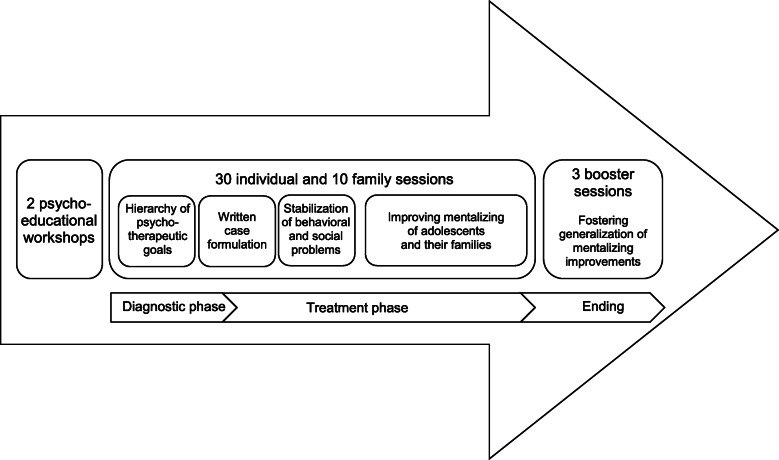
Esther Sobanski is responsible for the recruitment and data collection in the collaborating center Mainz RECRUITMENT COUNTRY: Germany HEALTH CONDITION STUDIED: Conduct disorder, oppositional defiant disorder INTERVENTION: Mentalization-based treatment for conduct disorder (MBT-CD): MBT-CD is an adaptation of MBT for Borderline Personality Disorder. This manualized psychodynamic psychotherapy focuses on increasing mentalizing, i.e., the ability to understand behavior in terms of mental states, in patients. MBT-CD includes weekly individual sessions with the patient and monthly family sessions.
Included are adolescent individuals with a diagnosis of conduct disorder or oppositional defiant disorder aged between 11 and 18 years.
Feasibility and pilot study (single-group) DATE OF FIRST ENROLLMENT: 19.01.2017 STUDY STATUS: The trial is currently in the follow-up assessment phase in Heidelberg and in the recruitment and treatment phase in Mainz.
Acceptability of MBT-CD intervention (as indicated by recruitment rates, completion rates, drop-out rates, treatment duration, oral evaluation), acceptability of scientific assessments (as indicated by adherence, missing data, oral evaluation), and necessary organizational resources (scientific personnel, recruitment networks, MBT-CD training and supervision) to estimate feasibility of an RCT SECONDARY OUTCOMES: Adolescents' symptom severity and mentalizing ability PROTOCOL VERSION: 20.08.2020, version 1.0.
品行障碍(CD)是一种复杂的精神障碍,其特征为严重的违规和攻击行为。虽然研究表明,几种治疗干预措施对治疗CD症状有效,但研究人员呼吁基于病因学知识和潜在病理机制进行治疗。基于心理化的治疗(MBT)可能代表这样一种治疗方法:研究表明,患有CD的个体存在心理化缺陷,而心理化可能是预防该障碍发展的保护因素。由于MBT侧重于从心理状态的角度理解社会行为,培养心理化能力可能有助于患有CD的个体(重新)获得一种适应性的方式来应对负面情绪,尤其是在社交互动中,从而减少攻击行为。为此,MBT被改编用于患有CD的青少年(MBT-CD)。这是一项可行性和试点研究的方案,旨在为前瞻性随机对照试验(RCT)的规划提供信息。主要目的是根据干预措施的可接受性以及CD个体及其家庭通过定量和定性数据表明的科学评估,以及进行RCT所需的组织资源,来估计RCT的可行性。次要目的是研究症状严重程度和心理化技能的变化过程。
这项双中心研究在德国与大学医院相关的两个门诊机构(海德堡和美因茨)进行。纳入年龄在11至18岁之间、诊断为品行障碍或对立违抗障碍(ODD)的青少年。参与者接受6至12个月的MBT-CD治疗。将对可行性研究的主要结果(如招募率和依从率)进行描述性分析。将使用多水平模型来研究次要结果数据。
培养心理化社交互动的能力,这种互动会引发未心理化的攻击行为,可能有助于患有CD的个体表现得更具适应性。可行性试验对于收集有关如何正确实施MBT-CD的信息至关重要,包括对该患者群体进行适当的科学评估,以便随后在RCT中研究MBT-CD的有效性。
ClinicalTrials.gov,NCT02988453。2016年11月30日 资金支持来源:迪特马尔·霍普基金会、海德霍夫基金会 招募状态:海德堡的招募和干预已完成,随访评估正在进行。美因茨的招募和评估正在进行。 海德堡的主要赞助商、首席研究员和主要研究者:斯文贾·陶布纳负责MBT-CD干预及可行性和试点研究的设计与实施、方案的编写和修订以及研究结果的发表。
埃丝特·索班斯基负责合作中心美因茨的招募和数据收集 招募国家:德国 研究的健康状况:品行障碍、对立违抗障碍 干预措施:针对品行障碍的基于心理化的治疗(MBT-CD):MBT-CD是对用于边缘型人格障碍的MBT的改编。这种手册化的心理动力心理治疗侧重于提高患者的心理化能力,即从心理状态的角度理解行为的能力。MBT-CD包括每周与患者进行的个体治疗以及每月的家庭治疗。
纳入年龄在11至18岁之间、诊断为品行障碍或对立违抗障碍的青少年个体。
可行性和试点研究(单组) 首次入组日期:2017年1月19日 研究状态:该试验目前在海德堡处于随访评估阶段,在美因茨处于招募和治疗阶段。
MBT-CD干预的可接受性(以招募率、完成率、退出率、治疗时长、口头评估表示)、科学评估的可接受性(以依从性、缺失数据、口头评估表示)以及估计RCT可行性所需的组织资源(科研人员、招募网络、MBT-CD培训和监督) 次要结果:青少年的症状严重程度和心理化能力 方案版本:2020年8月20日,版本1.0