Laboratory of Tissue Regeneration and Immunology and Department of Periodontics, Beijing Key Laboratory of Tooth Regeneration and Function Reconstruction, School of Stomatology, Capital Medical University, Tian Tan Xi Li No.4, Beijing, 100050, People's Republic of China.
Stem Cell Res Ther. 2021 Jul 2;12(1):377. doi: 10.1186/s13287-021-02456-w.
Over the past decades, many studies focused on mesenchymal stem cells (MSCs) therapy for bone regeneration. Due to the efficiency of topical application has been widely dicussed and systemic application was also a feasible way for new bone formation, the aim of this study was to systematically review systemic therapy of MSCs for bone regeneration in pre-clinical studies.
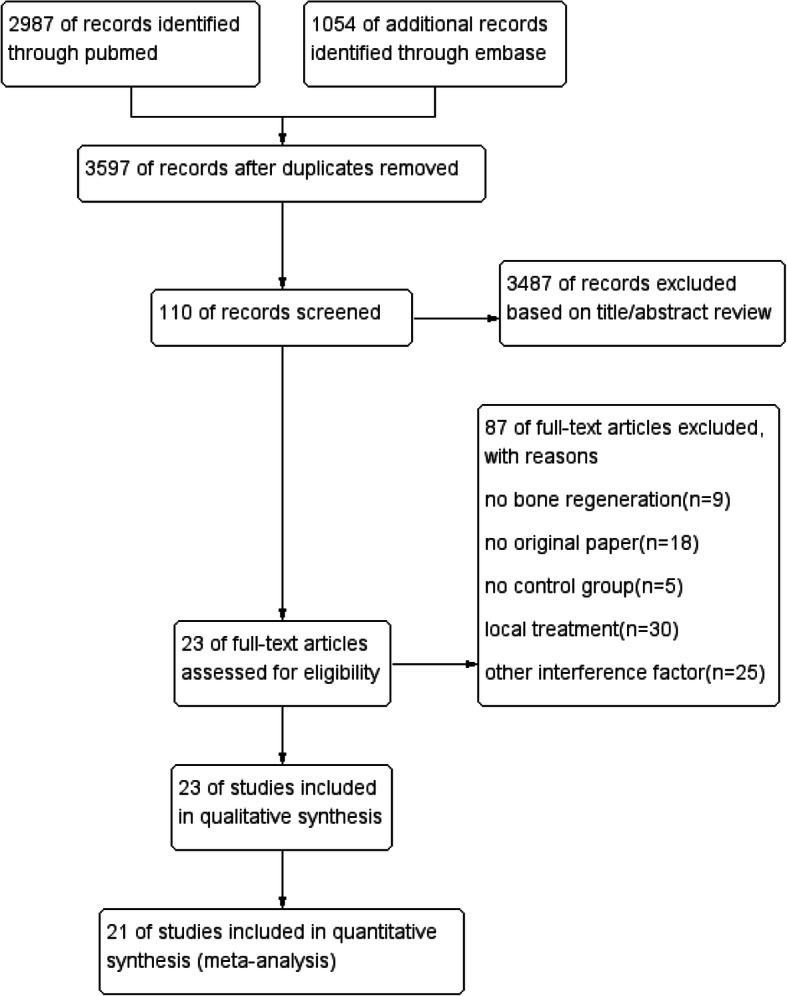
The article search was conducted in PubMed and Embase databases. Original research articles that assessed potential effect of systemic application of MSCs for bone regeneration in vivo were selected and evaluated in this review, according to eligibility criteria. The efficacy of MSC systemic treatment was analyzed by random effects meta-analysis, and the outcomes were expressed in standard mean difference (SMD) and its 95% confidence interval. Subgroup analyses were conducted on animal species and gender, MSCs types, frequency and time of injection, and bone diseases.
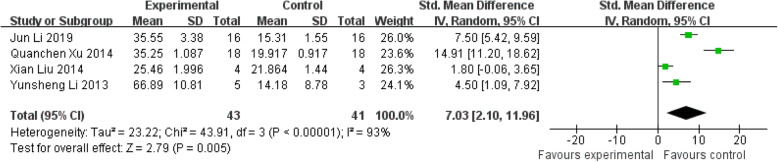
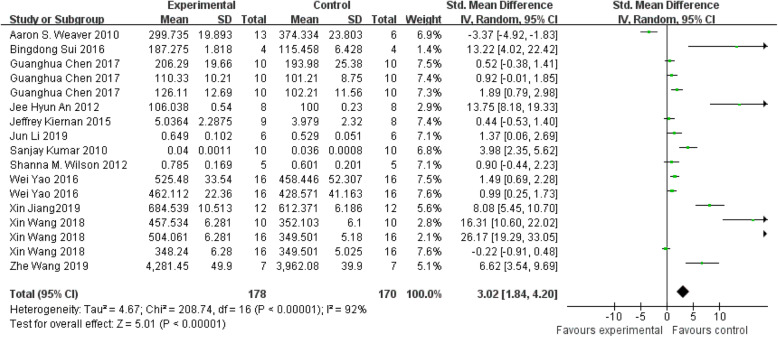
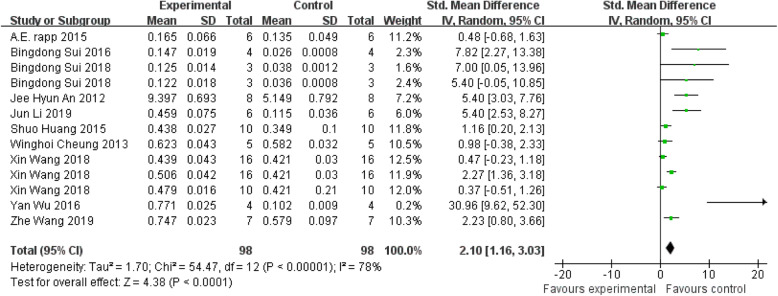
Twenty-three articles were selected in this review, of which 21 were included in meta-analysis. The results showed that systemic therapy increased bone mineral density (SMD 3.02 [1.84, 4.20]), bone volume to tissue volume ratio (2.10 [1.16, 3.03]), and the percentage of new bone area (7.03 [2.10, 11.96]). Bone loss caused by systemic disease tended to produce a better response to systemic treatment (p=0.05 in BMD, p=0.03 in BV/TV).
This study concluded that systemic therapy of MSCs promotes bone regeneration in preclinical experiments. These results provided important information for the systemic application of MSCs as a potential application of bone formation in further animal experiments.
在过去几十年中,许多研究都集中在间充质干细胞(MSCs)治疗骨再生上。由于局部应用的效率已被广泛讨论,且全身应用也是新骨形成的一种可行方法,因此本研究旨在系统地回顾间充质干细胞全身治疗在临床前研究中促进骨再生的作用。
在 PubMed 和 Embase 数据库中进行了文章检索。根据纳入标准,选择并评估了评估全身应用 MSCs 对体内骨再生潜在作用的原始研究文章。通过随机效应荟萃分析分析 MSC 全身治疗的效果,并用标准均数差(SMD)及其 95%置信区间表示结果。对动物种类和性别、MSCs 类型、注射频率和时间以及骨疾病进行了亚组分析。
本综述共选择了 23 篇文章,其中 21 篇被纳入荟萃分析。结果表明,全身治疗可增加骨矿物质密度(SMD 3.02 [1.84,4.20])、骨体积与组织体积比(2.10 [1.16,3.03])和新骨面积百分比(7.03 [2.10,11.96])。全身性疾病引起的骨丢失往往对全身治疗有更好的反应(在 BMD 中 p=0.05,在 BV/TV 中 p=0.03)。
本研究表明,MSCs 的全身治疗可促进临床前实验中的骨再生。这些结果为 MSCs 的全身应用提供了重要信息,作为进一步动物实验中骨形成的潜在应用。