Department of Neurology, Alzheimer Center Amsterdam, Amsterdam Neuroscience, Vrije Universiteit Amsterdam, Amsterdam UMC, De Boelelaan 1118, 1081 HZ, Amsterdam, The Netherlands.
Department of Psychiatry, University Medical Center Utrecht, Utrecht, The Netherlands.
J Neurol. 2022 Mar;269(3):1375-1385. doi: 10.1007/s00415-021-10689-1. Epub 2021 Jul 3.
Primary progressive aphasia (PPA) is divided into three prototypical subtypes that are all characterized by their single core symptom of aphasia. Although later in their course, other cognitive, behavioral, and motor domains may become involved, little is known about the progression profile of each subtype relative to the other subtypes.
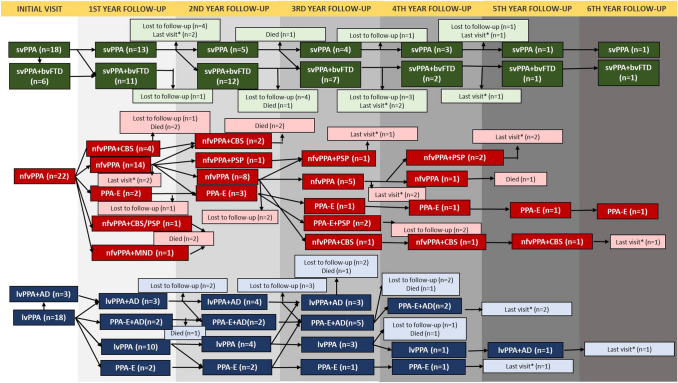
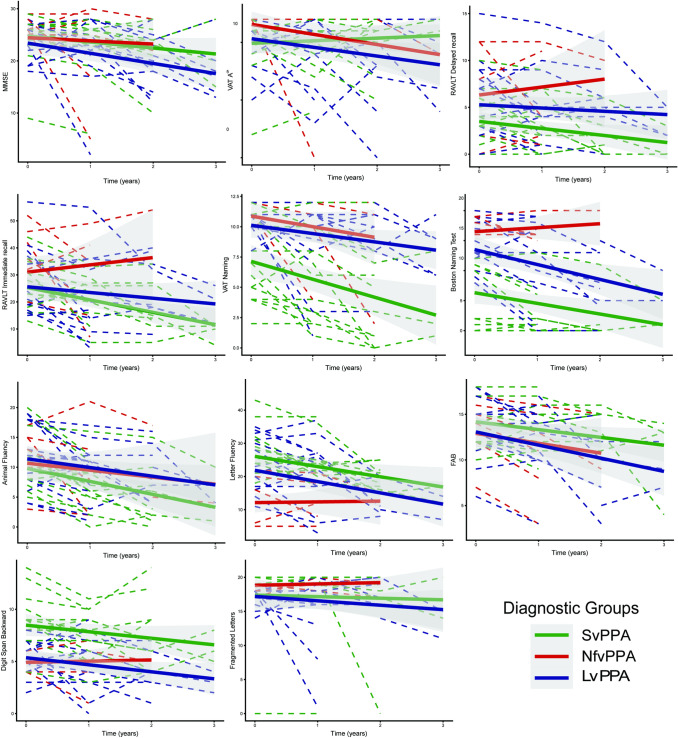
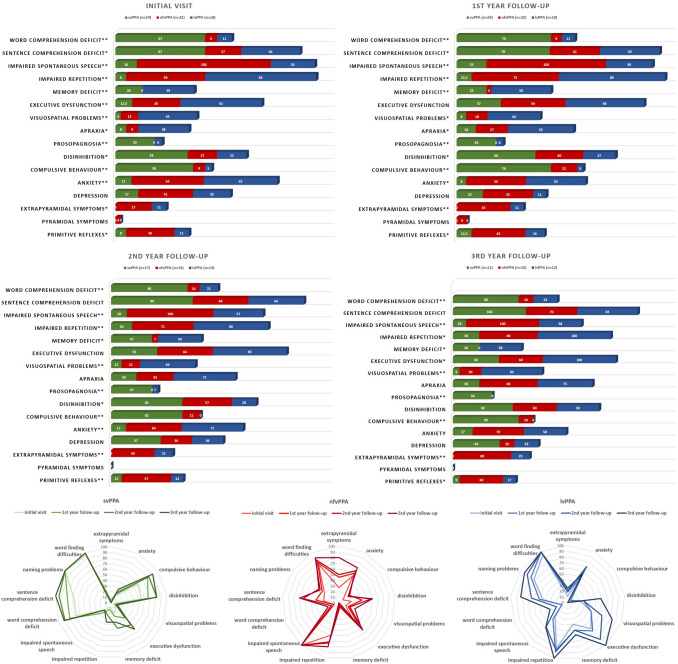
In this longitudinal retrospective cohort study, based on the recent biomarker-supported diagnostic criteria, 24 subjects diagnosed with semantic variant (svPPA), 22 with non-fluent variant (nfvPPA), and 18 with logopenic variant (lvPPA) were collected and followed up for 1-6 years. Symptom distribution, cognitive test and neuropsychiatric inventory scores, and progression into another syndrome were assessed.
Over time, lvPPA progressed with broader language problems (PPA-extended) and nfvPPA progressed to mutism, whereas semantic impairment remained the major problem in svPPA. Apart from linguistic problems, svPPA developed pronounced behavioral disturbances, whereas lvPPA exhibited a greater cognitive decline. By contrast, in nfvPPA motor deficits were more common. Furthermore, within 5 years (IQR = 2.5) after clinical onset, 65.6% of the patients additionally fulfilled the clinical criteria for another neurodegenerative syndrome (PPA-plus). Fourteen out of 24 (58%) svPPA patients additionally met the diagnostic criteria of behavioral variant frontotemporal dementia (5.1 years, IQR = 1.1), whereas the clinical features of 15/18 (83%) lvPPA patients were consistent with Alzheimer disease dementia (4.5 years IQR = 3.4). Furthermore, 12/22 (54%) of the subjects with the nfvPPA progressed to meet the diagnostic criteria of corticobasal syndrome, progressive supranuclear palsy, or motor neuron disease (5.1 years IQR = 3.4).
Despite aphasia being the initial and unique hallmark of the syndrome, our longitudinal results showed that PPA is not a language limited disorder and progression differs widely for each subtype, both with respect to the nature of symptoms and disease duration.
原发性进行性失语症(PPA)分为三个典型亚型,均以失语症为单一核心症状。尽管在病程后期,其他认知、行为和运动领域可能会受到影响,但对于每种亚型相对于其他亚型的进展情况知之甚少。
在这项基于最近生物标志物支持的诊断标准的纵向回顾性队列研究中,共收集了 24 名诊断为语义变异型(svPPA)、22 名非流利变异型(nfvPPA)和 18 名失读症变异型(lvPPA)的患者,并对其进行了 1-6 年的随访。评估了症状分布、认知测试和神经心理检查表评分以及进展为另一种综合征的情况。
随着时间的推移,lvPPA 表现出更广泛的语言问题(PPA-扩展),nfvPPA 进展为缄默症,而 svPPA 则保持语义障碍为主。除了语言问题外,svPPA 还出现了明显的行为障碍,而 lvPPA 则表现出更大的认知衰退。相比之下,nfvPPA 中更常见运动缺陷。此外,在临床发病后 5 年内(IQR=2.5),65.6%的患者另外符合另一种神经退行性综合征(PPA-附加)的临床标准。24 名 svPPA 患者中有 14 名(58%)另外符合行为变异型额颞叶痴呆的诊断标准(5.1 年,IQR=1.1),而 18 名 lvPPA 患者中有 15 名(83%)的临床特征符合阿尔茨海默病痴呆(4.5 年,IQR=3.4)。此外,22 名 nfvPPA 患者中有 12 名(54%)进展符合皮质基底节综合征、进行性核上性麻痹或运动神经元病的诊断标准(5.1 年,IQR=3.4)。
尽管失语症是该综合征的初始和独特标志,但我们的纵向结果表明,PPA 不仅仅是一种语言障碍,而且每种亚型的进展差异很大,无论是在症状性质还是疾病持续时间方面。