Institute of Epidemiology and Preventive Medicine, College of Public Health, National Taiwan University, Taipei, Taiwan.
School of Oral Hygiene, College of Oral Medicine, Taipei Medical University, Taipei, Taiwan.
Prev Med. 2021 Oct;151:106597. doi: 10.1016/j.ypmed.2021.106597. Epub 2021 Jun 30.
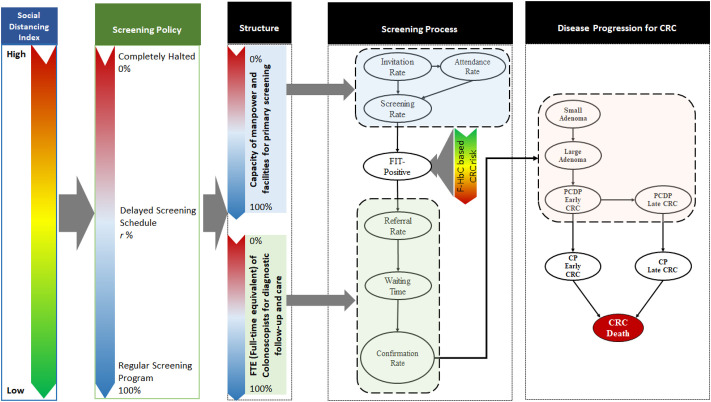
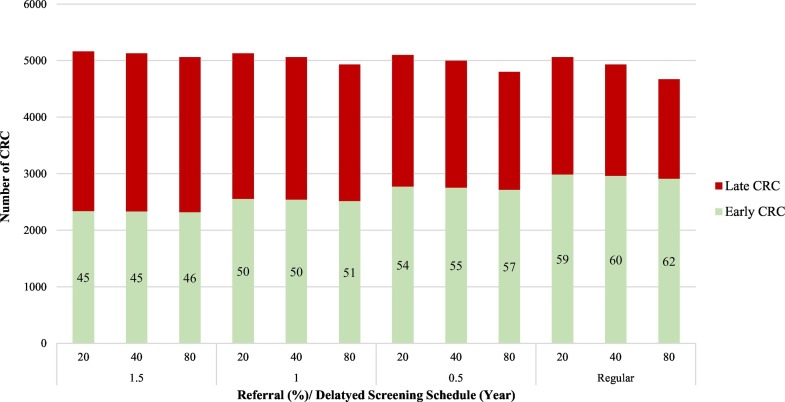
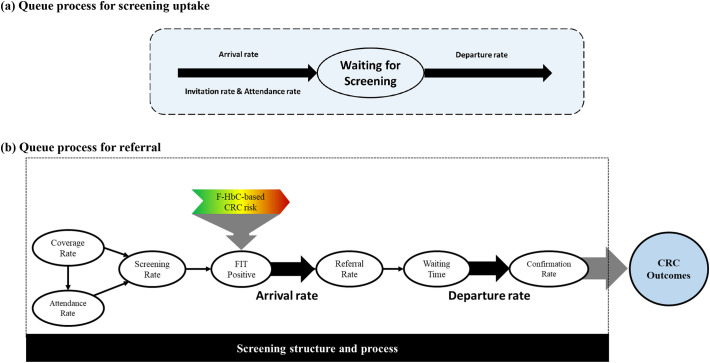
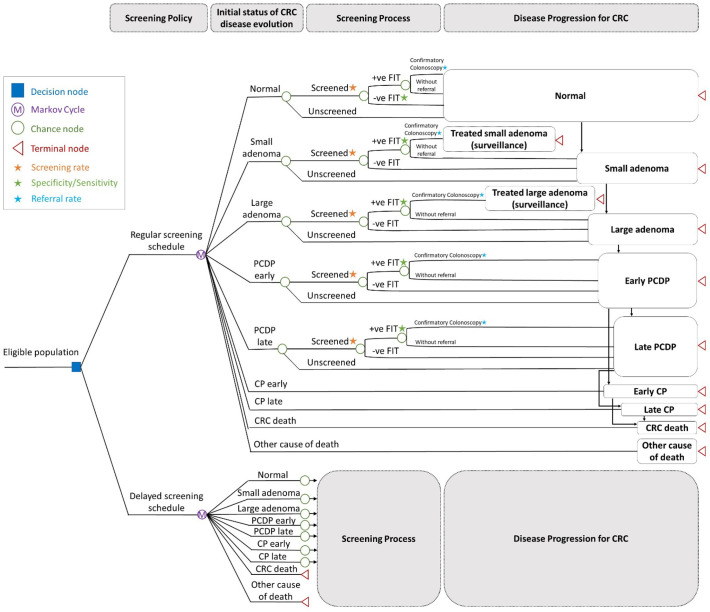
COVID-19 pandemic has severely affected regular public health interventions including population-based cancer screening. Impacts of such screening delays on the changes in structure and screening process and the resultant long-term outcomes are unknown. It is therefore necessary to develop a systematic framework to assess theses impacts related to these components of quality. Using population-based cancer screening with fecal immunochemical test (FIT) as an illustration, the main analysis was to assess how various scenarios of screening delays were associated with the capacity for primary screening and full time equivalent (FTE) for colonoscopy and impact long-term outcomes based on a Markov decision tree model on population level. The second analysis was to quantify how the extent of COVID-19 epidemic measured by social distancing index affected capacity and FTE that were translated to delays with an exponential relationship. COVID-19 epidemic led to 25%, 29%, 34%, and 39% statistically significantly incremental risks of late cancer for the delays of 0.5-year, 1-year,1.5-year, and 2-year, respectively compared with regular biennial FIT screening. The corresponding statistically findings of four delayed schedules for death from colorectal cancer (CRC) were 26%, 28%, 29%, and 30%, respectively. The higher social distancing index led to a lower capacity of uptake screening and a larger reduction of FTE, resulting in longer screening delay and longer waiting time, which further impacted long-term outcomes as above. In summary, a systematic modelling approach was developed for demonstrating the strong impact of screening delays caused by COVID-19 epidemic on long-term outcomes illustrated with a Taiwan population-based FIT screening of CRC.
新型冠状病毒肺炎疫情严重影响了常规公共卫生干预措施,包括基于人群的癌症筛查。这些筛查延迟对结构和筛查过程的变化以及由此产生的长期结果的影响尚不清楚。因此,有必要制定一个系统框架来评估与这些质量相关的这些方面的影响。以基于人群的粪便免疫化学试验(FIT)筛查为例,主要分析是评估各种筛查延迟情况如何与结肠镜检查的初级筛查能力和全职等效人员(FTE)相关联,并基于人群水平的马尔可夫决策树模型评估对长期结果的影响。第二次分析是量化由社会隔离指数衡量的新型冠状病毒肺炎疫情严重程度如何影响能力和 FTE,这与呈指数关系的延迟有关。与定期的两年一次的 FIT 筛查相比,新型冠状病毒肺炎疫情导致分别延迟 0.5 年、1 年、1.5 年和 2 年的晚期癌症的风险增加了 25%、29%、34%和 39%,这是具有统计学意义的。对于延迟四年的结直肠癌(CRC)死亡的相应统计学发现分别为 26%、28%、29%和 30%。较高的社会隔离指数导致筛查参与率降低和 FTE 更大幅度的减少,导致更长的筛查延迟和更长的等待时间,从而如前所述进一步影响长期结果。总之,开发了一种系统建模方法,用于展示新型冠状病毒肺炎疫情引起的筛查延迟对长期结果的强烈影响,以台湾基于人群的 CRC 的 FIT 筛查为例。