Perception and Eye Movement Laboratory, Departments of Neurology and BioMedical Research, Inselspital, Bern University Hospital and University of Bern, Freiburgstarsse 46, 3010, Bern, Switzerland.
Department of Neurology, Inselspital, Bern University Hospital, Bern, Switzerland.
Exp Brain Res. 2021 Sep;239(9):2693-2700. doi: 10.1007/s00221-021-06165-x. Epub 2021 Jul 4.
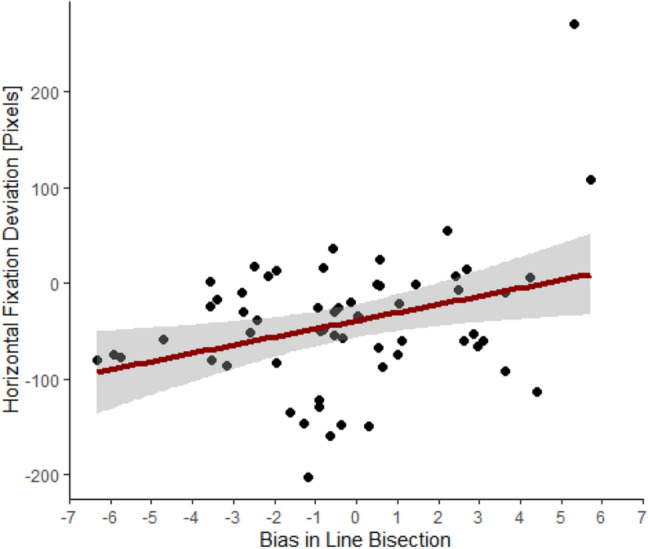
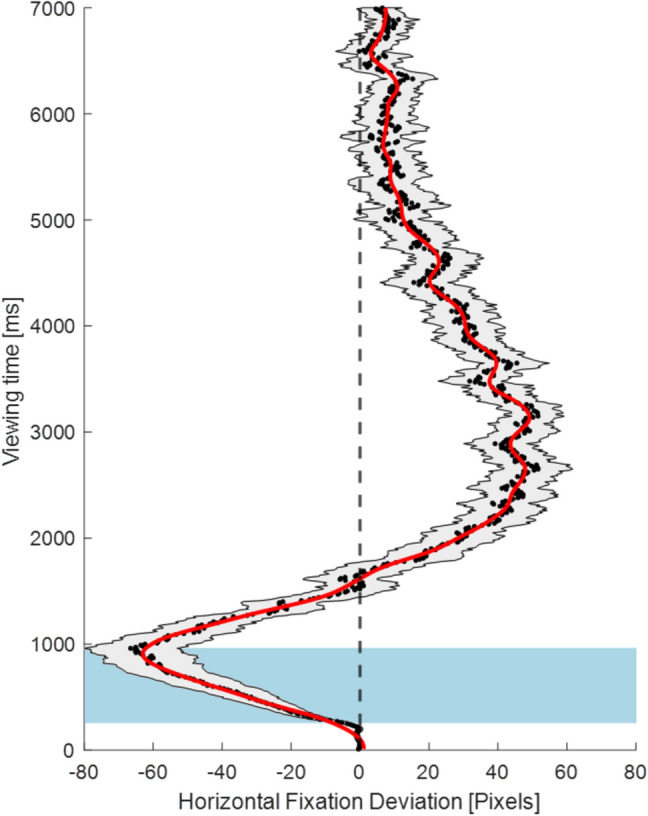
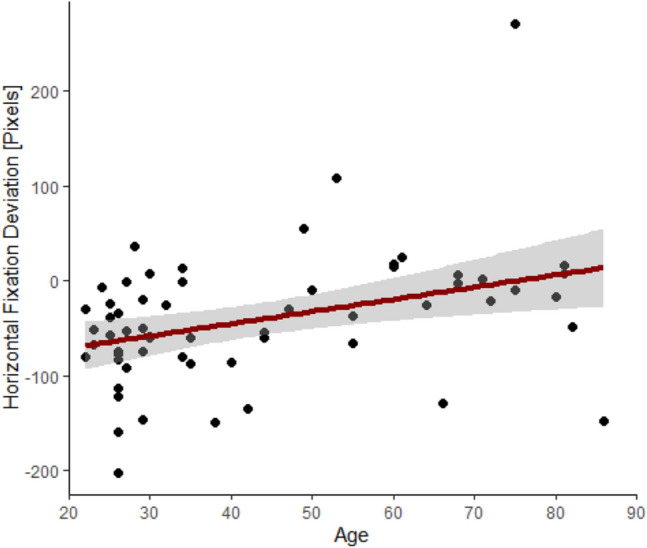
When humans visually explore an image, they typically tend to start exploring its left side. This phenomenon, so-called pseudoneglect, is well known, but its time-course has only sparsely been studied. Furthermore, it is unclear whether age influences pseudoneglect, and the relationship between visuo-spatial attentional asymmetries in a free visual exploration task and a classical line bisection task has not been established. To address these questions, 60 healthy participants, aged between 22 and 86, were assessed by means of a free visual exploration task with a series of naturalistic, colour photographs of everyday scenes, while their gaze was recorded by means of a contact-free eye-tracking system. Furthermore, a classical line bisection task was administered, and information concerning handedness and subjective alertness during the experiment was obtained. The results revealed a time-sensitive window during visual exploration, between 260 and 960 ms, in which age was a significant predictor of the leftward bias in gaze position, i.e., of pseudoneglect. Moreover, pseudoneglect as assessed by the line bisection task correlated with the average gaze position throughout a time-window of 300-1490 ms during the visual exploration task. These results suggest that age influences visual exploration and pseudoneglect in a time-sensitive fashion, and that the degree of pseudoneglect in the line bisection task correlates with the average gaze position during visual exploration in a time-sensitive manner.
当人类在视觉上探索图像时,他们通常倾向于从左侧开始探索。这种现象被称为假性忽视,虽然广为人知,但对其时间进程的研究却很少。此外,年龄是否会影响假性忽视,以及在自由视觉探索任务和经典的线二分任务中视空间注意不对称之间的关系尚未确定。为了解决这些问题,我们评估了 60 名年龄在 22 岁至 86 岁之间的健康参与者,他们通过一系列自然主义的、日常场景的彩色照片进行自由视觉探索任务,同时通过非接触式眼动跟踪系统记录他们的注视。此外,还进行了经典的线二分任务,并获得了有关实验期间手性和主观警觉性的信息。结果显示,在视觉探索期间存在一个时间敏感的窗口,在 260 到 960 毫秒之间,年龄是注视位置(即假性忽视)左偏的显著预测因子。此外,通过线二分任务评估的假性忽视与视觉探索过程中 300-1490 毫秒时间窗口内的平均注视位置相关。这些结果表明,年龄以时间敏感的方式影响视觉探索和假性忽视,并且线二分任务中的假性忽视程度与视觉探索过程中的平均注视位置以时间敏感的方式相关。