Institute for Theoretical Physics, Leipzig University, 04103, Leipzig, Germany.
Peter Debye Institute for Soft Matter Physics, Leipzig University, 04103, Leipzig, Germany.
Eur Phys J E Soft Matter. 2021 Jul 3;44(7):90. doi: 10.1140/epje/s10189-021-00090-1.
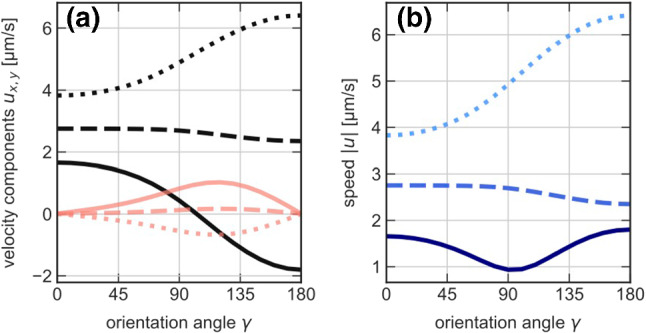
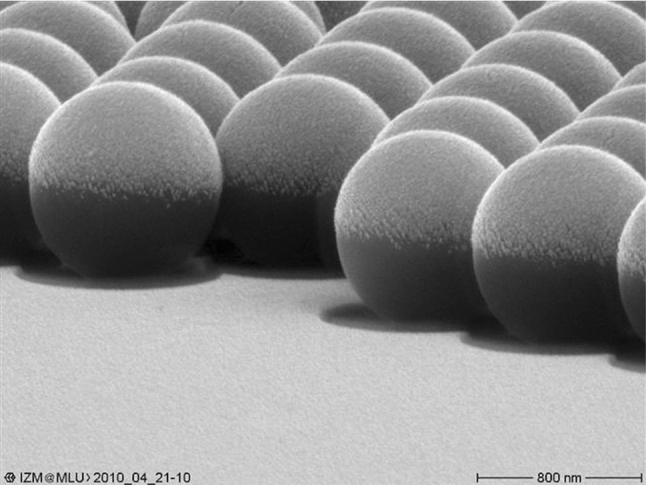
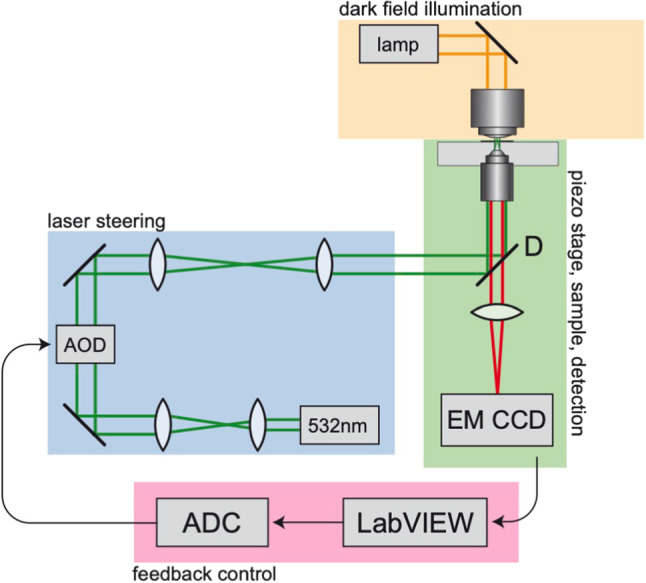
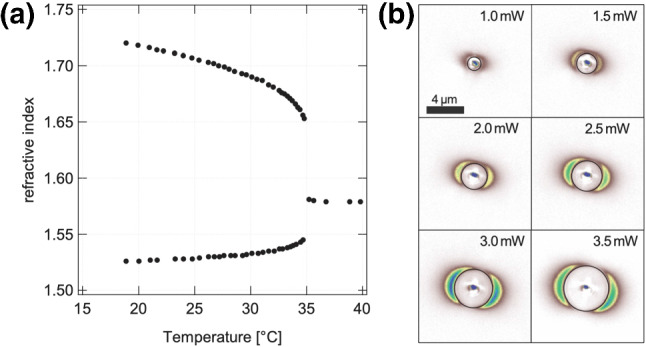
The interactions of autonomous microswimmers play an important role for the formation of collective states of motile active matter. We study them in detail for the common microswimmer-design of two-faced Janus spheres with hemispheres made from different materials. Their chemical and physical surface properties may be tailored to fine-tune their mutual attractive, repulsive or aligning behavior. To investigate these effects systematically, we monitor the dynamics of a single gold-capped Janus particle in the external temperature field created by an optically heated metal nanoparticle. We quantify the orientation-dependent repulsion and alignment of the Janus particle and explain it in terms of a simple theoretical model for the induced thermoosmotic surface fluxes. The model reveals that the particle's angular velocity is solely determined by the temperature profile on the equator between the Janus particle's hemispheres and their phoretic mobility contrast. The distortion of the external temperature field by their heterogeneous heat conductivity is moreover shown to break the apparent symmetry of the problem.
自主微游泳者的相互作用对于运动活性物质的集体状态的形成起着重要作用。我们详细研究了由不同材料制成的双面 Janus 球体的常见微游泳者设计,以精细调整它们之间的相互吸引、排斥或对齐行为。为了系统地研究这些影响,我们在由光加热的金属纳米粒子产生的外部温度场中监测单个镀金 Janus 粒子的动力学。我们量化了 Janus 粒子的取向依赖性排斥和对齐,并根据诱导热渗透表面通量的简单理论模型对其进行了解释。该模型表明,粒子的角速度仅由 Janus 粒子半球之间的赤道上的温度分布及其趋流迁移率对比决定。此外,通过它们的非均相热导率对外部温度场的变形被证明打破了问题的明显对称性。