Charing Cross Hospital, Imperial College Healthcare NHS Trust, Fulham Palace Rd, Hammersmith, London, W6 8RF, UK.
Charing Cross Hospital, Imperial College Healthcare NHS Trust, Fulham Palace Rd, Hammersmith, London, W6 8RF, UK.
Clin Radiol. 2021 Nov;76(11):854-860. doi: 10.1016/j.crad.2021.06.003. Epub 2021 Jun 18.
To assess trainee perceptions of the Radiology-Integrated Training Initiative (R-ITI)) e-learning modules.
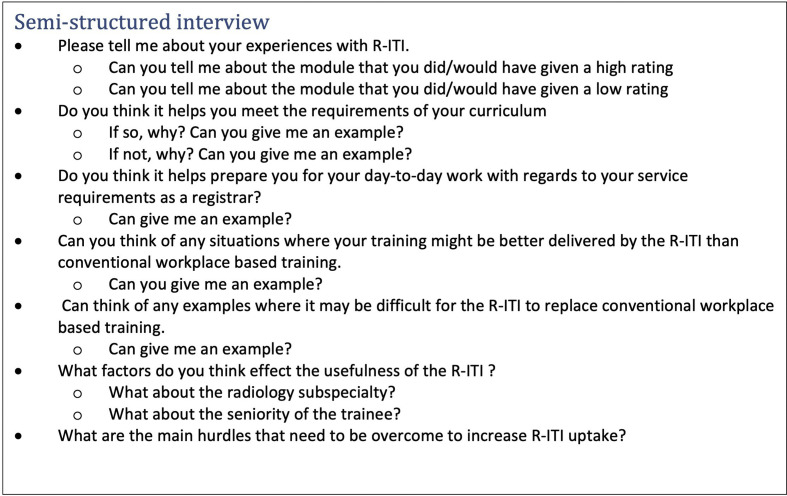
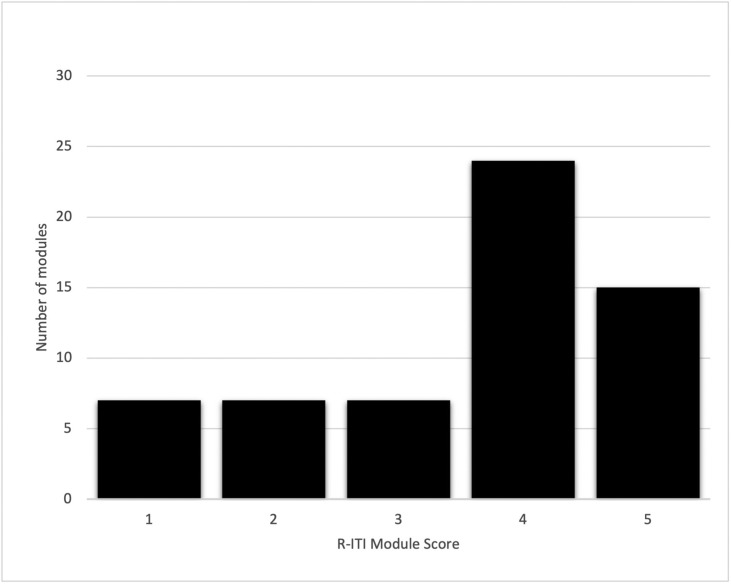
A mixed methodology approach was used, with triangulation between a thematic analysis of eight semi-structured interviews from radiology trainees and trainers, and a contextual analysis of 60 free-text feedback comments and module ratings from trainees after completion of R-ITI modules.
Three broad themes emerged: "learning the subject matter", "learning the role," and "e-learning preferences". Superficial learning techniques were prevalent when "learning the subject matter" during early training, with e-learning resources providing a good pedagogical fit for this learning. Much of what was considered "learning the role" of the radiologist was learned at the workplace. This included topics with inherent subjectivity, which were difficult to convey with e-learning. Trainees' "e-learning preferences" favoured modules that incorporated many imaging cases with layer annotation, clinical relevance, and self-assessment.
The ease of reproducing imaging studies using the R-ITI platform represents a huge potential for e-learning. Content tailored to the learning needs of the trainee, the appropriateness of the subject matter for an online platform, and the design of the e-learning modules are important considerations. Radiology training also involves important tacit learning and discussions around subjective topics, which are difficult to capture on this platform.
评估学员对放射学综合培训计划(R-ITI)电子学习模块的看法。
采用混合方法,对 8 名放射科受训者和培训师的 8 个半结构化访谈进行主题分析,并对 R-ITI 模块完成后受训者的 60 条自由文本反馈意见和模块评分进行情境分析,进行三角分析。
出现了三个广泛的主题:“学习主题”、“学习角色”和“电子学习偏好”。在早期培训期间“学习主题”时,普遍采用浅层学习技巧,电子学习资源非常适合这种学习。被认为是“学习放射科医生角色”的大部分内容都是在工作场所中学习的。这包括具有内在主观性的主题,这些主题很难通过电子学习来传达。学员的“电子学习偏好”倾向于包含带层注释、临床相关性和自我评估的大量成像案例的模块。
R-ITI 平台易于复制成像研究,这代表了电子学习的巨大潜力。根据学员的学习需求定制内容、主题是否适合在线平台以及电子学习模块的设计都是重要的考虑因素。放射科培训还涉及到一些重要的隐性学习和主观主题的讨论,这在该平台上很难捕捉到。