DeJonckheere Melissa, Vaughn Lisa M
Department of Family Medicine, University of Michigan, Ann Arbor, Michigan, USA.
Department of Pediatrics, University of Cincinnati College of Medicine, Cincinnati, Ohio, USA.
Fam Med Community Health. 2019 Mar 8;7(2):e000057. doi: 10.1136/fmch-2018-000057. eCollection 2019.
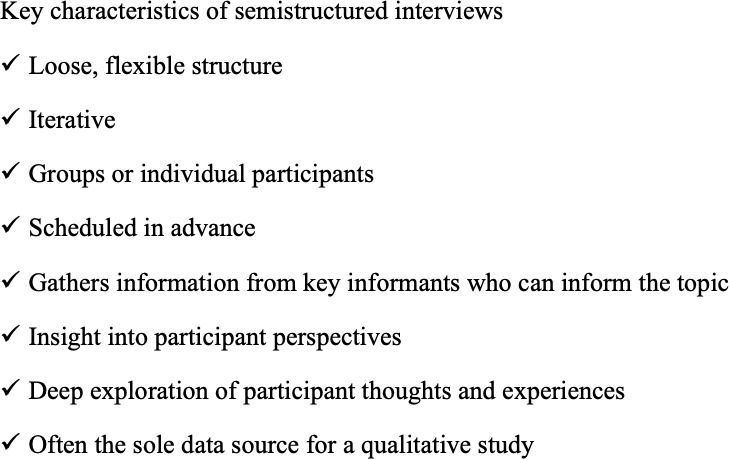
Semistructured in-depth interviews are commonly used in qualitative research and are the most frequent qualitative data source in health services research. This method typically consists of a dialogue between researcher and participant, guided by a flexible interview protocol and supplemented by follow-up questions, probes and comments. The method allows the researcher to collect open-ended data, to explore participant thoughts, feelings and beliefs about a particular topic and to delve deeply into personal and sometimes sensitive issues. The purpose of this article was to identify and describe the essential skills to designing and conducting semistructured interviews in family medicine and primary care research settings. We reviewed the literature on semistructured interviewing to identify key skills and components for using this method in family medicine and primary care research settings. Overall, semistructured interviewing requires both a relational focus and practice in the skills of facilitation. Skills include: (1) determining the purpose and scope of the study; (2) identifying participants; (3) considering ethical issues; (4) planning logistical aspects; (5) developing the interview guide; (6) establishing trust and rapport; (7) conducting the interview; (8) memoing and reflection; (9) analysing the data; (10) demonstrating the trustworthiness of the research; and (11) presenting findings in a paper or report. Semistructured interviews provide an effective and feasible research method for family physicians to conduct in primary care research settings. Researchers using semistructured interviews for data collection should take on a relational focus and consider the skills of interviewing to ensure quality. Semistructured interviewing can be a powerful tool for family physicians, primary care providers and other health services researchers to use to understand the thoughts, beliefs and experiences of individuals. Despite the utility, semistructured interviews can be intimidating and challenging for researchers not familiar with qualitative approaches. In order to elucidate this method, we provide practical guidance for researchers, including novice researchers and those with few resources, to use semistructured interviewing as a data collection strategy. We provide recommendations for the essential steps to follow in order to best implement semistructured interviews in family medicine and primary care research settings.
半结构化深度访谈常用于定性研究,是卫生服务研究中最常见的定性数据来源。该方法通常包括研究者与参与者之间的对话,由灵活的访谈提纲引导,并辅以后续问题、追问和评论。该方法使研究者能够收集开放式数据,探索参与者对特定主题的想法、感受和信念,并深入探讨个人问题,有时还包括敏感问题。本文的目的是确定并描述在家庭医学和初级保健研究环境中设计和进行半结构化访谈的基本技能。我们回顾了关于半结构化访谈的文献,以确定在家庭医学和初级保健研究环境中使用该方法的关键技能和组成部分。总体而言,半结构化访谈既需要关注人际关系,也需要具备引导技巧方面的实践。技能包括:(1)确定研究目的和范围;(2)确定参与者;(3)考虑伦理问题;(4)规划后勤方面;(5)制定访谈指南;(6)建立信任和融洽关系;(7)进行访谈;(8)记录和反思;(9)分析数据;(10)证明研究的可信度;以及(11)在论文或报告中呈现研究结果。半结构化访谈为家庭医生在初级保健研究环境中开展研究提供了一种有效且可行的研究方法。使用半结构化访谈进行数据收集的研究者应关注人际关系,并考虑访谈技巧以确保质量。半结构化访谈对于家庭医生、初级保健提供者和其他卫生服务研究者来说,可能是一种了解个体想法、信念和经历的有力工具。尽管有其效用,但对于不熟悉定性方法的研究者来说,半结构化访谈可能会令人生畏且具有挑战性。为了阐明这种方法,我们为研究者,包括新手研究者和资源有限的研究者,提供实用指导,以便他们将半结构化访谈用作数据收集策略。我们为在家庭医学和初级保健研究环境中最佳实施半结构化访谈应遵循的基本步骤提供建议。