• 文献检索
  • 文档翻译
  • 深度研究
  • 学术资讯
  • Suppr Zotero 插件Zotero 插件
  • 邀请有礼
  • 套餐&价格
  • 历史记录
应用&插件
Suppr Zotero 插件Zotero 插件浏览器插件Mac 客户端Windows 客户端微信小程序
定价
高级版会员购买积分包购买API积分包
服务
文献检索文档翻译深度研究API 文档MCP 服务
关于我们
关于 Suppr公司介绍联系我们用户协议隐私条款
关注我们

Suppr 超能文献

核心技术专利:CN118964589B侵权必究
粤ICP备2023148730 号-1Suppr @ 2026

文献检索

告别复杂PubMed语法,用中文像聊天一样搜索,搜遍4000万医学文献。AI智能推荐,让科研检索更轻松。

立即免费搜索

文件翻译

保留排版,准确专业,支持PDF/Word/PPT等文件格式,支持 12+语言互译。

免费翻译文档

深度研究

AI帮你快速写综述,25分钟生成高质量综述,智能提取关键信息,辅助科研写作。

立即免费体验

重复性消极思维介导成瘾性Facebook使用与自杀相关结果之间的关系:一项纵向研究。

Repetitive negative thinking mediates the relationship between addictive Facebook use and suicide-related outcomes: A longitudinal study.

作者信息

Brailovskaia Julia, Margraf Jürgen, Teismann Tobias

机构信息

Mental Health Research and Treatment Center, Department of Clinical Psychology and Psychotherapy, Ruhr-Universität Bochum, Massenbergstraße 9-13, 44787 Bochum, Germany.

出版信息

Curr Psychol. 2023;42(8):6791-6799. doi: 10.1007/s12144-021-02025-7. Epub 2021 Jun 28.

DOI:10.1007/s12144-021-02025-7
PMID:34220175
原文链接:https://pmc.ncbi.nlm.nih.gov/articles/PMC8238028/
Abstract

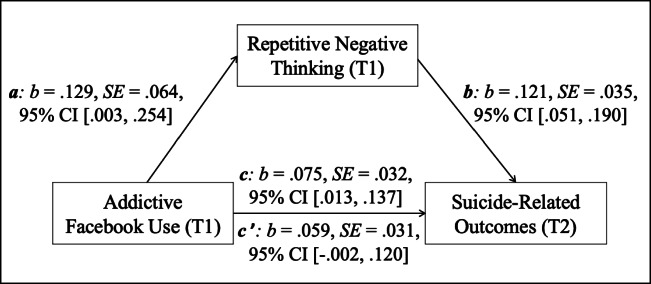
Repetitive negative thinking (RNT) and addictive Facebook use have been shown to be associated with suicide ideation and suicidal behavior. The present longitudinal study aimed to investigate whether the association between addictive Facebook use and suicide-related outcomes is mediated by RNT. Data of 191 German Facebook users (  = 26.17,  = 6.63) were assessed at two measurement time points over a one-year period (first measurement = T1, second measurement = T2) via online surveys. The significant positive association between addictive Facebook use (T1) and suicide-related outcomes (T2) was significantly mediated by RNT (T1). In contrast, a check test that included RNT (T1) as predictor and addictive Facebook use (T1) as mediator revealed no significant mediation effect. The current results demonstrate that if addictive Facebook use leads to RNT suicide ideation and attempts become likely. Therefore, RNT and addictive Facebook use should be taken into account when assessing individuals for risk of suicide.

摘要

反复消极思维(RNT)和沉迷于使用脸书已被证明与自杀意念和自杀行为有关。本纵向研究旨在调查沉迷于使用脸书与自杀相关结果之间的关联是否由反复消极思维介导。通过在线调查,在一年时间内的两个测量时间点(第一次测量=T1,第二次测量=T2)对191名德国脸书用户的数据(平均年龄=26.17岁,标准差=6.63)进行了评估。沉迷于使用脸书(T1)与自杀相关结果(T2)之间的显著正相关由反复消极思维(T1)显著介导。相比之下,一项以反复消极思维(T1)作为预测因素、沉迷于使用脸书(T1)作为中介变量的检验未显示出显著的中介效应。当前结果表明,如果沉迷于使用脸书导致反复消极思维,那么自杀意念和自杀企图就有可能出现。因此,在评估个体的自杀风险时,应考虑反复消极思维和沉迷于使用脸书的情况。
https://cdn.ncbi.nlm.nih.gov/pmc/blobs/a1b1/8238028/a88072e525fe/12144_2021_2025_Fig1_HTML.jpg

相似文献

1
Repetitive negative thinking mediates the relationship between addictive Facebook use and suicide-related outcomes: A longitudinal study.重复性消极思维介导成瘾性Facebook使用与自杀相关结果之间的关系:一项纵向研究。
Curr Psychol. 2023;42(8):6791-6799. doi: 10.1007/s12144-021-02025-7. Epub 2021 Jun 28.
2
Positive Mental Health Mediates the Relationship Between Facebook Addiction Disorder and Suicide-Related Outcomes: A Longitudinal Approach.积极心理健康在 Facebook 成瘾障碍与自杀相关结果之间的关系中介作用:纵向研究。
Cyberpsychol Behav Soc Netw. 2020 May;23(5):346-350. doi: 10.1089/cyber.2019.0563. Epub 2020 Mar 27.
3
Relationships between addictive Facebook use, depressiveness, insomnia, and positive mental health in an inpatient sample: A German longitudinal study.住院患者中 Facebook 成瘾使用、抑郁、失眠与积极心理健康之间的关系:一项德国纵向研究。
J Behav Addict. 2019 Dec 1;8(4):703-713. doi: 10.1556/2006.8.2019.63. Epub 2019 Dec 13.
4
Repetitive negative thinking as a unique transdiagnostic risk factor for suicidal ideation.重复性消极思维是自杀意念的一种独特的跨诊断风险因素。
Psychiatry Res. 2024 Apr;334:115787. doi: 10.1016/j.psychres.2024.115787. Epub 2024 Feb 13.
5
Repetitive negative thinking and suicide: a burgeoning literature with need for further exploration.重复消极思维与自杀:文献研究方兴未艾,尚需深入探索。
Curr Opin Psychol. 2018 Aug;22:68-72. doi: 10.1016/j.copsyc.2017.08.027. Epub 2017 Aug 24.
6
Efficacy of an internet and app-based gratitude intervention in reducing repetitive negative thinking and mechanisms of change in the intervention's effect on anxiety and depression: Results from a randomized controlled trial.基于互联网和应用程序的感恩干预对减少重复性消极思维的效果,以及这种干预对焦虑和抑郁影响的变化机制:一项随机对照试验的结果。
Behav Res Ther. 2019 Aug;119:103415. doi: 10.1016/j.brat.2019.103415. Epub 2019 Jun 8.
7
The relationship between repetitive negative thinking, sleep disturbance, and subjective fatigue in women with Generalized Anxiety Disorder.广泛性焦虑障碍女性患者中重复性消极思维、睡眠障碍与主观疲劳之间的关系。
Br J Clin Psychol. 2022 Sep;61(3):666-679. doi: 10.1111/bjc.12356. Epub 2022 Jan 27.
8
Repetitive negative thinking, metacognitive beliefs, and their interaction as possible predictors for problematic cannabis use.反复消极思维、元认知信念及其相互作用作为大麻使用问题的可能预测因素。
Clin Psychol Psychother. 2022 Mar;29(2):706-717. doi: 10.1002/cpp.2664. Epub 2021 Aug 30.
9
Repeat suicide attempts in Hong Kong community adolescents.香港社区青少年的反复自杀未遂行为。
Soc Sci Med. 2008 Jan;66(2):232-41. doi: 10.1016/j.socscimed.2007.08.031. Epub 2007 Oct 4.
10
Facebook and Suicidal Behaviour: User Experiences of Suicide Notes, Live-Streaming, Grieving and Preventive Strategies-A Scoping Review.脸书与自杀行为:自杀遗言、直播、哀悼以及预防策略的用户体验-范围综述。
Int J Environ Res Public Health. 2022 Oct 11;19(20):13001. doi: 10.3390/ijerph192013001.

引用本文的文献

1
The Bergen Facebook addiction scale: a reliability generalization meta-analysis.卑尔根Facebook成瘾量表:一项信度概括性元分析
Front Psychol. 2025 Jan 7;15:1444039. doi: 10.3389/fpsyg.2024.1444039. eCollection 2024.
2
The association between depression and addictive social media use during the COVID-19 pandemic: The mediating role of sense of control.新冠肺炎疫情期间抑郁与成瘾性社交媒体使用的关系:控制感的中介作用。
PLoS One. 2023 Sep 8;18(9):e0291034. doi: 10.1371/journal.pone.0291034. eCollection 2023.
3
Social Media is Addictive and Influences Behavior: Should it Be Regulated as a Digital Therapeutic?

本文引用的文献

1
Prevalence of Internet-based addictive behaviors during COVID-19 pandemic: a systematic review.新冠疫情期间基于互联网的成瘾行为的流行情况:一项系统综述。
J Addict Dis. 2021 Oct-Dec;39(4):468-488. doi: 10.1080/10550887.2021.1895962. Epub 2021 Mar 22.
2
Cognitive behavioral based group psychotherapy focusing on repetitive negative thinking: Decreased uncontrollability of rumination is related to brain perfusion increases in the left dorsolateral prefrontal cortex.基于认知行为的团体心理治疗,聚焦于重复性消极思维:反刍不可控性的降低与左侧背外侧前额叶皮质脑灌注增加有关。
J Psychiatr Res. 2021 Apr;136:281-287. doi: 10.1016/j.jpsychires.2021.02.011. Epub 2021 Feb 13.
3
社交媒体具有成瘾性并影响行为:它是否应被视为一种数字治疗方法而受到监管?
J Med Internet Res. 2023 Jan 26;25:e43174. doi: 10.2196/43174.
4
Social media use, mental health, and suicide-related outcomes in Russian women: A cross-sectional comparison between two age groups.社交媒体使用、心理健康和俄罗斯女性自杀相关结果:两个年龄组的横断面比较。
Womens Health (Lond). 2022 Jan-Dec;18:17455057221141292. doi: 10.1177/17455057221141292.
5
Positive mental health and mindfulness as protective factors against addictive social media use during the COVID-19 outbreak.积极的心理健康和正念作为保护因素,可预防在 COVID-19 爆发期间对社交媒体的上瘾。
PLoS One. 2022 Nov 30;17(11):e0277631. doi: 10.1371/journal.pone.0277631. eCollection 2022.
6
Facebook and Suicidal Behaviour: User Experiences of Suicide Notes, Live-Streaming, Grieving and Preventive Strategies-A Scoping Review.脸书与自杀行为:自杀遗言、直播、哀悼以及预防策略的用户体验-范围综述。
Int J Environ Res Public Health. 2022 Oct 11;19(20):13001. doi: 10.3390/ijerph192013001.
7
Addictive and other mental disorders: a call for a standardized definition of dual disorders.成瘾和其他精神障碍:呼吁对双重障碍进行标准化定义。
Transl Psychiatry. 2022 Oct 13;12(1):446. doi: 10.1038/s41398-022-02212-5.
8
Addictive social media use during Covid-19 outbreak: Validation of the Bergen Social Media Addiction Scale (BSMAS) and investigation of protective factors in nine countries.新冠疫情期间社交媒体成瘾行为:卑尔根社交媒体成瘾量表(BSMAS)的验证及九个国家保护因素的调查
Curr Psychol. 2022 May 21:1-19. doi: 10.1007/s12144-022-03182-z.
9
From low sense of control to problematic smartphone use severity during Covid-19 outbreak: The mediating role of fear of missing out and the moderating role of repetitive negative thinking.从低控制感到新冠疫情期间智能手机使用问题的严重程度:错失恐惧的中介作用和重复消极思维的调节作用。
PLoS One. 2021 Dec 22;16(12):e0261023. doi: 10.1371/journal.pone.0261023. eCollection 2021.
Increase in suicide following an initial decline during the COVID-19 pandemic in Japan.
日本 COVID-19 大流行初期自杀人数下降后增加。
Nat Hum Behav. 2021 Feb;5(2):229-238. doi: 10.1038/s41562-020-01042-z. Epub 2021 Jan 15.
4
Associations between symptoms of problematic smartphone, Facebook, WhatsApp, and Instagram use: An item-level exploratory graph analysis perspective.智能手机、Facebook、WhatsApp 和 Instagram 使用问题症状之间的关联:项目层面的探索性图形分析视角。
J Behav Addict. 2020 Aug 13;9(3):686-697. doi: 10.1556/2006.2020.00036. Print 2020 Oct 12.
5
Relationship Between Depression Symptoms, Physical Activity, and Addictive Social Media Use.抑郁症状、身体活动与沉迷社交媒体之间的关系。
Cyberpsychol Behav Soc Netw. 2020 Dec;23(12):818-822. doi: 10.1089/cyber.2020.0255. Epub 2020 Aug 18.
6
Importance of Face Masks for COVID-19: A Call for Effective Public Education.口罩对2019冠状病毒病的重要性:呼吁开展有效的公众教育
Clin Infect Dis. 2020 Nov 19;71(16):2195-2198. doi: 10.1093/cid/ciaa593.
7
Changes in sleep pattern, sense of time and digital media use during COVID-19 lockdown in Italy.意大利 COVID-19 封锁期间睡眠模式、时间感知和数字媒体使用的变化。
J Sleep Res. 2020 Aug;29(4):e13074. doi: 10.1111/jsr.13074. Epub 2020 May 15.
8
A Multiple-Baseline Evaluation of Acceptance and Commitment Therapy Focused on Repetitive Negative Thinking for Comorbid Generalized Anxiety Disorder and Depression.一项针对共病广泛性焦虑症和抑郁症且聚焦于重复性消极思维的接纳与承诺疗法的多基线评估。
Front Psychol. 2020 Mar 13;11:356. doi: 10.3389/fpsyg.2020.00356. eCollection 2020.
9
Positive Mental Health Mediates the Relationship Between Facebook Addiction Disorder and Suicide-Related Outcomes: A Longitudinal Approach.积极心理健康在 Facebook 成瘾障碍与自杀相关结果之间的关系中介作用:纵向研究。
Cyberpsychol Behav Soc Netw. 2020 May;23(5):346-350. doi: 10.1089/cyber.2019.0563. Epub 2020 Mar 27.
10
Relationships between addictive Facebook use, depressiveness, insomnia, and positive mental health in an inpatient sample: A German longitudinal study.住院患者中 Facebook 成瘾使用、抑郁、失眠与积极心理健康之间的关系:一项德国纵向研究。
J Behav Addict. 2019 Dec 1;8(4):703-713. doi: 10.1556/2006.8.2019.63. Epub 2019 Dec 13.