Xiao Xuewen, Liu Hui, Liu Xixi, Zhang Weiwei, Zhang Sizhe, Jiao Bin
Department of Neurology, Xiangya Hospital, Central South University, Changsha, China.
National Clinical Research Center for Geriatric Disorders, Central South University, Changsha, China.
Front Aging Neurosci. 2021 Jun 18;13:695808. doi: 10.3389/fnagi.2021.695808. eCollection 2021.
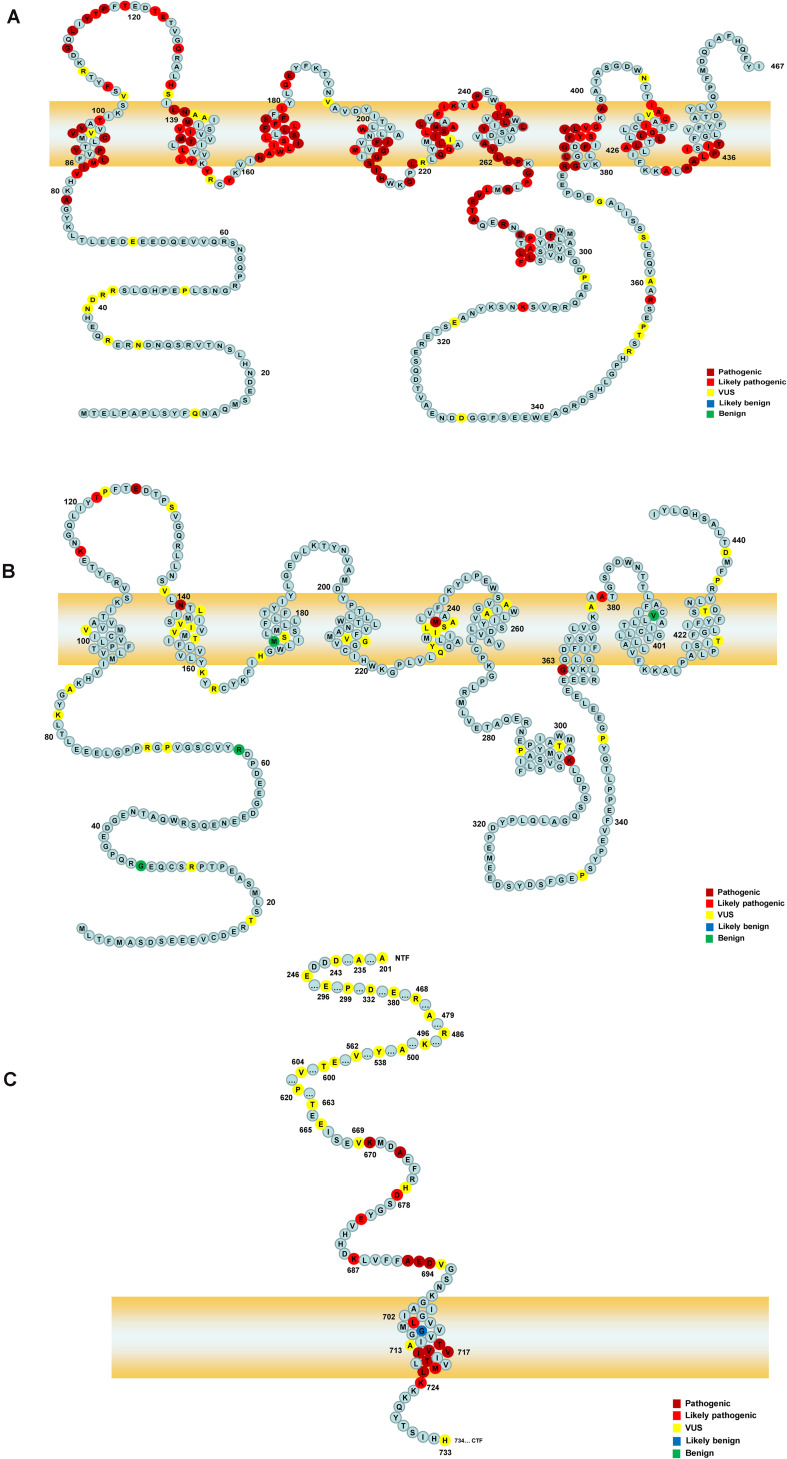
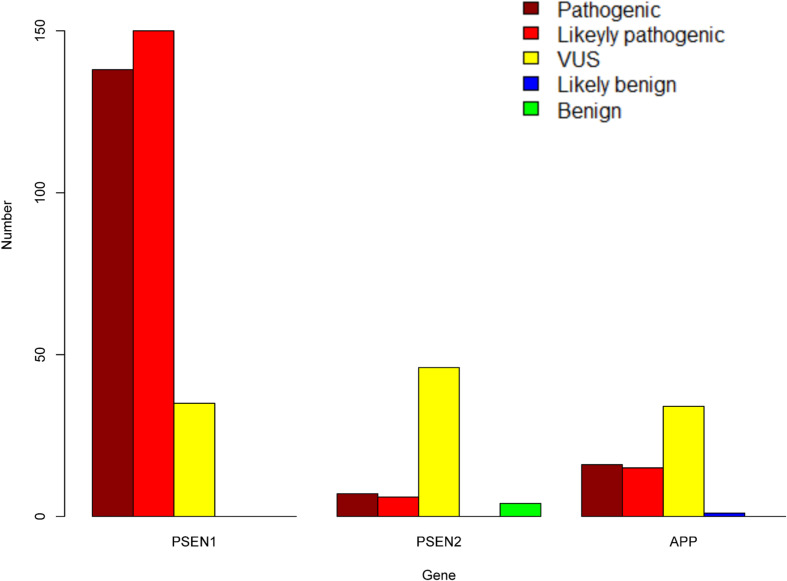
The strategies of classifying , , and variants varied substantially in the previous studies. We aimed to re-evaluate these variants systematically according to the American college of medical genetics and genomics and the association for molecular pathology (ACMG-AMP) guidelines. In our study, , , and variants were collected by searching Alzforum and PubMed database with keywords "PSEN1," "PSEN2," and "APP." These variants were re-evaluated based on the ACMG-AMP guidelines. We compared the number of pathogenic/likely pathogenic variants of , , and . In total, 66 variants, 323 variants, and 63 variants were re-evaluated in our study. 94.91% of previously reported pathogenic variants were re-classified as pathogenic/likely pathogenic variants, while 5.09% of them were variants of uncertain significance (VUS). carried the most prevalent pathogenic/likely pathogenic variants, followed by and . Significant statistically difference was identified among these three genes when comparing the number of pathogenic/likely pathogenic variants ( < 2.2 × 10). Most of the previously reported pathogenic variants were re-classified as pathogenic/likely pathogenic variants while the others were re-evaluated as VUS, highlighting the importance of interpreting , , and variants with caution according to ACMG-AMP guidelines.
在先前的研究中,对PSEN1、PSEN2和APP变体的分类策略差异很大。我们旨在根据美国医学遗传学与基因组学学会以及分子病理学协会(ACMG-AMP)指南对这些变体进行系统的重新评估。在我们的研究中,通过在Alzforum和PubMed数据库中使用关键词“PSEN1”、“PSEN2”和“APP”搜索来收集PSEN1、PSEN2和APP变体。这些变体根据ACMG-AMP指南进行了重新评估。我们比较了PSEN1、PSEN2和APP的致病/可能致病变体的数量。在我们的研究中,总共对66个PSEN1变体、323个PSEN2变体和63个APP变体进行了重新评估。先前报道的致病变体中有94.91%被重新分类为致病/可能致病变体,而其中5.09%为意义未明的变体(VUS)。PSEN1携带的致病/可能致病变体最为普遍,其次是PSEN2和APP。在比较致病/可能致病变体数量时,这三个基因之间存在显著的统计学差异(P < 2.2×10)。大多数先前报道的致病变体被重新分类为致病/可能致病变体,而其他变体则被重新评估为VUS,这突出了根据ACMG-AMP指南谨慎解读PSEN1、PSEN2和APP变体的重要性。