Yu Yang, Yao Changliang, Guo De-An
Shanghai Research Center for Modernization of Traditional Chinese Medicine, National Engineering Laboratory for TCM Standardization Technology, Shanghai Institute of Materia Medica, Chinese Academy of Sciences, Shanghai 201203, China.
University of Chinese Academy of Sciences, Beijing 100049, China.
Acta Pharm Sin B. 2021 Jun;11(6):1469-1492. doi: 10.1016/j.apsb.2021.02.017. Epub 2021 Feb 26.
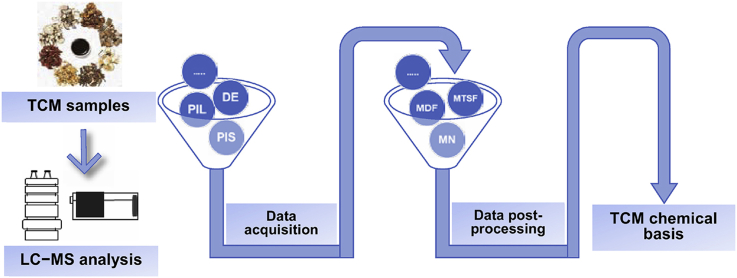
Traditional Chinese medicine (TCM) has been an indispensable source of drugs for curing various human diseases. However, the inherent chemical diversity and complexity of TCM restricted the safety and efficacy of its usage. Over the past few decades, the combination of liquid chromatography with mass spectrometry has contributed greatly to the TCM qualitative analysis. And novel approaches have been continuously introduced to improve the analytical performance, including both the data acquisition methods to generate a large and informative dataset, and the data post-processing tools to extract the structure-related MS information. Furthermore, the fast-developing computer techniques and big data analytics have markedly enriched the data processing tools, bringing benefits of high efficiency and accuracy. To provide an up-to-date review of the latest techniques on the TCM qualitative analysis, multiple data-independent acquisition methods and data-dependent acquisition methods (precursor ion list, dynamic exclusion, mass tag, precursor ion scan, neutral loss scan, and multiple reaction monitoring) and post-processing techniques (mass defect filtering, diagnostic ion filtering, neutral loss filtering, mass spectral trees similarity filter, molecular networking, statistical analysis, database matching, etc.) were summarized and categorized. Applications of each technique and integrated analytical strategies were highlighted, discussion and future perspectives were proposed as well.
中药一直是治疗各种人类疾病不可或缺的药物来源。然而,中药固有的化学多样性和复杂性限制了其使用的安全性和有效性。在过去几十年中,液相色谱与质谱联用对中药定性分析做出了巨大贡献。并且不断引入新方法来提高分析性能,包括生成大量信息丰富数据集的数据采集方法,以及提取与结构相关的质谱信息的数据后处理工具。此外,快速发展的计算机技术和大数据分析显著丰富了数据处理工具,带来了高效和准确的好处。为了对中药定性分析的最新技术进行最新综述,总结并分类了多种数据非依赖型采集方法和数据依赖型采集方法(前体离子列表、动态排除、质量标签、前体离子扫描、中性丢失扫描和多反应监测)以及后处理技术(质量亏损过滤、诊断离子过滤、中性丢失过滤、质谱树相似性过滤、分子网络、统计分析、数据库匹配等)。突出了每种技术的应用和综合分析策略,并提出了讨论和未来展望。