Manouchehrian Nahid, Moradi Abbas, Torkashvand Leyla
Department of Anesthesiology, Hamadan University of Medical Sciences, Hamadan, Iran.
Medical Sciences Faculty, Hamadan University of Medical Sciences, Hamadan, Iran.
Anesth Pain Med. 2021 Feb 27;11(1):e111483. doi: 10.5812/aapm.111483. eCollection 2021 Feb.
Spinal anesthesia is the method of choice for the cesarean section. Hypotension is a common complication of this method.
This study aimed to compare the effect of spinal anesthesia in the sitting and lateral positions on the onset time of sensory block and hemodynamic condition in cesarean sections.
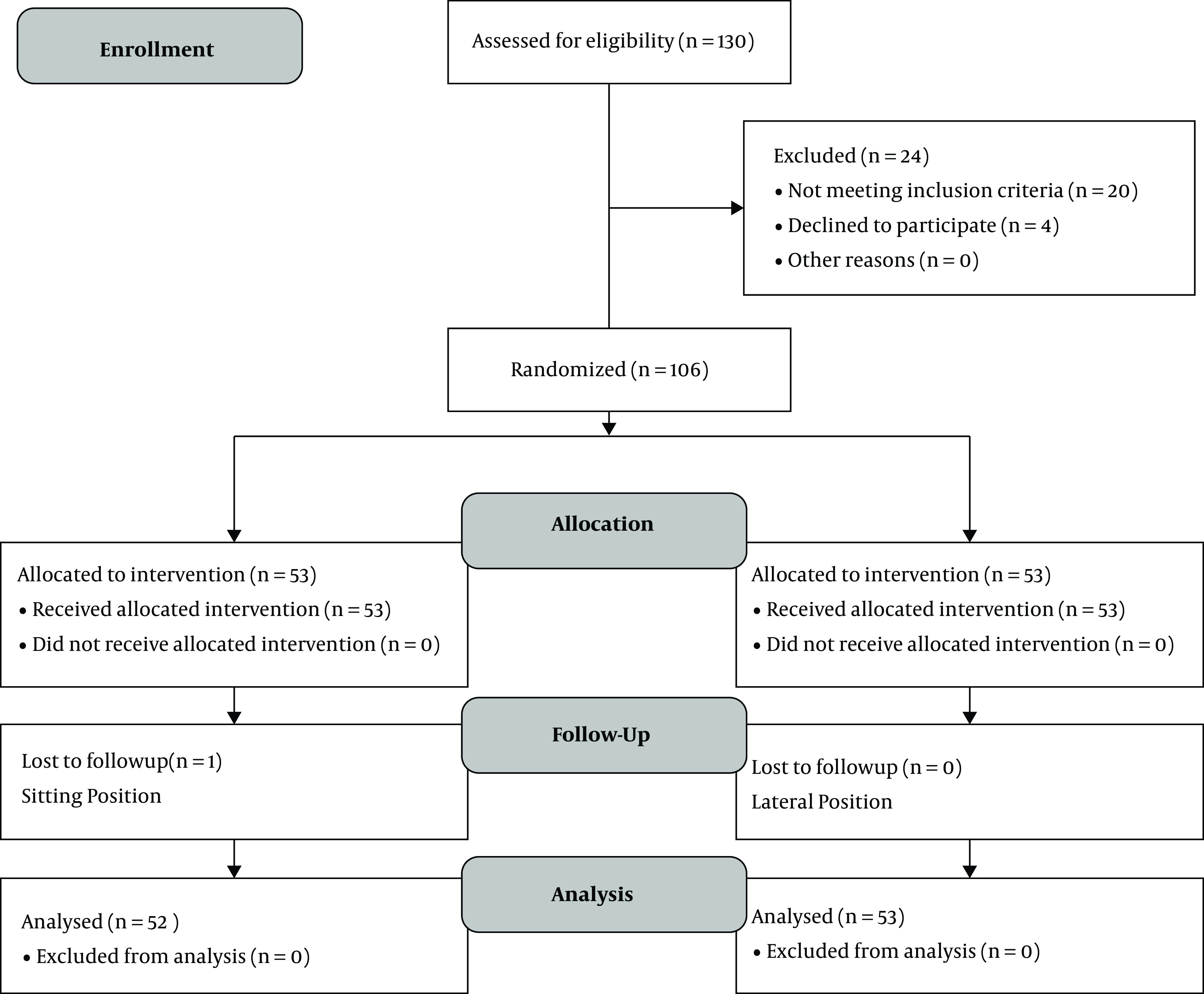
In this clinical trial, 106 elective cesarean section candidates under spinal anesthesia were selected and randomly divided into two groups: spinal anesthesia in the sitting position (group S) and the lateral position (group L). The onset time of the sensory block, quality of sensory and motor block, hemodynamic condition, frequency of hypotension, nausea, and vomiting, and the doses of ephedrine and atropine were compared between both groups. Data were analyzed with SPSS version 16 software at a 95% confidence level.
There was no statistically significant difference between the two groups in terms of age. The frequency of hypotension in L and S groups was 24.5% and 57.7%, respectively (P = 0.001), in minute 6 after spinal anesthesia and 5.7% and 36.5%, respectively (P < 0.001), in minute 8 after spinal anesthesia. The mean time to reach the sensory level of T6 was 1.30 ± 0.43 min versus 4.54 ± 2.12 min (P < 0.001), motor block score in minute 5 was 2.98 ± 0.14 versus 2.82 (P = 0.044), and ephedrine dose was 11.5 mg and 16.92 mg in the L and S groups, respectively (P = 0.010). The maximum sensory-motor block and satisfaction of women with spinal anesthesia were significantly higher in the lateral position than in the sitting position (P < 0.05).
Cesarean sections under spinal anesthesia in the lateral position than in the sitting position lead to a more rapid sensory and motor block, reduced ephedrine consumption, and enhanced satisfaction of women.
脊髓麻醉是剖宫产的首选方法。低血压是该方法的常见并发症。
本研究旨在比较脊髓麻醉时坐位与侧卧位对剖宫产感觉阻滞起效时间和血流动力学状况的影响。
在这项临床试验中,选择106例接受脊髓麻醉的择期剖宫产候选者,并随机分为两组:坐位脊髓麻醉组(S组)和侧卧位脊髓麻醉组(L组)。比较两组感觉阻滞的起效时间、感觉和运动阻滞质量、血流动力学状况、低血压、恶心和呕吐的发生率以及麻黄碱和阿托品的用量。使用SPSS 16版软件在95%置信水平下进行数据分析。
两组在年龄方面无统计学显著差异。脊髓麻醉后第6分钟,L组和S组低血压发生率分别为24.5%和57.7%(P = 0.001);脊髓麻醉后第8分钟,分别为5.7%和36.5%(P < 0.001)。达到T6感觉平面的平均时间分别为1.30±0.43分钟和4.54±2.12分钟(P < 0.001);第5分钟时运动阻滞评分分别为2.98±0.14和2.82(P = 0.044);L组和S组麻黄碱用量分别为11.5毫克和16.92毫克(P = 0.010)。侧卧位脊髓麻醉时女性的最大感觉运动阻滞和满意度显著高于坐位(P < 0.05)。
脊髓麻醉下剖宫产采用侧卧位比坐位导致感觉和运动阻滞更快、麻黄碱用量减少且女性满意度提高。