Yang Fan, Xie Yuan, Tang Jiefu, Liu Boxuan, Luo Yuancheng, He Qiyuan, Zhang Lingxue, Xin Lele, Wang Jianhao, Wang Sinan, Zhang Shuqiang, Cao Qingze, Wang Liang, He Liqun, Zhang Lei
Department of Neurosurgery, Tianjin Medical University General Hospital, Tianjin Neurological Institute, Key Laboratory of Post-Neuro-injury Neuro-Repair and Regeneration in Central Nervous System, Ministry of Education and Tianjin City, Tianjin, China.
Key Laboratory of Ministry of Education for Medicinal Plant Resource and Natural Pharmaceutical Chemistry, National Engineering Laboratory for Resource Developing of Endangered Chinese Crude Drugs in Northwest of China, College of Life Sciences, Shaanxi Normal University, Xi'an, China.
Front Oncol. 2021 Jun 17;11:683367. doi: 10.3389/fonc.2021.683367. eCollection 2021.
Glioblastoma (GBM) is the most aggressive and lethal type of brain tumors. Magnetic resonance imaging (MRI) has been commonly used for GBM diagnosis. Contrast enhancement (CE) on T1-weighted sequences are presented in nearly all GBM as a result of high vascular permeability in glioblastomas. Although several radiomics studies indicated that CE is associated with distinct molecular signatures in tumors, the effects of vascular endothelial cells, the key component of blood brain barrier (BBB) controlling vascular permeability, on CE have not been thoroughly analyzed.
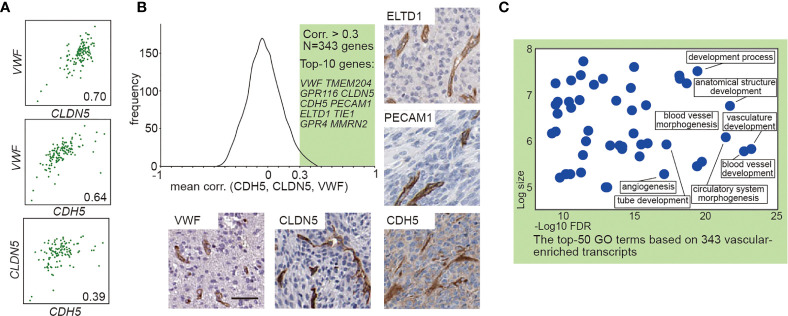
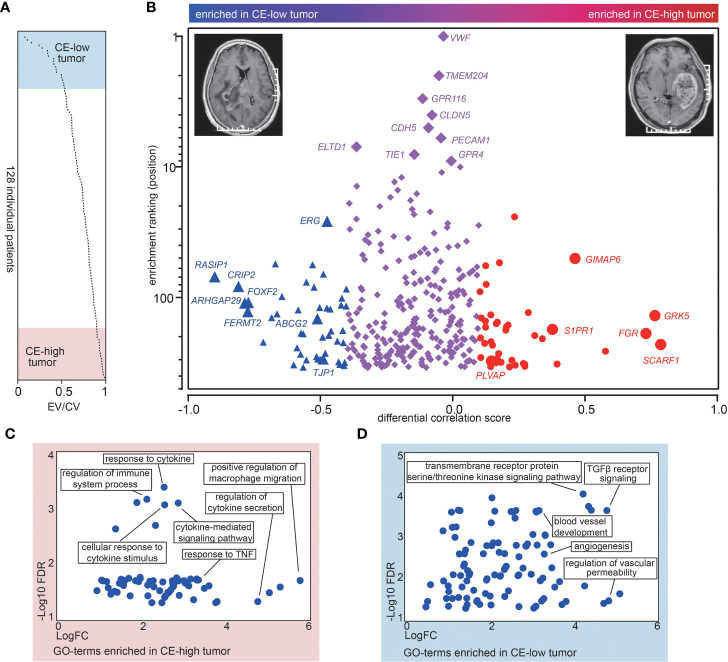
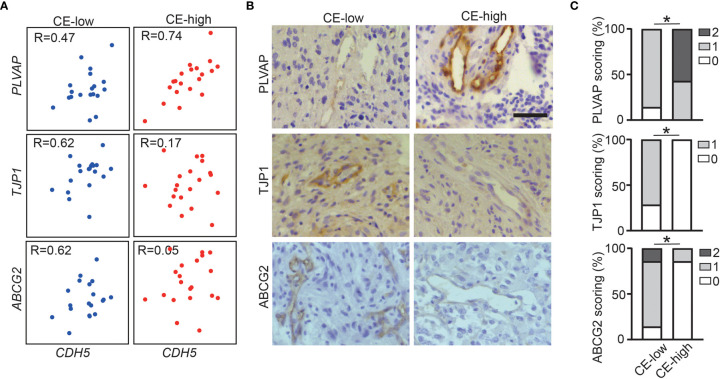
Endothelial cell enriched genes have been identified using transcriptome data from 128 patients by a systematic method based on correlation analysis. Distinct endothelial cell enriched genes associated with CE were identified by analyzing difference of correlation score between CE-high and CE-low GBM cases. Immunohistochemical staining was performed on in-house patient cohort to validate the selected genes associated with CE. Moreover, a survival analysis was conducted to uncover the relation between CE and patient survival.
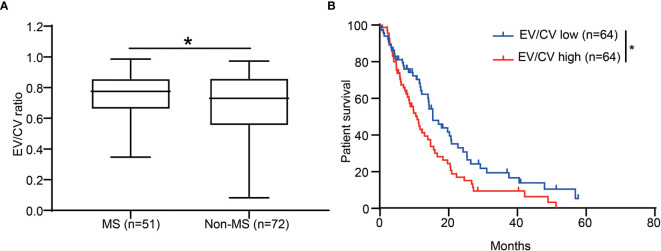
We illustrated that CE is associated with distinct vascular molecular imprints characterized by up-regulation of pro-inflammatory genes and deregulation of BBB related genes. Among them, PLVAP is up-regulated, whereas TJP1 and ABCG2 are down-regulated in the vasculature of GBM with high CE. In addition, we found that the high CE is associated with poor prognosis and GBM mesenchymal subtype.
We provide an additional insight to reveal the molecular trait for CE in MRI images with special focus on vascular endothelial cells, linking CE with BBB disruption in the molecular level. This study provides a potential new direction that may be applied for the treatment optimization based on MRI features.
胶质母细胞瘤(GBM)是最具侵袭性和致命性的脑肿瘤类型。磁共振成像(MRI)已被广泛用于GBM的诊断。由于胶质母细胞瘤血管通透性高,几乎所有GBM在T1加权序列上都会出现对比增强(CE)。尽管多项放射组学研究表明CE与肿瘤中不同的分子特征相关,但作为控制血管通透性的血脑屏障(BBB)关键组成部分的血管内皮细胞对CE的影响尚未得到充分分析。
通过基于相关性分析的系统方法,利用128例患者的转录组数据鉴定出内皮细胞富集基因。通过分析CE高和CE低的GBM病例之间相关性评分的差异,鉴定出与CE相关的不同内皮细胞富集基因。对内部患者队列进行免疫组织化学染色,以验证所选的与CE相关的基因。此外,进行生存分析以揭示CE与患者生存之间的关系。
我们表明CE与不同的血管分子印记相关,其特征在于促炎基因的上调和BBB相关基因的失调。其中,在CE高的GBM血管中,PLVAP上调,而TJP1和ABCG2下调。此外,我们发现高CE与预后不良和GBM间充质亚型相关。
我们提供了额外的见解,以揭示MRI图像中CE的分子特征,特别关注血管内皮细胞,在分子水平上将CE与BBB破坏联系起来。本研究提供了一个潜在的新方向,可应用于基于MRI特征的治疗优化。