Zhang Lin, Li Chenfei, Yang Liting, Adzika Gabriel Komla, Machuki Jeremiah Ong'achwa, Shi Mingjin, Sun Qi, Sun Hong
Department of Physiology, Xuzhou Medical University, Xuzhou, China.
Institute of Cardiovascular Disease Research, Xuzhou Medical University, Xuzhou, China.
Front Cardiovasc Med. 2021 Jun 16;8:679240. doi: 10.3389/fcvm.2021.679240. eCollection 2021.
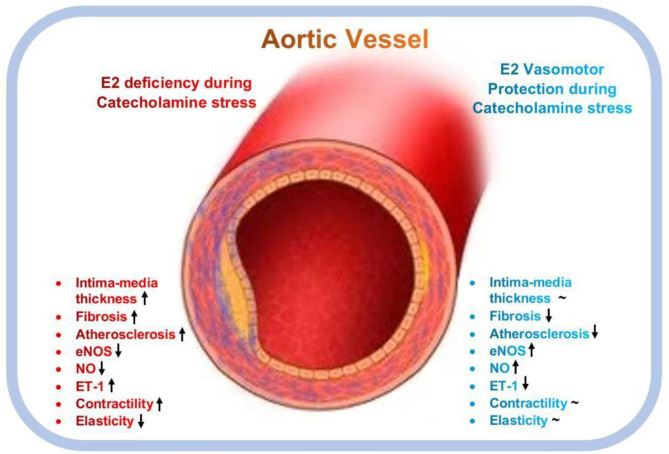
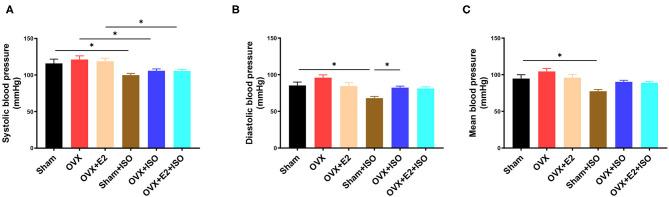
The incidence of dysfunctional vasomotor diseases has mostly occurred in postmenopausal women but not in premenopausal women. Hence, this study sought to investigate the impact of estrogen deficiency during catecholamine stress on vasomotor function. Also, attempts were made to utilize estrogen replacement therapy to mitigate the adverse effects (pathological remodeling) of stress on the aortic vessels to preserve vasomotor functions. To do this, female Sprague-Dawley (SD) rats were ovariectomized (OVX) along with sham operations (Sham). Day 14 after OVX operation, 17-estradiol (E) was subcutaneously implanted (OVX+E). Day 35 after operation, stress was induced by isoproterenol (ISO) subcutaneous injections. Clinically relevant blood pressure indexes (systolic, diastolic, and mean atrial blood pressures) were assessed in the rats. Aortic vascular ring tensions were assessed to ascertain the impact of E on their vasomotor function. Aortic vascular rings (AVRs) from OVX+ISO exhibited a significant increase in contractility in response to phenylephrine than AVRs isolated from Sham+ISO rats. Also, sera levels of nitric oxide (NO) and endothelin-1 (ET-1) and the expression of p-eNOS/eNOS from vascular tissues were ascertained. We demonstrate that, during stress, E prevented excessive weight gain and OVX rats had higher blood pressures than those in the Sham group. Further, we showed that E decreases ET-1 expressions during stress while upregulating NO expressions via enhancing eNOS activities to facilitate vasomotor functions. Finally, histological assessment revealed the E treatments during stress preserved vasomotor functions by preventing excessive intima-media thickening and collagen depositions in the aortic vascular walls.
功能失调性血管舒缩疾病的发病率大多发生在绝经后女性,而非绝经前女性。因此,本研究旨在探讨儿茶酚胺应激期间雌激素缺乏对血管舒缩功能的影响。此外,还尝试利用雌激素替代疗法减轻应激对主动脉血管的不良影响(病理重塑),以维持血管舒缩功能。为此,将雌性斯普拉格-道利(SD)大鼠进行卵巢切除(OVX)并进行假手术(Sham)。OVX手术后第14天,皮下植入17-β-雌二醇(E)(OVX+E)。手术后第35天,通过皮下注射异丙肾上腺素(ISO)诱导应激。评估大鼠临床相关的血压指标(收缩压、舒张压和平均心房压)。评估主动脉血管环张力,以确定E对其血管舒缩功能的影响。与从Sham+ISO大鼠分离的主动脉血管环(AVR)相比,来自OVX+ISO的AVR对去氧肾上腺素的收缩反应显著增加。此外,还测定了血清一氧化氮(NO)和内皮素-1(ET-1)水平以及血管组织中p-eNOS/eNOS的表达。我们证明,在应激期间,E可防止体重过度增加,且OVX大鼠的血压高于假手术组。此外,我们还表明,E在应激期间可降低ET-1表达,同时通过增强eNOS活性上调NO表达,以促进血管舒缩功能。最后,组织学评估显示,应激期间的E治疗通过防止主动脉血管壁内膜-中膜过度增厚和胶原蛋白沉积来维持血管舒缩功能。