Patterson Emma, Tang Ho Tsun, Ji Chen, Perkins Gavin D, Couper Keith
Warwick Medical School, University of Warwick, Coventry, UK.
Critical Care Unit, University Hospitals Birmingham NHS Foundation Trust, Birmingham, UK.
Resusc Plus. 2021 Jan 8;5:100067. doi: 10.1016/j.resplu.2020.100067. eCollection 2021 Mar.
Newly-developed suction-based airway clearance devices potentially provide a novel way to improve outcome in patients with foreign body airway obstruction. We conducted a randomised controlled crossover manikin trial to compare the efficacy and usability of two of these devices with abdominal thrusts.
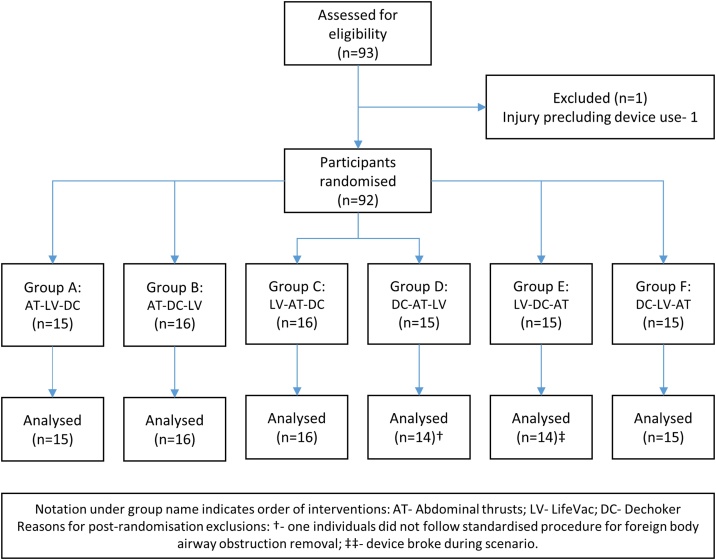
We randomised participants from a UK medical school to one of six groups which determined the order in which participants attempted the three techniques (abdominal thrusts; LifeVac, Nesconset, New York, USA; Dechoker, Concord North Carolina, USA). Randomisation was performed using an online randomisation system. Following brief training, participants sought to remove a foreign body airway obstruction from a manikin using the allocated technique. The primary outcome was successful removal of the foreign body. Usability was assessed in a questionnaire following the three simulations.
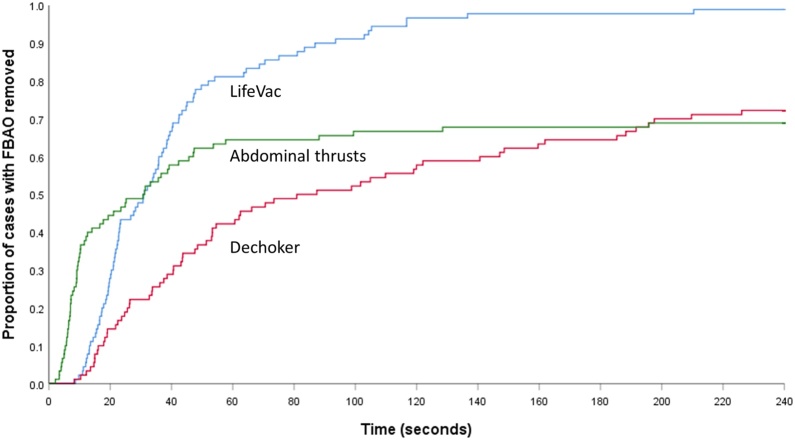
We randomised and analysed data from 90 participants (58% male; 86% aged 18-29 years). Compared with abdominal thrusts, successful foreign body airway obstruction removal was achieved more frequently in manikins in the LifeVac group (odds ratio 47.32, 95% CI 5.75-389.40) but not in the Dechoker group (odds ratio 1.22, 95% CI 0.60-2.47). The usability of LifeVac and abdominal thrusts were generally evaluated more positively than the Dechoker.
In this manikin study, we found that, compared with abdominal thrusts, the success rate for foreign body airway obstruction removal was higher in the LifeVac group but not in the Dechoker group.
新开发的基于吸力的气道清理设备可能为改善异物气道阻塞患者的治疗效果提供一种新方法。我们进行了一项随机对照交叉人体模型试验,以比较其中两种设备与腹部冲击法的有效性和可用性。
我们将来自英国一所医学院的参与者随机分为六组,每组决定参与者尝试三种技术(腹部冲击法;LifeVac,美国纽约州内斯肯塞特;Dechoker,美国北卡罗来纳州康科德)的顺序。使用在线随机系统进行随机分组。经过简短培训后,参与者使用指定技术试图清除人体模型的异物气道阻塞。主要结局是成功清除异物。在三次模拟后通过问卷调查评估可用性。
我们对90名参与者(58%为男性;86%年龄在18 - 29岁之间)的数据进行了随机分组和分析。与腹部冲击法相比,LifeVac组的人体模型中异物气道阻塞清除成功率更高(优势比47.32,95%置信区间5.75 - 389.40),但Dechoker组并非如此(优势比1.22,95%置信区间0.60 - 2.47)。与Dechoker相比,LifeVac和腹部冲击法的可用性总体评价更为积极。
在这项人体模型研究中,我们发现,与腹部冲击法相比,LifeVac组清除异物气道阻塞的成功率更高,但Dechoker组并非如此。