Zhang Haiqin, Hojo Hidehiro, Parshuram Raturi Vijay, Nakamura Naoki, Nakamura Masaki, Okumura Masayuki, Hirano Yasuhiro, Motegi Atsushi, Kageyama Shun-Ichiro, Zenda Sadamoto, Akimoto Tetsuo
Department of Oncology, Jinan Central Hospital, Cheeloo College of Medicine, Shandong University, Jinan, Shandong, P.R. China.
Department of Oncology, Jinan Central Hospital Affiliated to Shandong First Medical University, Jinan, Shandong, P.R. China.
Palliat Med Rep. 2020 Sep 29;1(1):201-207. doi: 10.1089/pmr.2020.0027. eCollection 2020.
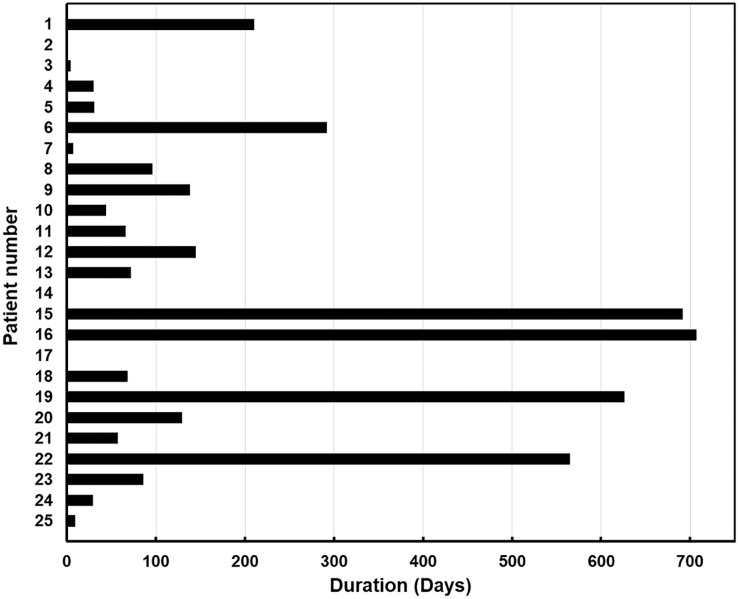
To assess the efficacy and toxicity profiles of palliative radiation therapy (RT) for macroscopic hematuria (MH) caused by urothelial cancer. A total of 25 urothelial cancer patients with MH who underwent palliative RT between 2008 and 2018 were analyzed in this retrospective study. The hematuria-free survival (HFS) time was defined as the period from complete resolution of MH to the recurrence of MH, death, or the last follow-up examination. Adverse events were classified according to the Common Terminology Criteria for Adverse Events version 4.0. By the end of the median follow-up duration of 90 days (11-886 days), complete resolution of MH had been achieved in 22 patients (88%), and the median interval between the start of RT and resolution of MH was 9 days (2-179 days). Of the 22 patients in whom the symptom resolved, 9 (41%) developed recurrent MH, and the median time to relapse of MH was 129 days (30-692 days). The median RT dose was 30 Gy (20-40 Gy). Nine (36%) patients received a blood transfusion before the RT. The three-month HFS rate was 52.1%. There was a significant difference in the three-month HFS rate between patients with and without a history of pretreatment blood transfusion (HFS rate: 34.6% vs. 61.5%, = 0.03). Grade 2 urinary tract pain and grade 3 diarrhea were seen in one patient each. Palliative RT appeared to be effective with limited toxicities for urothelial cancer patients with MH.
评估姑息性放射治疗(RT)对尿路上皮癌所致肉眼血尿(MH)的疗效和毒性特征。本回顾性研究分析了2008年至2018年间接受姑息性RT的25例患有MH的尿路上皮癌患者。无血尿生存期(HFS)定义为从MH完全缓解至MH复发、死亡或最后一次随访检查的时间段。不良事件根据《不良事件通用术语标准》第4.0版进行分类。在中位随访期90天(11 - 886天)结束时,22例患者(88%)实现了MH的完全缓解,RT开始至MH缓解的中位间隔时间为9天(2 - 179天)。在症状缓解的22例患者中,9例(41%)出现了复发性MH,MH复发的中位时间为129天(30 - 692天)。RT的中位剂量为30 Gy(20 - 40 Gy)。9例(36%)患者在RT前接受了输血。三个月的HFS率为52.1%。有预处理输血史和无预处理输血史的患者在三个月HFS率上存在显著差异(HFS率:34.6%对61.5%,P = 0.03)。1例患者出现2级尿路疼痛,1例患者出现3级腹泻。姑息性RT对患有MH的尿路上皮癌患者似乎有效且毒性有限。