Department of Psychiatry, University of Oxford, Oxford, UK.
Oxford Health NHS Foundation Trust, Oxford, UK.
Transl Psychiatry. 2021 Jun 17;11(1):367. doi: 10.1038/s41398-021-01477-6.
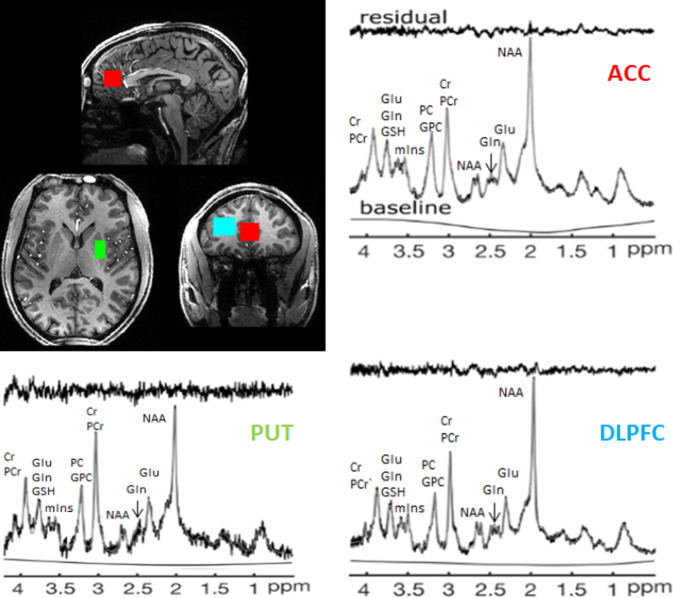
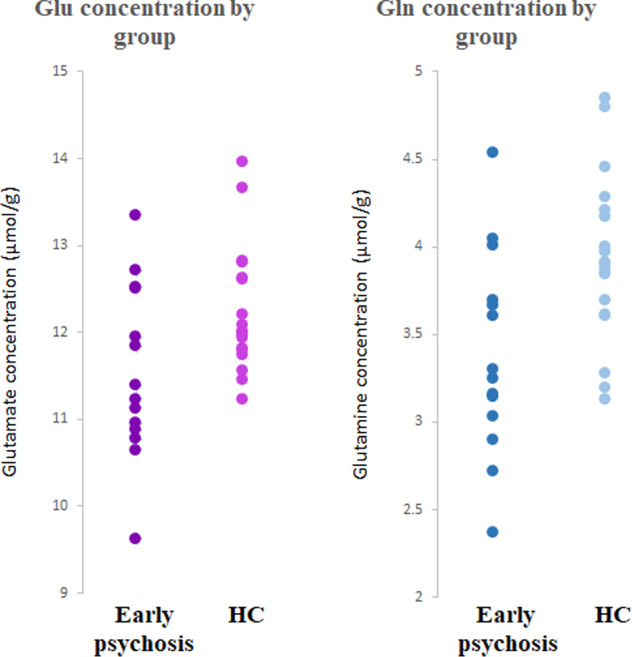
Abnormalities in glutamate neurotransmission are linked to psychotic symptoms and cognitive dysfunction in schizophrenia. magnetic resonance spectroscopy (MRS) provides an acceptable means of measuring glutamate in the human brain but findings from patient studies at conventional magnetic field strength show considerable heterogeneity. Ultra-high-field MRS offers greater precision in glutamate measurement, particularly in delineation of glutamate from its precursor and metabolite, glutamine. This study aimed to use high-field (7 T) MRS to measure concentrations of glutamate and glutamine in three brain regions, anterior cingulate cortex (ACC), dorsolateral prefrontal cortex (DLPFC) and putamen (PUT), in young men with early psychosis. MRS was performed in 17 male participants with early psychosis and 18 healthy age-matched controls. Neurometabolite levels were calculated with unsuppressed water signal as the reference and corrected for individual grey matter, white matter and cerebrospinal fluid concentration. Cognitive function was measured with the Brief Assessment of Cognition in Schizophrenia (BACS). Compared to controls, patients with early psychosis had lower concentrations of glutamate and glutamine in ACC. No differences were apparent in the DLPFC and PUT. In patients with early psychosis, there was a highly significant correlation between glutamate concentration in ACC and performance on the BACS, though the numbers available for this analysis were small. Our finding of lower glutamate levels in ACC in patients with schizophrenia is consistent with a recent meta-analysis of 7 T studies and suggests that this abnormality is present in both patients with early psychosis and those with longer-established illness. The possible link between ACC glutamate and cognitive performance requires replication in larger studies.
谷氨酸神经传递异常与精神分裂症的精神病症状和认知功能障碍有关。磁共振波谱(MRS)提供了一种可接受的测量人脑谷氨酸的方法,但在常规磁场强度下进行的患者研究的结果显示出相当大的异质性。超高场 MRS 提供了更精确的谷氨酸测量,特别是在区分谷氨酸与其前体和代谢物谷氨酰胺方面。本研究旨在使用高场(7T)MRS 测量早期精神病男性患者三个脑区(前扣带皮层(ACC)、背外侧前额叶皮层(DLPFC)和壳核(PUT))中的谷氨酸和谷氨酰胺浓度。MRS 在 17 名患有早期精神病的男性参与者和 18 名年龄匹配的健康对照组中进行。神经代谢物水平是用未抑制的水信号作为参考计算的,并针对个体灰质、白质和脑脊液浓度进行了校正。认知功能采用简明精神分裂症认知评估(BACS)进行测量。与对照组相比,早期精神病患者的 ACC 中谷氨酸和谷氨酰胺浓度较低。在 DLPFC 和 PUT 中没有明显差异。在早期精神病患者中,ACC 中的谷氨酸浓度与 BACS 上的表现之间存在高度显著的相关性,尽管进行此分析的可用数量较少。我们在精神分裂症患者的 ACC 中发现谷氨酸水平较低的发现与最近的 7T 研究荟萃分析一致,表明这种异常存在于早期精神病患者和病程较长的患者中。ACC 谷氨酸与认知表现之间的可能联系需要在更大的研究中进行复制。