Sciacchitano Salvatore, Sacconi Andrea, De Vitis Claudia, Blandino Giovanni, Piaggio Giulia, Salvati Valentina, Napoli Christian, Marchetti Paolo, Taurelli Beatrice Salimbeni, Coluzzi Flaminia, Rocco Monica, Vecchione Andrea, Anibaldi Paolo, Marcolongo Adriano, Ciliberto Gennaro, Mancini Rita, Capalbo Carlo
Department of Clinical and Molecular Medicine, Sapienza University of Rome, via di Grottarossa 1035-1039, 00189, Rome, Italy.
Laboratory of Biomedical Research, Niccolò Cusano University Foundation, Rome, Italy.
Cell Death Discov. 2021 Jun 25;7(1):158. doi: 10.1038/s41420-021-00541-w.
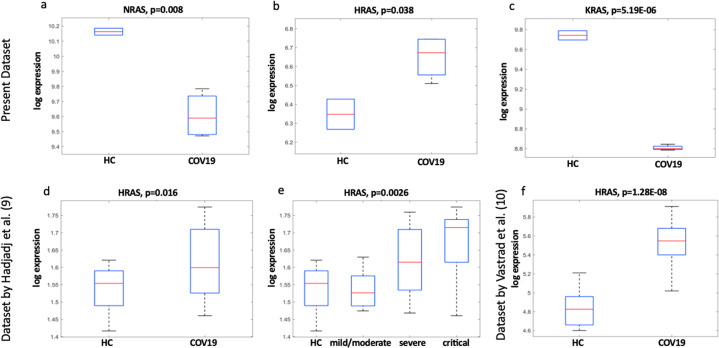
Ras gene family members play a relevant role in cancer, especially when they are mutated. However, they may play additional roles in other conditions beside cancer. We performed gene expression analysis using the NanoString PanCancer IO 360 panel in the peripheral blood mononuclear cell (PBMC) of six COVID-19 patients and we found that H-Ras gene was significantly upregulated, while both K-Ras and N-Ras genes were downregulated. In particular, H-Ras gene upregulation was more evident in COVID-19 patients with a more severe disease. We compared our results with those obtained by analyzing two different and independent datasets, including a total of 53 COVID-19 patients, in which the gene expression analysis was performed using the Immunology_V2 panel. Comparative analysis of the H-Ras gene expression in these patients confirmed our preliminary results. In both of them, in fact, we were able to confirm the upregulation of the expression of the H-Ras gene. The exact role of this specific upregulation of the H-Ras gene in response to SARS-CoV-2 infection and its possible role in cancer still remains to be elucidated. In conclusion, H-Ras gene participates to the host immune response to SARS-CoV-2 virus infection, especially in patients affected by the most severe form of the COVID-19.
Ras基因家族成员在癌症中发挥着重要作用,尤其是当它们发生突变时。然而,它们可能在癌症以外的其他病症中发挥额外作用。我们使用NanoString PanCancer IO 360检测板对6例新冠肺炎患者外周血单个核细胞(PBMC)进行了基因表达分析,发现H-Ras基因显著上调,而K-Ras和N-Ras基因均下调。特别是,H-Ras基因上调在病情更严重的新冠肺炎患者中更为明显。我们将我们的结果与通过分析两个不同且独立的数据集(共53例新冠肺炎患者)所获得的结果进行了比较,在这些数据集中,基因表达分析使用的是Immunology_V2检测板。对这些患者中H-Ras基因表达的比较分析证实了我们的初步结果。事实上,在这两个数据集中,我们都能够确认H-Ras基因表达上调。H-Ras基因这种特定上调在应对SARS-CoV-2感染时的确切作用及其在癌症中的可能作用仍有待阐明。总之,H-Ras基因参与了宿主对SARS-CoV-2病毒感染的免疫反应,尤其是在受最严重形式新冠肺炎影响的患者中。