Imaging Department, Royal Orthopaedic Hospital, Birmingham, B31 2AP, UK.
Imaging Department, Bristol Royal Infirmary, Bristol, BS7 0QA, UK.
Skeletal Radiol. 2022 Mar;51(3):557-564. doi: 10.1007/s00256-021-03857-x. Epub 2021 Jul 6.
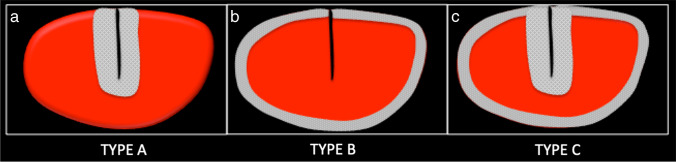
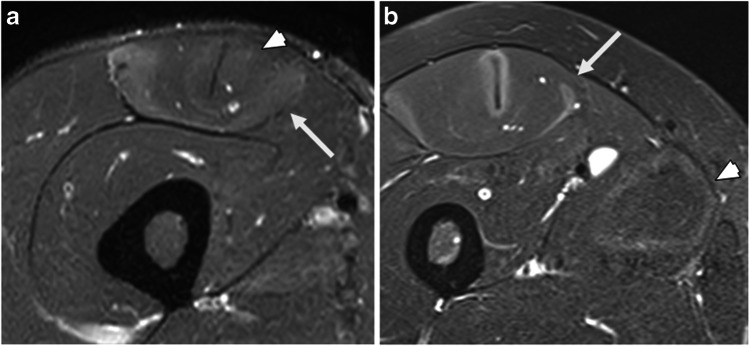
This study aims to describe the prevalence, anatomy and morphology of ERSA (exercise-related signal abnormality) lesions, a previously undescribed pattern of muscle signal changes on MRI in professional soccer players with suspected acute thigh muscle injury.
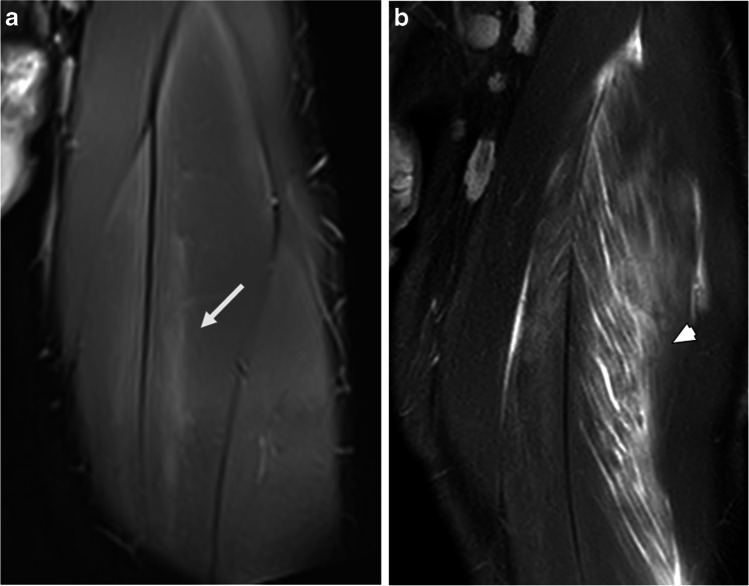
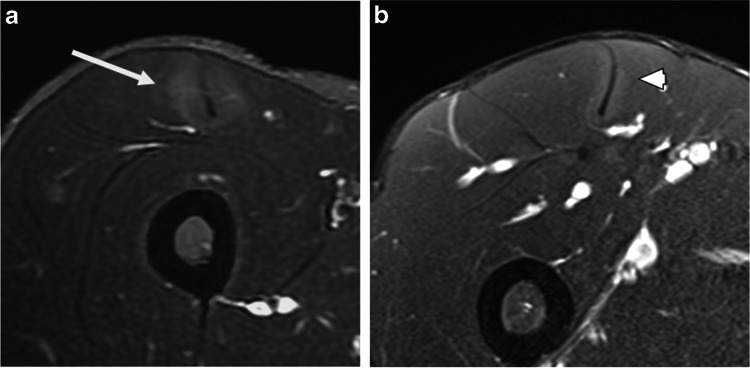
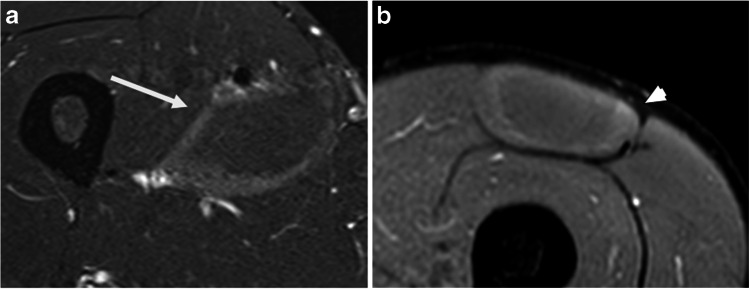
A multicenter retrospective review was performed of 287 MRIs of professional soccer players referred for suspected acute thigh injury from August 2017 to February 2020. MR images were reviewed for muscle signal abnormalities corresponding to a peritendinous ovoid region or a subfascial ring of faint increased signal on fluid-sensitive MR images. Imaging features including anatomical site, morphology, and craniocaudal length were recorded. Concomitant acute muscle injury was graded in accordance with the British Athletics Muscle Injury Classification (BAMIC).
ERSA lesions comprising a peritendinous ovoid region, a subfascial ring, or both, were identified in 40 muscles across 31/287 studies (10.8%). These lesions had a mean length of 15.8 cm and were predominantly located in the proximal or mid-portions of muscles. Affected muscles were rectus femoris (n = 22), adductor longus (n = 11), semitendinosus (n = 6) and biceps femoris (n = 1). 21/31 studies (67.7%) had a BAMIC grade 1-4 injury in a separate muscle, which were largely (81%) in a separate anatomic compartment or contralateral.
ERSA lesions were evident on MRI in 10.8% of our cohort of professional soccer players referred for suspected acute thigh muscle injury. Characteristic morphology and the longitudinal length (mean 15.8 cm) distinguish ERSA lesions from recognized patterns of acute muscle injury.
本研究旨在描述 ERSA(与运动相关的信号异常)病变的患病率、解剖结构和形态,这是一种在疑似急性大腿肌肉损伤的职业足球运动员的 MRI 上以前未描述的肌肉信号变化模式。
对 2017 年 8 月至 2020 年 2 月期间因疑似急性大腿损伤而转诊的 287 名职业足球运动员的 MRI 进行了多中心回顾性研究。对 MRI 图像进行了检查,以寻找与肌腱周围卵圆形区域或筋膜下环形的微弱高信号相对应的肌肉信号异常。记录了影像学特征,包括解剖部位、形态和头尾长度。根据英国田径肌肉损伤分类(BAMIC)对急性肌肉损伤进行分级。
在 31/287 项研究(10.8%)的 40 块肌肉中发现了 ERSA 病变,包括肌腱周围卵圆形区域、筋膜下环形或两者均有。这些病变的平均长度为 15.8cm,主要位于肌肉的近端或中部。受影响的肌肉有股直肌(n=22)、长收肌(n=11)、半腱肌(n=6)和股二头肌(n=1)。在 31 项研究中有 21 项(67.7%)在另一块肌肉中存在 BAMIC 1-4 级损伤,这些损伤主要位于另一解剖部位或对侧(81%)。
在我们的职业足球运动员疑似急性大腿肌肉损伤转诊队列中,10.8%的患者在 MRI 上出现 ERSA 病变。特征性形态和纵向长度(平均 15.8cm)将 ERSA 病变与公认的急性肌肉损伤模式区分开来。