RTI International, Washington, District of Columbia, United States of America.
Division of Epidemiology and Public Health, School of Medicine, University of Nottingham, Nottingham, United Kingdom.
PLoS Negl Trop Dis. 2021 Jul 6;15(7):e0009535. doi: 10.1371/journal.pntd.0009535. eCollection 2021 Jul.
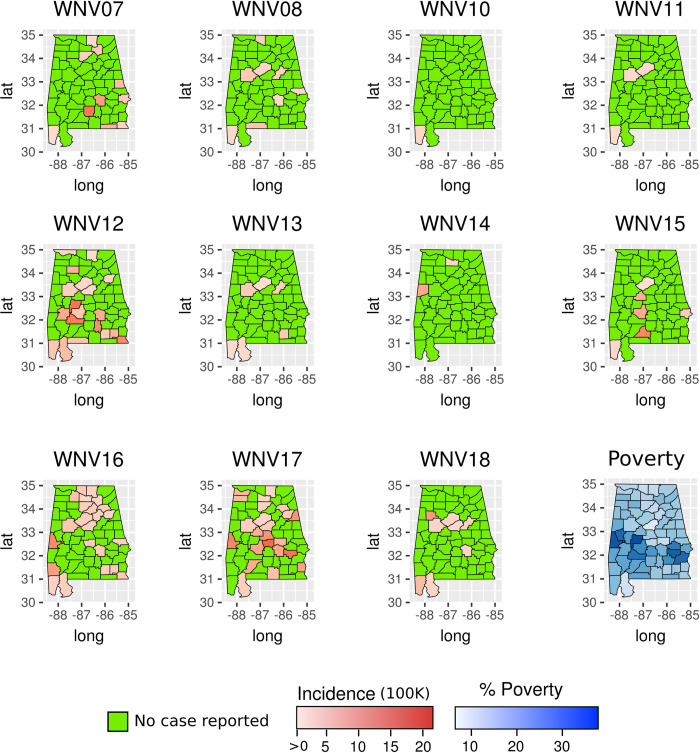
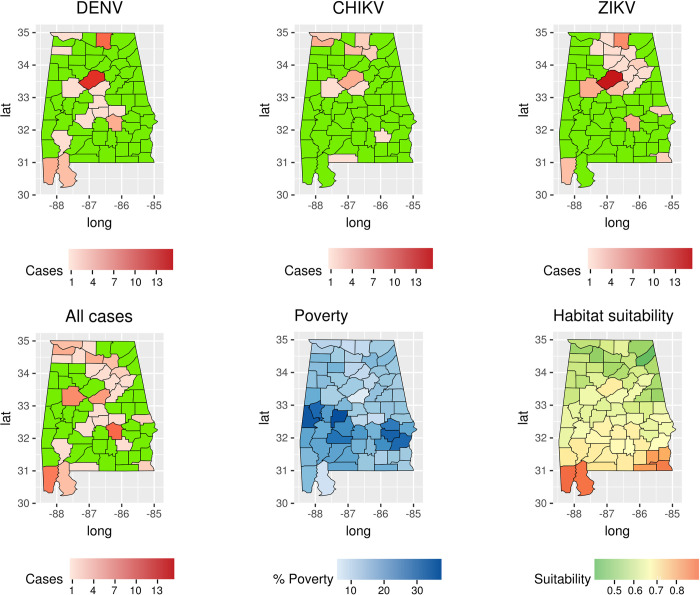
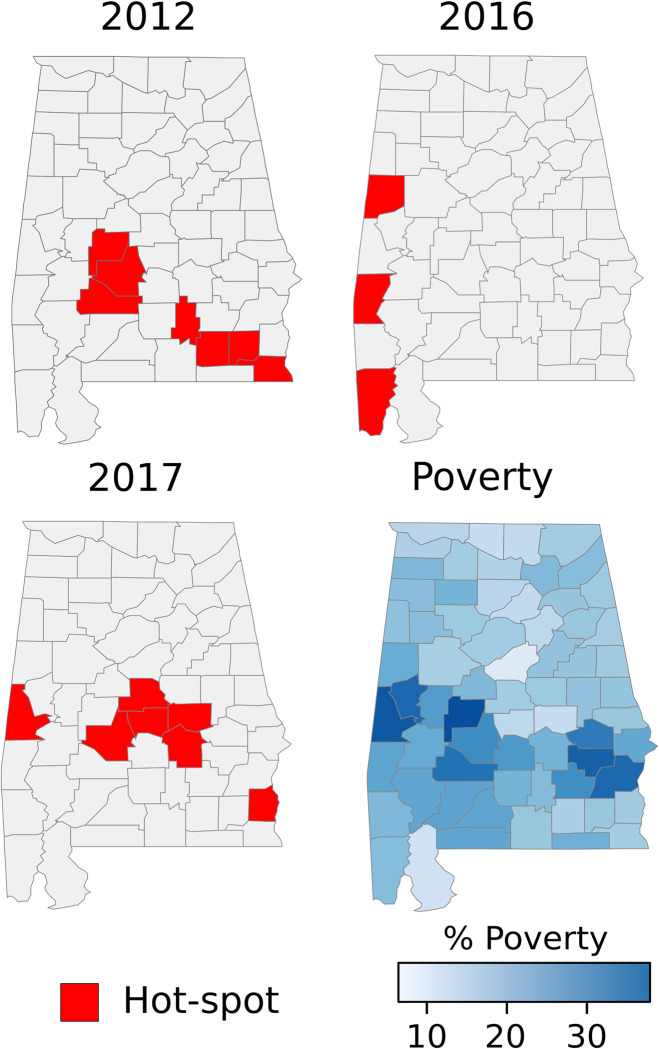
Mosquito-borne viruses cause diseases of great public health concern. Arboviral disease case distributions have complex relationships with socioeconomic and environmental factors. We combined information about socio-economic (population, and poverty rate) and environmental (precipitation, and land use) characteristics with reported human cases of arboviral disease in the counties of Alabama, USA, from 2007-2017. We used county level data on West Nile virus (WNV), dengue virus (DENV), chikungunya virus (CHIKV), Zika virus (ZIKV), California serogroup virus, Eastern equine encephalitis virus, and Saint Louis encephalitis virus to provide a detailed description of their spatio-temporal pattern. We found a significant spatial convergence between incidence of WNV and poverty rate clustered in the southern part of Alabama. DENV, CHIKV and ZIKV cases showed a different spatial pattern, being mostly located in the northern part, in areas of high socioeconomic status. The results of our study establish that poverty-driven inequities in arboviral risk exist in the southern USA, and should be taken into account when planning prevention and intervention strategies.
蚊媒病毒引起的疾病对公众健康具有重大影响。虫媒病毒病的病例分布与社会经济和环境因素有着复杂的关系。我们结合了美国阿拉巴马州 2007-2017 年报告的虫媒病毒病的社会经济(人口和贫困率)和环境(降水和土地利用)特征信息与报告的人类病例。我们使用了西尼罗河病毒(WNV)、登革热病毒(DENV)、基孔肯雅热病毒(CHIKV)、寨卡病毒(ZIKV)、加利福尼亚血清群病毒、东部马脑炎病毒和圣路易斯脑炎病毒的县级数据,以详细描述它们的时空模式。我们发现,WNV 的发病率与贫困率之间存在显著的空间趋同,这一现象集中在阿拉巴马州的南部。DENV、CHIKV 和 ZIKV 的病例呈现出不同的空间模式,主要分布在北部,在社会经济地位较高的地区。本研究的结果表明,美国南部存在由贫困驱动的虫媒病毒风险的不平等现象,在规划预防和干预策略时应考虑到这一点。