Aging Research Center, Department of Neurobiology, Care Sciences and Society, Karolinska Institutet and Stockholm University, Stockholm, Sweden.
Stockholm Gerontology Research Center, Stockholm, Sweden.
Age Ageing. 2021 Nov 10;50(6):2183-2191. doi: 10.1093/ageing/afab138.
the aim of this study was to examine the cross-sectional and longitudinal associations of different multimorbidity patterns with physical frailty in older adults.
we used data from the Swedish National study on Aging and Care in Kungsholmen to generate a physical frailty measure, and clusters of participants with similar multimorbidity patterns were identified through fuzzy c-means cluster analyses. The cross-sectional association (n = 2,534) between multimorbidity clusters and physical frailty was measured through logistic regression analyses. Six- (n = 2,122) and 12-year (n = 2,140) longitudinal associations were determined through multinomial logistic regression analyses.
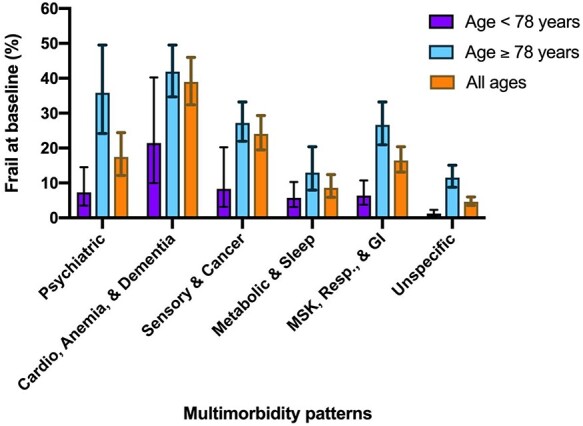
six multimorbidity patterns were identified at baseline: psychiatric diseases; cardiovascular diseases, anaemia and dementia; sensory impairments and cancer; metabolic and sleep disorders; musculoskeletal, respiratory and gastrointestinal diseases; and an unspecific pattern lacking any overrepresented diseases. Cross-sectionally, each pattern was associated with physical frailty compared with the unspecific pattern. Over 6 years, the psychiatric diseases (relative risk ratio [RRR]: 3.04; 95% confidence intervals [CI]: 1.59-5.79); cardiovascular diseases, anaemia and dementia (RRR 2.25; 95% CI: 1.13-4.49) and metabolic and sleep disorders (RRR 1.99; 95% CI: 1.25-3.16) patterns were associated with incident physical frailty. The cardiovascular diseases, anaemia and dementia (RRR: 4.81; 95% CI: 1.59-14.60); psychiatric diseases (RRR 2.62; 95% CI: 1.45-4.72) and sensory impairments and cancer (RRR 1.87; 95% CI: 1.05-3.35) patterns were more associated with physical frailty, compared with the unspecific pattern, over 12 years.
we found that older adults with multimorbidity characterised by cardiovascular and neuropsychiatric disease patterns are most susceptible to developing physical frailty.
本研究旨在探讨不同多种疾病模式与老年人身体虚弱的横断面和纵向关联。
我们使用瑞典 Kungsholmen 老龄化和护理国家研究的数据生成身体虚弱测量值,并通过模糊 c-均值聚类分析确定具有相似多种疾病模式的参与者聚类。通过逻辑回归分析测量横断面关联(n=2534)。通过多项逻辑回归分析确定 6 年(n=2122)和 12 年(n=2140)纵向关联。
在基线时确定了六种多种疾病模式:精神疾病;心血管疾病、贫血和痴呆;感觉障碍和癌症;代谢和睡眠障碍;肌肉骨骼、呼吸和胃肠道疾病;以及缺乏任何代表性疾病的非特异性模式。与非特异性模式相比,每种模式在横截面上都与身体虚弱相关。在 6 年期间,精神疾病(相对风险比 [RRR]:3.04;95%置信区间 [CI]:1.59-5.79);心血管疾病、贫血和痴呆(RRR 2.25;95% CI:1.13-4.49)和代谢和睡眠障碍(RRR 1.99;95% CI:1.25-3.16)模式与身体虚弱的发生相关。心血管疾病、贫血和痴呆(RRR:4.81;95% CI:1.59-14.60);精神疾病(RRR 2.62;95% CI:1.45-4.72)和感觉障碍和癌症(RRR 1.87;95% CI:1.05-3.35)模式与非特异性模式相比,与身体虚弱的关联更为密切,随访 12 年。
我们发现,多种疾病模式以心血管和神经精神疾病为特征的老年人最容易出现身体虚弱。