Department of Laboratory Medicine and Pathology, Division of Clinical Biochemistry and Immunology, Mayo Clinic, MN 55905, USA; Center for Individualized Medicine, Mayo Clinic, Rochester, MN 55905, USA.
Department of Laboratory Medicine and Pathology, Division of Clinical Biochemistry and Immunology, Mayo Clinic, MN 55905, USA.
EBioMedicine. 2021 Jul;69:103465. doi: 10.1016/j.ebiom.2021.103465. Epub 2021 Jul 3.
The COVID-19 pandemic caused by severe acute respiratory syndrome-coronavirus 2 (SARS-CoV-2) has overwhelmed health systems worldwide and highlighted limitations of diagnostic testing. Several types of diagnostic tests including RT-PCR-based assays and antigen detection by lateral flow assays, each with their own strengths and weaknesses, have been developed and deployed in a short time.
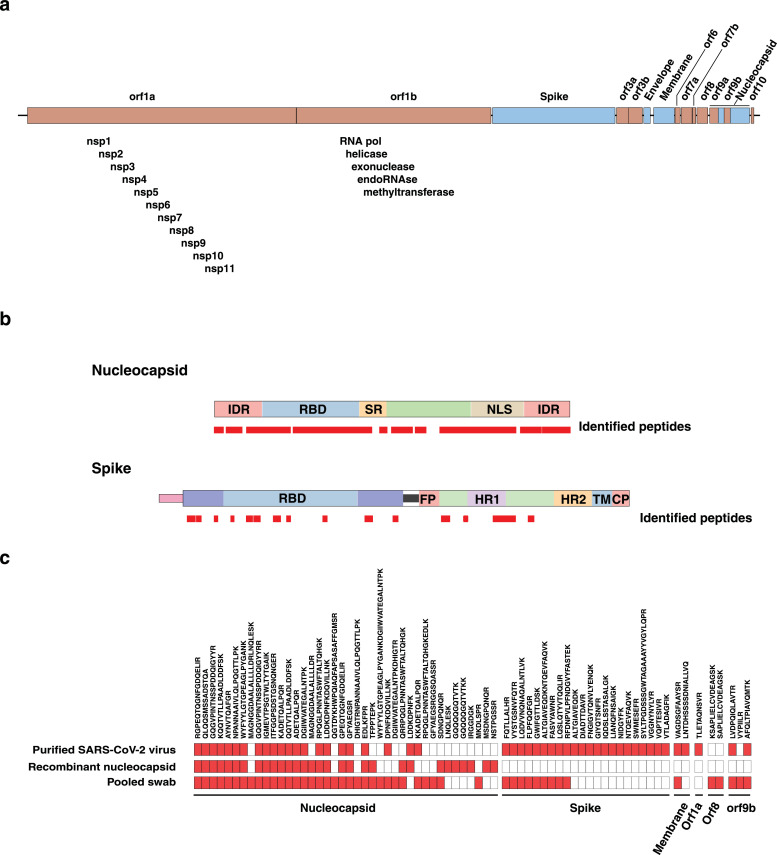
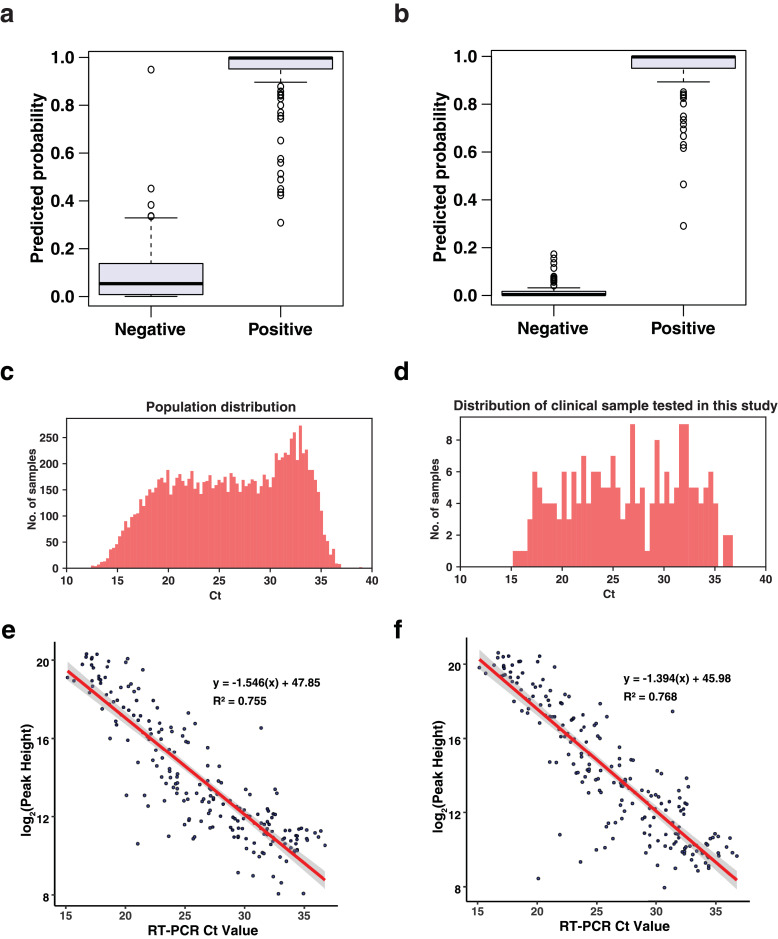
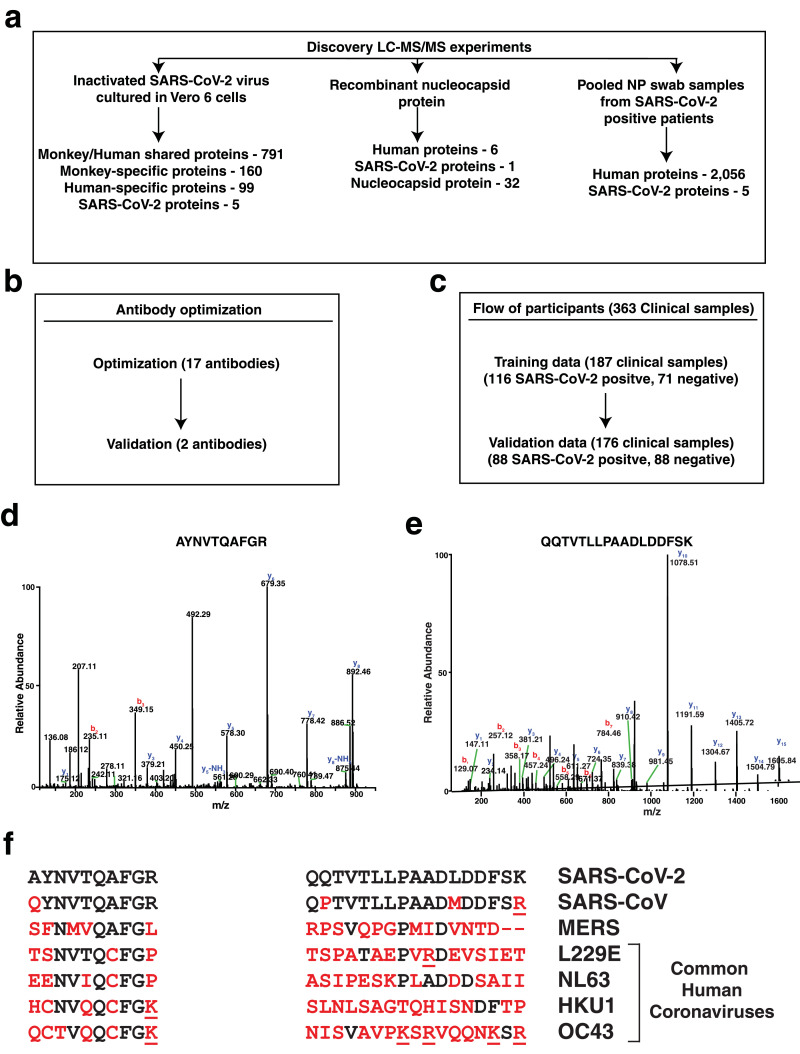
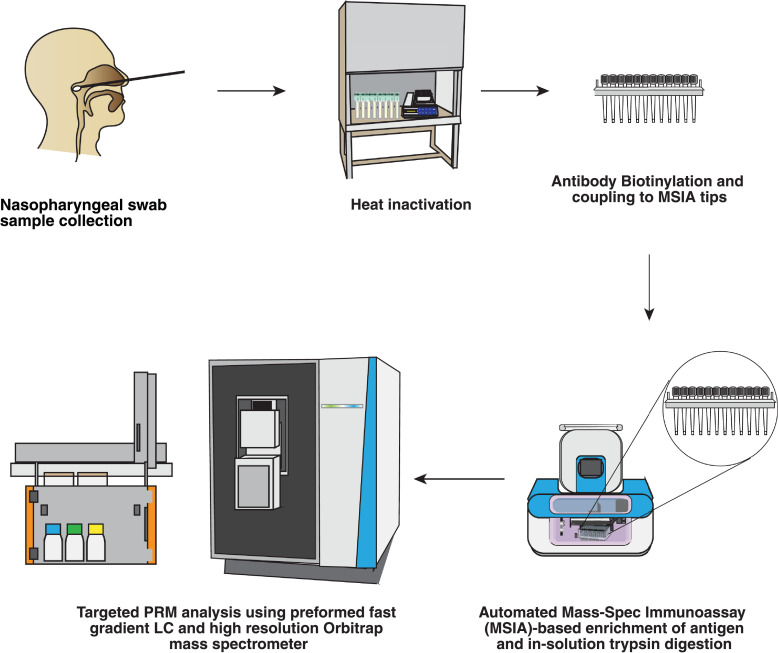
Here, we describe an immunoaffinity purification approach followed a by high resolution mass spectrometry-based targeted qualitative assay capable of detecting SARS-CoV-2 viral antigen from nasopharyngeal swab samples. Based on our discovery experiments using purified virus, recombinant viral protein and nasopharyngeal swab samples from COVID-19 positive patients, nucleocapsid protein was selected as a target antigen. We then developed an automated antibody capture-based workflow coupled to targeted high-field asymmetric waveform ion mobility spectrometry (FAIMS) - parallel reaction monitoring (PRM) assay on an Orbitrap Exploris 480 mass spectrometer. An ensemble machine learning-based model for determining COVID-19 positive samples was developed using fragment ion intensities from the PRM data.
The optimized targeted assay, which was used to analyze 88 positive and 88 negative nasopharyngeal swab samples for validation, resulted in 98% (95% CI = 0.922-0.997) (86/88) sensitivity and 100% (95% CI = 0.958-1.000) (88/88) specificity using RT-PCR-based molecular testing as the reference method.
Our results demonstrate that direct detection of infectious agents from clinical samples by tandem mass spectrometry-based assays have potential to be deployed as diagnostic assays in clinical laboratories, which has hitherto been limited to analysis of pure microbial cultures.
This study was supported by DBT/Wellcome Trust India Alliance Margdarshi Fellowship grant IA/M/15/1/502023 awarded to AP and the generosity of Eric and Wendy Schmidt.
由严重急性呼吸系统综合征冠状病毒 2(SARS-CoV-2)引起的 COVID-19 大流行使全球卫生系统不堪重负,凸显出诊断检测的局限性。在短时间内开发并部署了多种诊断测试,包括基于 RT-PCR 的检测方法和侧向流动检测的抗原检测,每种方法都有其自身的优势和局限性。
在这里,我们描述了一种免疫亲和纯化方法,随后是一种基于高分辨率质谱的靶向定性检测方法,能够从鼻咽拭子样本中检测 SARS-CoV-2 病毒抗原。基于我们使用纯化病毒、重组病毒蛋白和 COVID-19 阳性患者的鼻咽拭子样本进行的发现实验,选择核衣壳蛋白作为靶抗原。然后,我们开发了一种基于抗体自动捕获的工作流程,并结合了 Orbitrap Exploris 480 质谱仪上的靶向高场非对称波形离子迁移谱(FAIMS)-平行反应监测(PRM)检测。使用 PRM 数据的碎片离子强度开发了一种用于确定 COVID-19 阳性样本的基于集成机器学习的模型。
该优化的靶向检测方法用于分析 88 个阳性和 88 个阴性鼻咽拭子样本进行验证,使用基于 RT-PCR 的分子检测作为参考方法,检测灵敏度为 98%(95%CI=0.922-0.997)(86/88),特异性为 100%(95%CI=0.958-1.000)(88/88)。
我们的结果表明,基于串联质谱的检测方法直接从临床样本中检测传染性病原体具有在临床实验室中部署为诊断检测的潜力,而这迄今为止仅限于对纯微生物培养物的分析。
本研究得到 DBT/Wellcome Trust India Alliance Margdarshi 奖学金项目 IA/M/15/1/502023 资助,该项目授予 AP,同时感谢 Eric 和 Wendy Schmidt 的慷慨资助。