Division of Endocrinology and Metabolic Diseases, Department of Advanced Medical and Surgical Sciences, University of Campania Luigi Vanvitelli, Naples, Italy.
Ph.D. of Translational Medicine, Chair of Endocrinology and Metabolic Diseases, Department of Advanced Medical and Surgical Sciences, University of Campania Luigi Vanvitelli, Naples, Italy.
Cardiovasc Diabetol. 2021 Jul 6;20(1):135. doi: 10.1186/s12933-021-01325-3.
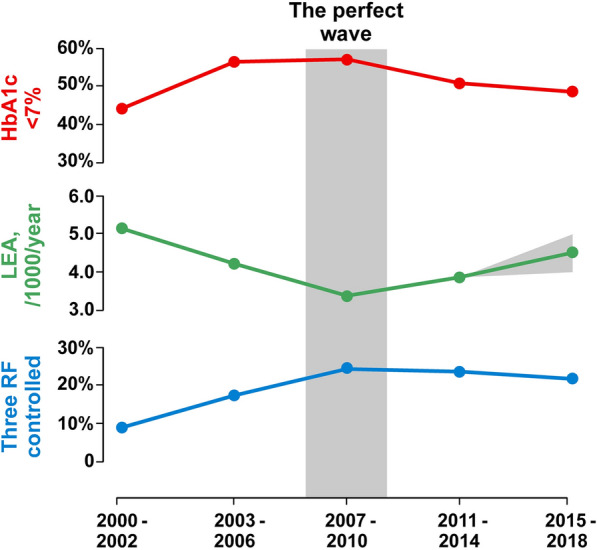
Lower extremity amputations (LEA) are associated with a high mortality and medical expenditure. Diabetes accounts for 45% to 70% of LEA and is one of the most potent risk factors for peripheral artery diseases (PAD). The existence of a link between the recent relaxation of glycemic targets and the resurgence of LEA is suggested from the analysis of adult participants in the National Health and Nutrition Examination Survey (NHANES) between 2010 and 2015, when diabetes-related LEA increased by more than 25% associated with a decline in glycemic control. Indeed, in "the perfect wave" of NHANES, including the years 2007-2010, there was the highest number of diabetic people with hemoglobin A1c (HbA1c), non-high-density lipoprotein (HDL) cholesterol and blood pressure levels at their respective targets, associated with the lowest number of LEA. Until now, the ACCORD study, testing the role of aggressive vs conventional glucose control, and the LEADER trial, evaluating the effects of liraglutide versus placebo, have shown a reduced incidence of LEA in people with type 2 diabetes. The results of ongoing clinical trials involving glucagon-like peptide-1 receptor agonists (GLP-1RA, liraglutide or semaglutide) hopefully will tell us whether the wider use of these drugs may provide additional vascular benefits for diabetic people affected by PAD to decrease their risk of LEA.
下肢截肢(LEA)与高死亡率和医疗支出有关。糖尿病占 LEA 的 45%至 70%,是外周动脉疾病(PAD)的最有力危险因素之一。从 2010 年至 2015 年期间对国家健康和营养检查调查(NHANES)的成年参与者进行的分析表明,血糖目标最近放宽与 LEA 再次出现之间存在联系,因为与血糖控制下降相关,糖尿病相关的 LEA 增加了 25%以上。事实上,在包括 2007-2010 年在内的“NHANES 完美波”中,糖化血红蛋白(HbA1c)、非高密度脂蛋白(HDL)胆固醇和血压水平达到各自目标的糖尿病患者数量最多,同时 LEA 的数量最少。到目前为止,ACCORD 研究测试了强化与常规血糖控制的作用,以及 LEADER 试验评估了利拉鲁肽与安慰剂的效果,都表明 2 型糖尿病患者的 LEA 发生率降低。正在进行的涉及胰高血糖素样肽-1 受体激动剂(GLP-1RA,利拉鲁肽或司美格鲁肽)的临床试验的结果有望告诉我们,这些药物的更广泛使用是否可以为受 PAD 影响的糖尿病患者提供额外的血管益处,以降低他们的 LEA 风险。