From the Ministry of Health (A.J., C.G., F.P., T.F., G.J., A.P., J.A., K.L., F.L., C.S., P.L., P.S., H.G.-E., R.A.), Facultad de Matemáticas (A.J.) and Escuela de Gobierno (E.A.U.), Pontificia Universidad Católica de Chile, Millennium Nucleus Center for the Discovery of Structures in Complex Data (A.J.), Millennium Initiative for Collaborative Research in Bacterial Resistance (E.A.U., R.A.), the Research Center for Integrated Disaster Risk Management (E.A.U.), Instituto de Ciencias e Innovación en Medicina, Facultad de Medicina, Clínica Alemana Universidad del Desarrollo (R.A.), and the Advanced Center for Chronic Diseases (R.A.) - all in Santiago, Chile; and the CIFAR Azrieli Global Scholars Program, CIFAR, Toronto (E.A.U.).
N Engl J Med. 2021 Sep 2;385(10):875-884. doi: 10.1056/NEJMoa2107715. Epub 2021 Jul 7.
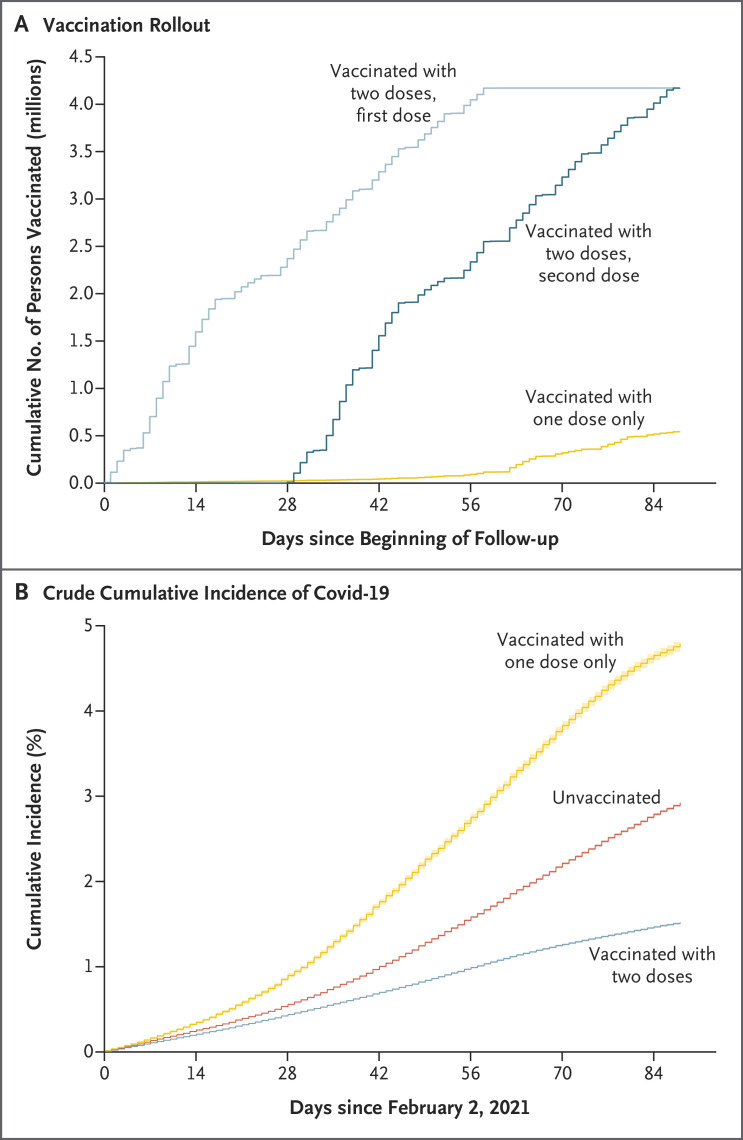
Mass vaccination campaigns to prevent coronavirus disease 2019 (Covid-19) are occurring in many countries; estimates of vaccine effectiveness are urgently needed to support decision making. A countrywide mass vaccination campaign with the use of an inactivated severe acute respiratory syndrome coronavirus 2 (SARS-CoV-2) vaccine (CoronaVac) was conducted in Chile starting on February 2, 2021.
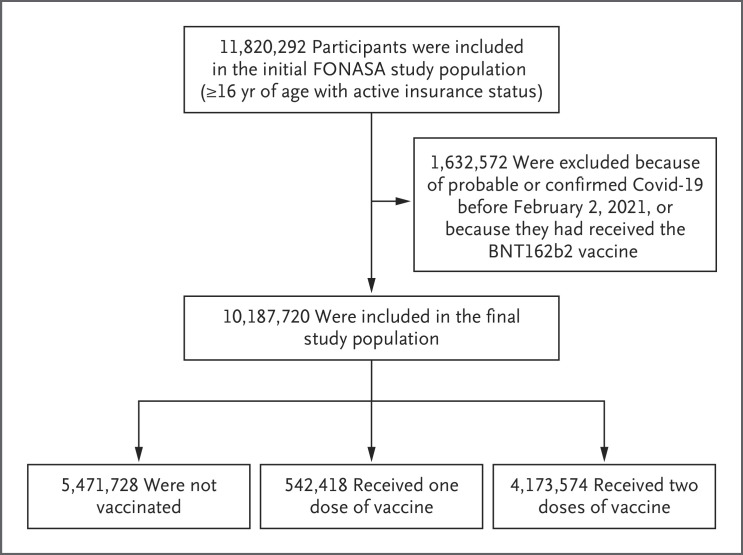
We used a prospective national cohort, including participants 16 years of age or older who were affiliated with the public national health care system, to assess the effectiveness of the inactivated SARS-CoV-2 vaccine with regard to preventing Covid-19 and related hospitalization, admission to the intensive care unit (ICU), and death. We estimated hazard ratios using the extension of the Cox proportional-hazards model, accounting for time-varying vaccination status. We estimated the change in the hazard ratio associated with partial immunization (≥14 days after receipt of the first dose and before receipt of the second dose) and full immunization (≥14 days after receipt of the second dose). Vaccine effectiveness was estimated with adjustment for individual demographic and clinical characteristics.
The study was conducted from February 2 through May 1, 2021, and the cohort included approximately 10.2 million persons. Among persons who were fully immunized, the adjusted vaccine effectiveness was 65.9% (95% confidence interval [CI], 65.2 to 66.6) for the prevention of Covid-19 and 87.5% (95% CI, 86.7 to 88.2) for the prevention of hospitalization, 90.3% (95% CI, 89.1 to 91.4) for the prevention of ICU admission, and 86.3% (95% CI, 84.5 to 87.9) for the prevention of Covid-19-related death.
Our results suggest that the inactivated SARS-CoV-2 vaccine effectively prevented Covid-19, including severe disease and death, a finding that is consistent with results of phase 2 trials of the vaccine. (Funded by Agencia Nacional de Investigación y Desarrollo and others.).
许多国家正在开展大规模疫苗接种活动,以预防 2019 年冠状病毒病(COVID-19);迫切需要评估疫苗的有效性,以支持决策。2021 年 2 月 2 日,智利开始使用一种灭活的严重急性呼吸综合征冠状病毒 2(SARS-CoV-2)疫苗(科兴疫苗)进行全国范围内的大规模疫苗接种活动。
我们使用了一个前瞻性的全国队列,包括年龄在 16 岁及以上、与公共国家卫生保健系统有关联的参与者,评估了灭活的 SARS-CoV-2 疫苗在预防 COVID-19 及相关住院、入住重症监护病房(ICU)和死亡方面的有效性。我们使用 Cox 比例风险模型的扩展来估计危险比,同时考虑疫苗接种状态的时间变化。我们估计了部分免疫(接种第一剂后 14 天及之后、第二剂前)和完全免疫(接种第二剂后 14 天及之后)与危险比变化的关联。根据个人人口统计学和临床特征对疫苗有效性进行了调整。
该研究于 2021 年 2 月 2 日至 5 月 1 日进行,队列中约有 1020 万人。在完全免疫的人群中,调整后的疫苗有效性为预防 COVID-19 的 65.9%(95%置信区间[CI],65.2 至 66.6)和预防住院的 87.5%(95%CI,86.7 至 88.2),预防 ICU 入住的 90.3%(95%CI,89.1 至 91.4)和预防 COVID-19 相关死亡的 86.3%(95%CI,84.5 至 87.9)。
我们的结果表明,灭活的 SARS-CoV-2 疫苗有效预防了 COVID-19,包括严重疾病和死亡,这与该疫苗的 2 期临床试验结果一致。(由国家研究与开发机构和其他机构资助)。