Nakra Tripti, Singh Varsha, Nambirajan Aruna, Malik Prabhat Singh, Mohan Anant, Jain Deepali
Department of Pathology, All India Institute of Medical Sciences, New Delhi, India.
Department of Medical Oncology, Dr B.R. Ambedkar Institute Rotary Cancer Hospital, All India Institute of Medical Sciences, New Delhi, India.
J Pathol Transl Med. 2021 Jul;55(4):279-288. doi: 10.4132/jptm.2021.05.10. Epub 2021 Jul 8.
Thyroid transcription factor (TTF-1) is a diagnostic marker expressed in 75%-85% of primary lung adenocarcinomas (ACs). Activating mutations in the tyrosine kinase domain of the epidermal growth factor receptor (EGFR) gene is the most common targetable driver alteration in lung AC. Previous studies have shown a positive correlation between TTF-1 and EGFR mutation status. We aimed to determine the predictive value of TTF-1 immunoexpression for underlying EGFR mutation status in a large Indian cohort.
This retrospective designed study was conducted with medical record data from 2011 to 2020. All cases of primary lung AC and non-small cell lung carcinoma not otherwise specified (NSCLC, NOS) with known TTF-1 expression diagnosed by immunohistochemistry using 8G7G3/1 antibodies and EGFR mutation status diagnosed by quantitative polymerase chain reaction were retrieved, reviewed, and the results were analyzed.
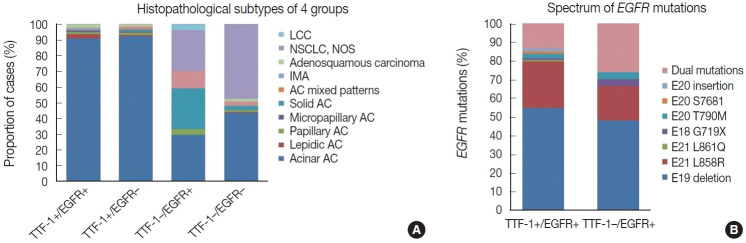
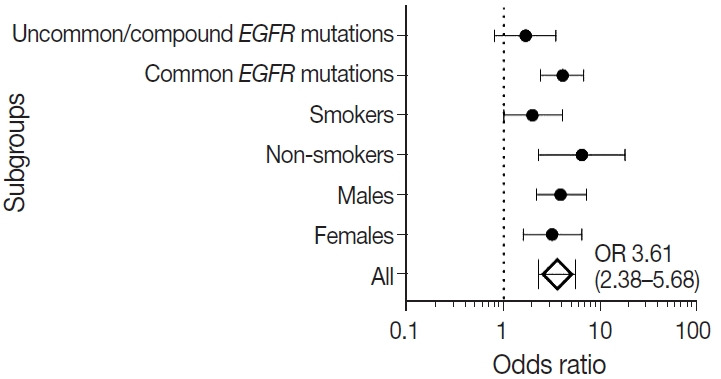
Among 909 patient samples diagnosed as lung AC and NSCLC, NOS, TTF-1 was positive in 76.8% cases (698/909) and EGFR mutations were detected in 29.6% (269/909). A strong positive correlation was present between TTF-1 positivity and EGFR mutation status (odds ratio, 3.61; p < .001), with TTF-1 positivity showing high sensitivity (90%) and negative predictive value (87%) for EGFR mutation. TTF-1 immunoexpression did not show significant correlation with uncommon/dual EGFR mutations (odds ratio, 1.69; p = .098). EGFR-tyrosine kinase inhibitor therapy was significantly superior to chemotherapy among EGFR mutant cases irrespective of TTF-1 status; however, no significant differences among survival outcomes were observed.
Our study confirms a strong positive correlation between TTF-1 expression and common EGFR mutations (exon 19 deletion and exon 21 L858R) in advanced lung AC with significantly high negative predictive value of TTF-1 for EGFR mutations.
甲状腺转录因子(TTF-1)是一种诊断标志物,在75%-85%的原发性肺腺癌(AC)中表达。表皮生长因子受体(EGFR)基因酪氨酸激酶结构域的激活突变是肺AC中最常见的可靶向驱动改变。既往研究显示TTF-1与EGFR突变状态之间存在正相关。我们旨在确定在一个大型印度队列中TTF-1免疫表达对潜在EGFR突变状态的预测价值。
本回顾性设计研究采用2011年至2020年的病历数据。检索、回顾并分析了所有经免疫组织化学使用8G7G3/1抗体诊断为TTF-1表达已知的原发性肺AC和未另行特指的非小细胞肺癌(NSCLC,NOS)病例,以及经定量聚合酶链反应诊断的EGFR突变状态。
在909例诊断为肺AC和NSCLC,NOS的患者样本中,TTF-1在76.8%(698/909)的病例中呈阳性,EGFR突变在29.6%(269/909)的病例中被检测到。TTF-1阳性与EGFR突变状态之间存在强正相关(比值比,3.61;p <.001),TTF-1阳性对EGFR突变显示出高敏感性(90%)和阴性预测值(87%)。TTF-1免疫表达与罕见/双重EGFR突变无显著相关性(比值比,1.69;p =.098)。无论TTF-1状态如何,在EGFR突变病例中,EGFR酪氨酸激酶抑制剂治疗显著优于化疗;然而,生存结局方面未观察到显著差异。
我们的研究证实了在晚期肺AC中TTF-1表达与常见EGFR突变(外显子19缺失和外显子21 L858R)之间存在强正相关,TTF-1对EGFR突变具有显著高的阴性预测值。