Guangdong Provincial Key Laboratory of Malignant Tumor Epigenetics and Gene Regulation, Department of Medical Oncology, Breast Tumor Centre, Phase I Clinical Trial Centre, Sun Yat-sen Memorial Hospital, Sun Yat-sen University, Guangzhou, China.
Department of Breast Surgery, Tungwah Hospital, Sun Yat-sen University, Dongguan, China.
EBioMedicine. 2021 Jul;69:103460. doi: 10.1016/j.ebiom.2021.103460. Epub 2021 Jul 4.
in current clinical practice, the standard evaluation for axillary lymph node (ALN) status in breast cancer has a low efficiency and is based on an invasive procedure that causes operative-associated complications in many patients. Therefore, we aimed to use machine learning techniques to develop an efficient preoperative magnetic resonance imaging (MRI) radiomics evaluation approach of ALN status and explore the association between radiomics and the tumor microenvironment in patients with early-stage invasive breast cancer.
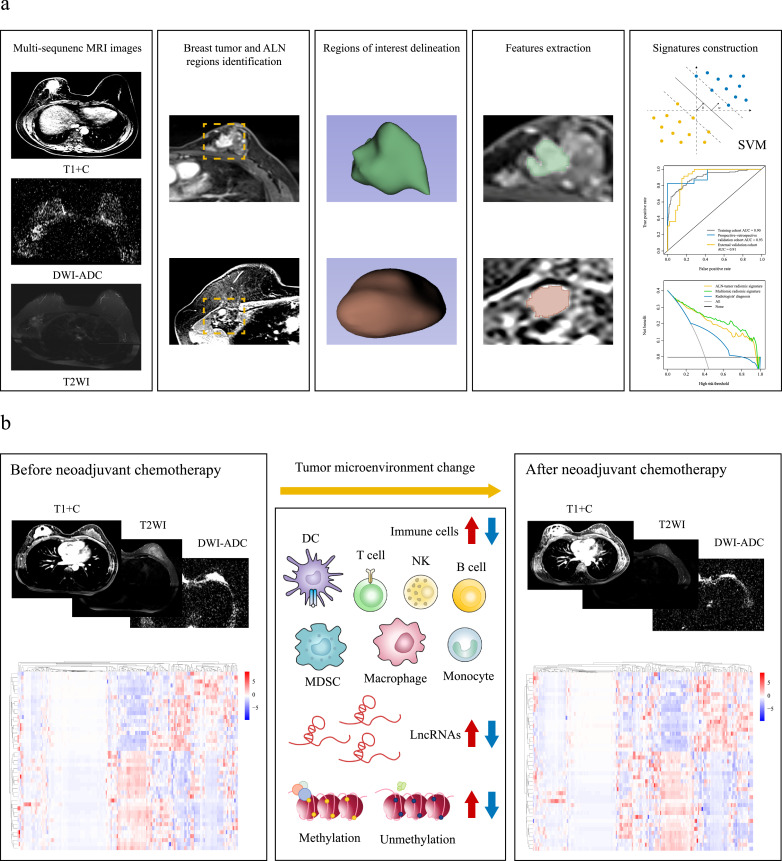
in this retrospective multicenter study, three independent cohorts of patients with breast cancer (n = 1,088) were used to develop and validate signatures predictive of ALN status. After applying the machine learning random forest algorithm to select the key preoperative MRI radiomic features, we used ALN and tumor radiomic features to develop the ALN-tumor radiomic signature for ALN status prediction by the support vector machine algorithm in 803 patients with breast cancer from Sun Yat-sen Memorial Hospital and Sun Yat-sen University Cancer Center (training cohort). By combining ALN and tumor radiomic features with corresponding clinicopathologic information, the multiomic signature was constructed in the training cohort. Next, the external validation cohort (n = 179) of patients from Shunde Hospital of Southern Medical University and Tungwah Hospital of Sun Yat-Sen University, and the prospective-retrospective validation cohort (n = 106) of patients treated with neoadjuvant chemotherapy in prospective phase 3 trials [NCT01503905], were included to evaluate the predictive value of the two signatures, and their predictive performance was assessed by the area under operating characteristic curve (AUC). This study was registered with ClinicalTrials.gov, number NCT04003558.
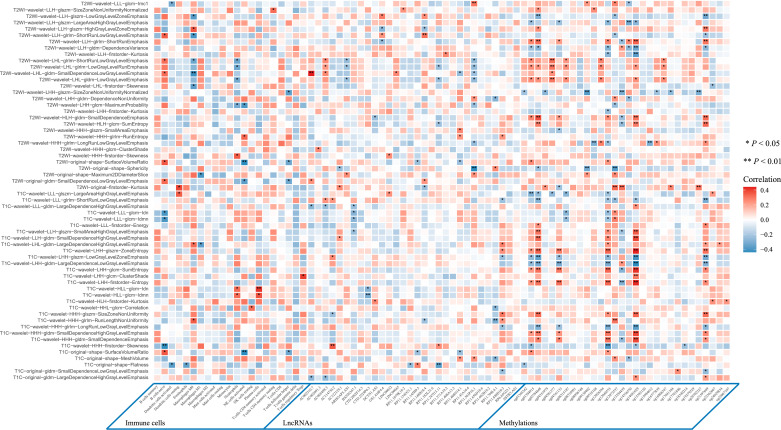
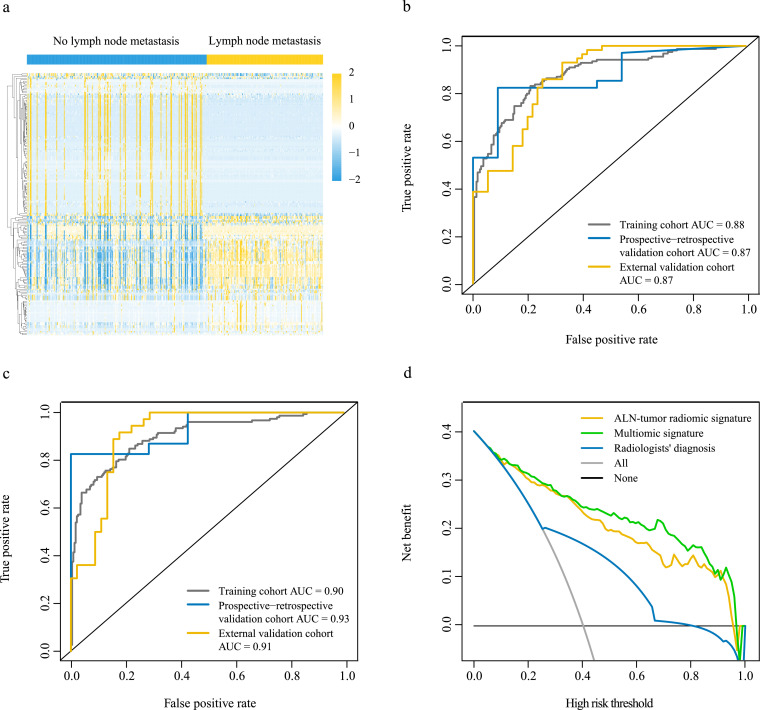
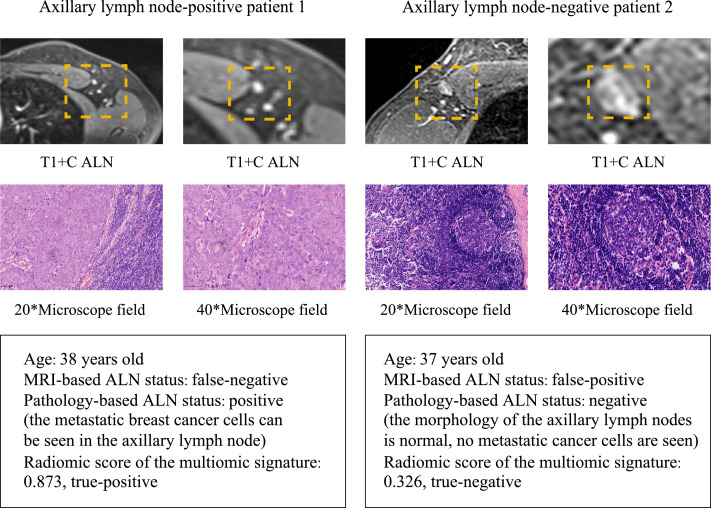
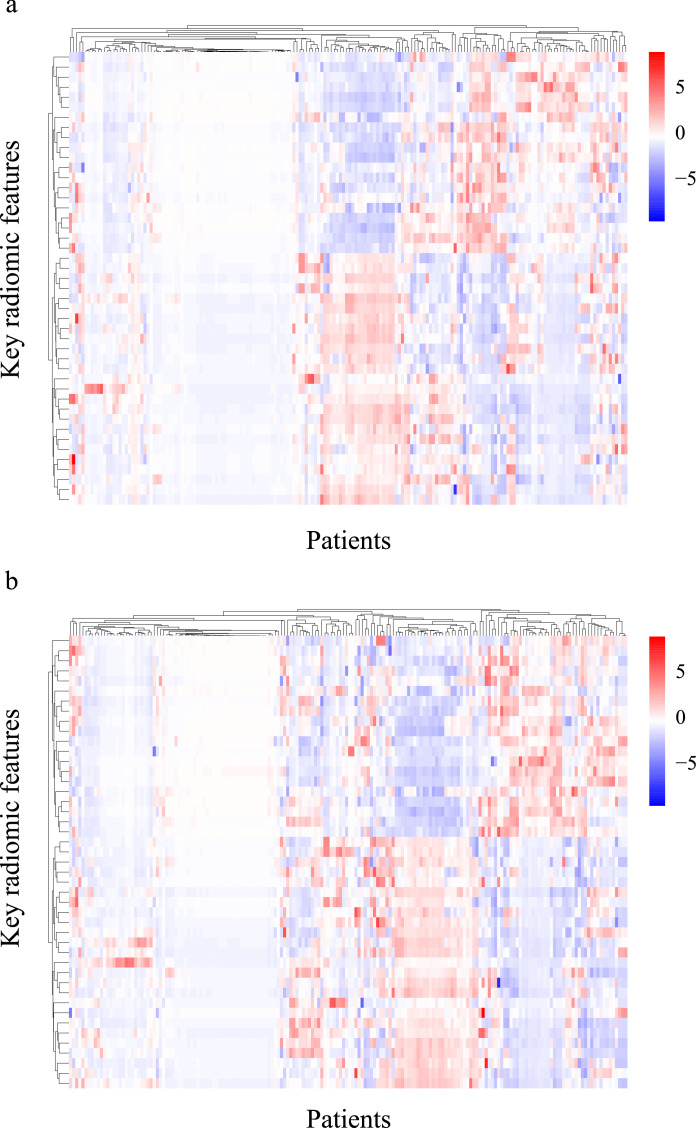
the ALN-tumor radiomic signature for ALN status prediction comprising ALN and tumor radiomic features showed a high prediction quality with AUC of 0·88 in the training cohort, 0·87 in the external validation cohort, and 0·87 in the prospective-retrospective validation cohort. The multiomic signature incorporating tumor and lymph node MRI radiomics, clinical and pathologic characteristics, and molecular subtypes achieved better performance for ALN status prediction with AUCs of 0·90, 0·91, and 0·93 in the training cohort, the external validation cohort, and the prospective-retrospective validation cohort, respectively. Among patients who underwent neoadjuvant chemotherapy in the prospective-retrospective validation cohort, there were significant differences in the key radiomic features before and after neoadjuvant chemotherapy, especially in the gray-level dependence matrix features. Furthermore, there was an association between MRI radiomics and tumor microenvironment features including immune cells, long non-coding RNAs, and types of methylated sites. Interpretation this study presented a multiomic signature that could be preoperatively and conveniently used for identifying patients with ALN metastasis in early-stage invasive breast cancer. The multiomic signature exhibited powerful predictive ability and showed the prospect of extended application to tailor surgical management. Besides, significant changes in key radiomic features after neoadjuvant chemotherapy may be explained by changes in the tumor microenvironment, and the association between MRI radiomic features and tumor microenvironment features may reveal the potential biological underpinning of MRI radiomics.
No funding.
在当前的临床实践中,腋窝淋巴结(ALN)状态的标准评估效率低下,且基于一种会在许多患者中引起手术相关并发症的侵入性操作。因此,我们旨在使用机器学习技术开发一种有效的术前磁共振成像(MRI)放射组学 ALN 状态评估方法,并探讨放射组学与早期浸润性乳腺癌患者肿瘤微环境之间的关联。
本回顾性多中心研究纳入了三批乳腺癌患者队列(n=1088),用于开发和验证预测 ALN 状态的特征。我们应用机器学习随机森林算法选择关键的术前 MRI 放射组学特征,然后使用 ALN 和肿瘤放射组学特征,通过支持向量机算法,在中山大学孙逸仙纪念医院和中山大学肿瘤防治中心的 803 例乳腺癌患者(训练队列)中开发用于预测 ALN 状态的 ALN-肿瘤放射组学特征。通过结合 ALN 和肿瘤放射组学特征与相应的临床病理信息,我们在训练队列中构建了多组学特征。然后,纳入南方医科大学顺德医院和中山大学孙逸仙纪念医院的患者外部验证队列(n=179),以及前瞻性、回顾性验证队列(n=106),该队列患者在前瞻性 III 期临床试验[ NCT01503905]中接受新辅助化疗,以评估这两个特征的预测价值,并通过接受者操作特征曲线下面积(AUC)评估其预测性能。本研究在 ClinicalTrials.gov 上注册,编号为 NCT04003558。
ALN-肿瘤放射组学特征预测 ALN 状态的特征,包括 ALN 和肿瘤放射组学特征,在训练队列中具有 0.88 的高预测质量,在外部验证队列中为 0.87,在前瞻性、回顾性验证队列中为 0.87。纳入肿瘤和淋巴结 MRI 放射组学、临床病理特征和分子亚型的多组学特征,在训练队列、外部验证队列和前瞻性、回顾性验证队列中的 ALN 状态预测中,获得了更好的性能,AUC 分别为 0.90、0.91 和 0.93。在前瞻性、回顾性验证队列中接受新辅助化疗的患者中,新辅助化疗前后关键放射组学特征存在显著差异,尤其是灰度依赖矩阵特征。此外,MRI 放射组学与包括免疫细胞、长链非编码 RNA 和甲基化位点类型在内的肿瘤微环境特征之间存在关联。
本研究提出了一种多组学特征,可以在术前方便地用于识别早期浸润性乳腺癌中的 ALN 转移患者。多组学特征表现出强大的预测能力,并显示出在制定手术管理方案方面的扩展应用前景。此外,新辅助化疗后关键放射组学特征的变化可能是肿瘤微环境变化的结果,MRI 放射组学特征与肿瘤微环境特征之间的关联可能揭示了 MRI 放射组学的潜在生物学基础。
无。