Ouyang Taohui, Zhang Na, Xie Shenhao, Tang Bin, Li Junjun, Xiao Limin, Zhang Fabao, Wu Bowen, Zhou Dongwei, Li Meihua, Hong Tao
Department of Neurosurgery, the First Affiliated Hospital of Nanchang University, Nanchang, China.
Department of Neurology, the First Affiliated Hospital of Nanchang University, Nanchang, China.
Front Oncol. 2021 Jun 21;11:693063. doi: 10.3389/fonc.2021.693063. eCollection 2021.
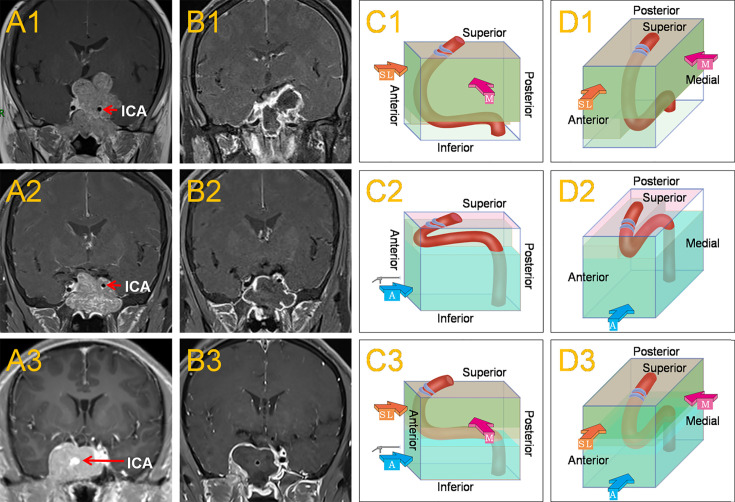
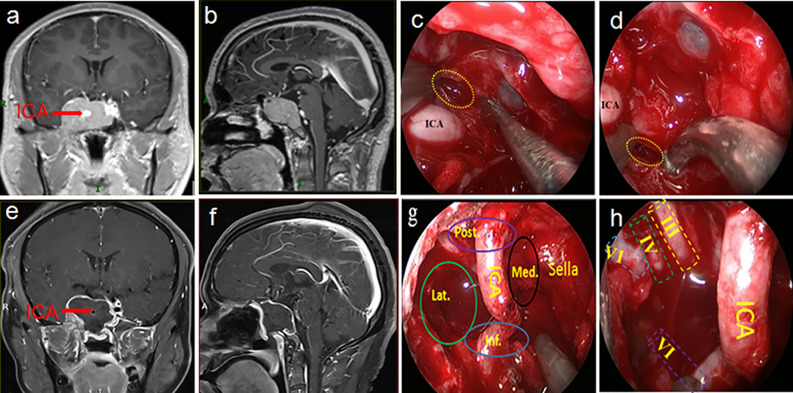
Surgery for pituitary adenomas (PAs) with cavernous sinus (CS) invasion in Knosp grade 4 is a great challenge and whether to adopt a conservative or aggressive surgical strategy is controversial. The aim of this study is to provide the outcomes and complications of an aggressive resection strategy for Knosp grade 4 PAs with transsphenoidal endoscopic surgery. Outcomes and complications were retrospectively analyzed in 102 patients with Knosp grade 4 PAs. Among them, primary PAs were seen in 60 patients and recurrent PAs were seen in 42 cases. Gross total resection (GTR) of the entire tumor was achieved in 72 cases (70.6%), subtotal tumor resection (STR) in 18 cases (17.6%), and partial tumor resection (PTR) in 12 cases (11.8%). Additionally, GTR of the tumor within the CS was achieved in 82 patients (80.4%), STR in 17 patients (16.7%), and PTR in 3 patients (2.9%). Statistical analyses showed that both recurrent tumors and firm consistency tumors were adverse factors for complete resection (P<0.05). Patients with GTR of the entire tumor were more likely to have favorable endocrine and visual outcomes than those with incomplete resection (P<0.05). Overall, the most common surgical complication was new cranial nerve palsy (n=7, 6.8%). The incidence of internal carotid artery (ICA) injury and postoperative cerebrospinal fluid (CSF) leakage was 2.0% (n=2) and 5.9% (n=6), respectively. Six patients (5.9%) experienced tumor recurrence postoperatively. For experienced neuroendoscopists, an aggressive tumor resection strategy transsphenoidal endoscopic surgery may be an effective and safe option for Knosp grade 4 PAs.
对于Knosp 4级海绵窦(CS)侵袭性垂体腺瘤(PA)的手术是一项巨大挑战,采用保守还是积极的手术策略存在争议。本研究旨在提供经蝶窦内镜手术对Knosp 4级PA采取积极切除策略的结果及并发症。对102例Knosp 4级PA患者的结果及并发症进行回顾性分析。其中,60例为原发性PA,42例为复发性PA。72例(70.6%)实现了肿瘤全切除(GTR),18例(17.6%)为次全肿瘤切除(STR),12例(11.8%)为部分肿瘤切除(PTR)。此外,82例(80.4%)患者实现了CS内肿瘤的GTR,17例(16.7%)为STR,3例(2.9%)为PTR。统计分析表明,复发性肿瘤和质地硬的肿瘤均为完全切除的不利因素(P<0.05)。肿瘤全切除的患者比未完全切除的患者更有可能获得良好的内分泌和视力结果(P<0.05)。总体而言,最常见的手术并发症是新发脑神经麻痹(n = 7,6.8%)。颈内动脉(ICA)损伤和术后脑脊液(CSF)漏的发生率分别为2.0%(n = 2)和5.9%(n = 6)。6例(5.9%)患者术后出现肿瘤复发。对于经验丰富的神经内镜医师,经蝶窦内镜手术采取积极的肿瘤切除策略可能是Knosp 4级PA的一种有效且安全的选择。