Dumitriu-Stan Roxana-Ioana, Burcea Iulia-Florentina, Salmen Teodor, Poiana Catalina
Department of Endocrinology, 'Carol Davila' University of Medicine and Pharmacy, 020021 Bucharest, Romania.
Doctoral School of 'Carol Davila' University of Medicine and Pharmacy, 050474 Bucharest, Romania.
Diagnostics (Basel). 2023 Jun 19;13(12):2118. doi: 10.3390/diagnostics13122118.
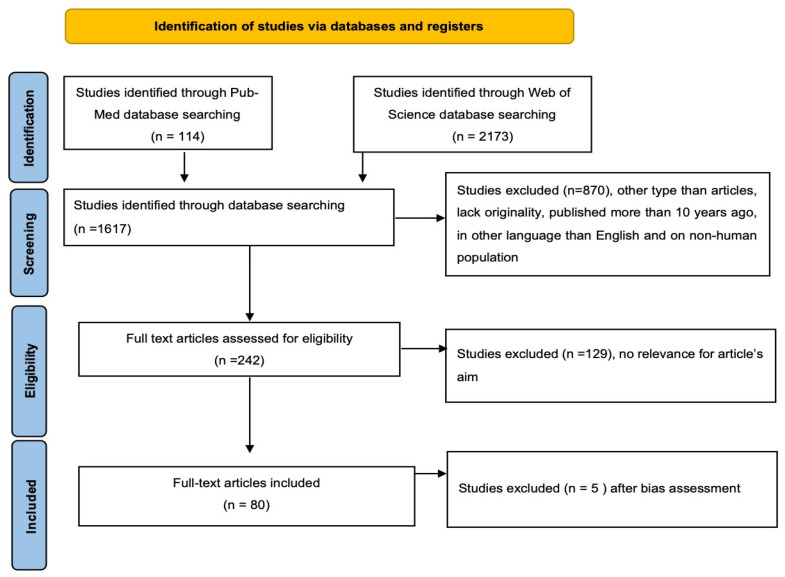
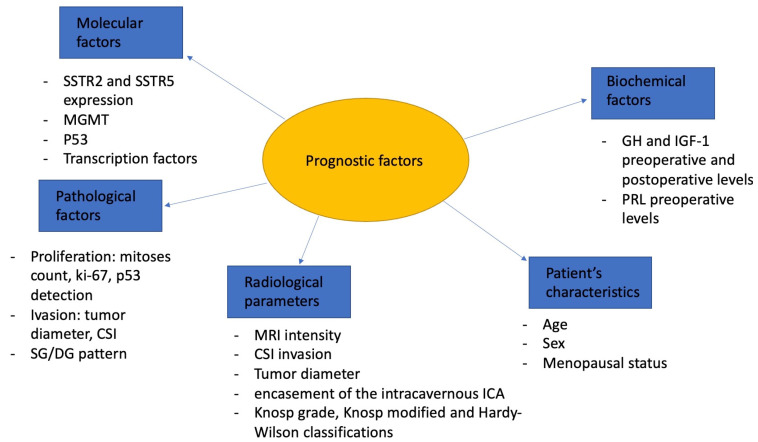
Growth-hormone (GH)- and prolactin (PRL)-secreting PitNETs (pituitary neuroendocrine tumors) are divided into multiple histological subtypes, which determine their clinical and biological variable behavior. Proliferation markers alone have a questionable degree of prediction, so we try to identify validated prognostic models as accurately as possible. (1) Background: The data available so far show that the use of staging and clinical-pathological classification of PitNETs, along with imaging, are useful in predicting the evolution of these tumors. So far, there is no consensus for certain markers that could predict tumor evolution. The application of the WHO (World Health Organisation) classification in practice needs to be further evaluated and validated. (2) Methods: We performed the CRD42023401959 protocol in Prospero with a systematic literature search in PubMed and Web of Science databases and included original full-text articles (randomized control trials and clinical trials) from the last 10 years, published in English, and the search used the following keywords: (i) pituitary adenoma AND (prognosis OR outcome OR prediction), (ii) growth hormone pituitary adenoma AND (prognosis OR outcome OR prediction), (iii) prolactin pituitary adenoma AND (prognosis OR outcome OR prediction); (iv) mammosomatotroph adenoma AND (prognosis OR outcome OR prediction). (3) Results: Two researchers extracted the articles of interest and if any disagreements occurred in the selection process, these were settled by a third reviewer. The articles were then assessed using the ROBIS bias assessment and 75 articles were included. (4) Conclusions: the clinical-pathological classification along with factors such as GH, IGF-1, prolactin levels both preoperatively and postoperatively offer valuable information.
分泌生长激素(GH)和催乳素(PRL)的垂体神经内分泌肿瘤(PitNETs)可分为多种组织学亚型,这些亚型决定了它们的临床和生物学可变行为。仅增殖标志物的预测程度存在疑问,因此我们试图尽可能准确地确定经过验证的预后模型。(1)背景:目前可得的数据表明,PitNETs的分期和临床病理分类以及影像学检查在预测这些肿瘤的进展方面是有用的。到目前为止,对于某些能够预测肿瘤进展的标志物尚无共识。世界卫生组织(WHO)分类在实际应用中需要进一步评估和验证。(2)方法:我们在Prospero中执行了CRD42023401959方案,在PubMed和Web of Science数据库中进行了系统的文献检索,并纳入了过去10年以英文发表的原始全文文章(随机对照试验和临床试验),检索使用了以下关键词:(i)垂体腺瘤AND(预后或结局或预测),(ii)生长激素垂体腺瘤AND(预后或结局或预测),(iii)催乳素垂体腺瘤AND(预后或结局或预测);(iv)混合性生长激素-催乳素细胞腺瘤AND(预后或结局或预测)。(3)结果:两名研究人员提取了感兴趣的文章,如果在选择过程中出现任何分歧,则由第三位评审员解决。然后使用ROBIS偏倚评估对文章进行评估,共纳入75篇文章。(4)结论:临床病理分类以及术前和术后的GH、IGF-1、催乳素水平等因素提供了有价值的信息。