
利用高通量工程平台,通过自发溶液扩展涂层理解聚合物薄膜的微观结构形成。
Understanding the Microstructure Formation of Polymer Films by Spontaneous Solution Spreading Coating with a High-Throughput Engineering Platform.
机构信息
Institute of Materials for Electronics and Energy Technology (i-MEET), Friedrich-Alexander-Universität Erlangen-Nürnberg, Martensstrasse 7, 91058, Erlangen, Germany.
Erlangen Graduate School in Advanced Optical Technologies (SAOT), Paul-Gordan-Straße 6, 91052, Erlangen, Germany.
出版信息
ChemSusChem. 2021 Sep 6;14(17):3590-3598. doi: 10.1002/cssc.202100927. Epub 2021 Jul 8.
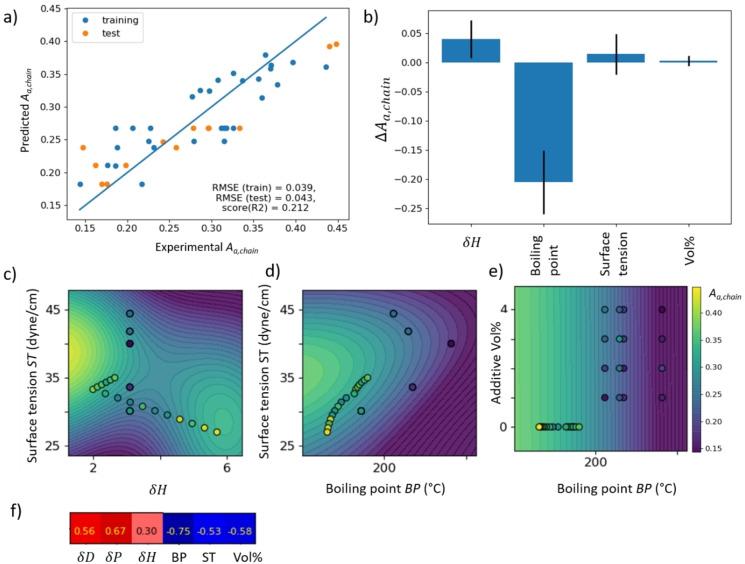
An important step of the great achievement of organic solar cells in power conversion efficiency is the development of low-band gap polymer donors, PBDB-T derivatives, which present interesting aggregation effects dominating the device performance. The aggregation of polymers can be manipulated by a series of variables from a materials design and processing conditions perspective; however, optimization of film quality is a time- and energy-consuming work. Here, we introduce a robot-based high-throughput platform (HTP) that is offering automated film preparation and optical spectroscopy thin-film characterization in combination with an analysis algorithm. PM6 films are prepared by the so-called spontaneous film spreading (SFS) process, where a polymer solution is coated on a water surface. Automated acquisition of UV/Vis and photoluminescence (PL) spectra and automated extraction of morphological features is coupled to Gaussian Process Regression to exploit available experimental evidence for morphology optimization but also for hypothesis formulation and testing with respect to the underlying physical principles. The integrated spectral modeling workflow yields quantitative microstructure information by distinguishing amorphous from ordered phases and assesses the extension of amorphous versus the ordered domains. This research provides an easy to use methodology to analyze the exciton coherence length in conjugated semiconductors and will allow to optimize exciton splitting in thin film organic semiconductor layers as a function of processing.
有机太阳能电池在功率转换效率方面取得重大成就的重要一步是开发低带隙聚合物给体 PBDB-T 衍生物,它具有有趣的聚集效应,主导着器件性能。从材料设计和处理条件的角度来看,可以通过一系列变量来控制聚合物的聚集;然而,优化薄膜质量是一项耗时耗力的工作。在这里,我们引入了一种基于机器人的高通量平台 (HTP),该平台提供自动化的薄膜制备和光学光谱薄膜特性分析,结合分析算法。PM6 薄膜是通过所谓的自发薄膜铺展 (SFS) 过程制备的,其中聚合物溶液涂覆在水面上。紫外/可见和光致发光 (PL) 光谱的自动采集以及形态特征的自动提取与高斯过程回归相结合,以利用可用的实验证据进行形态优化,同时还可以针对潜在的物理原理进行假设的制定和测试。集成的光谱建模工作流程通过区分无定形相与有序相来提供定量的微观结构信息,并评估无定形相与有序域的扩展程度。这项研究提供了一种易于使用的方法来分析共轭半导体中的激子相干长度,并将允许优化薄膜有机半导体层中的激子分裂,作为处理功能的函数。


 Zotero 插件