Baek In-Chul, Jo Soobin, Kim Eun Ji, Lee Ga Ryoung, Lee Dong Hun, Jeon Hong Jin
Department of Psychiatry, Depression Center, Samsung Medical Center, Sungkyunkwan University School of Medicine, Seoul, South Korea.
Korea Psychological Autopsy Center (KPAC), Seoul, South Korea.
Front Psychiatry. 2021 Jun 22;12:679779. doi: 10.3389/fpsyt.2021.679779. eCollection 2021.
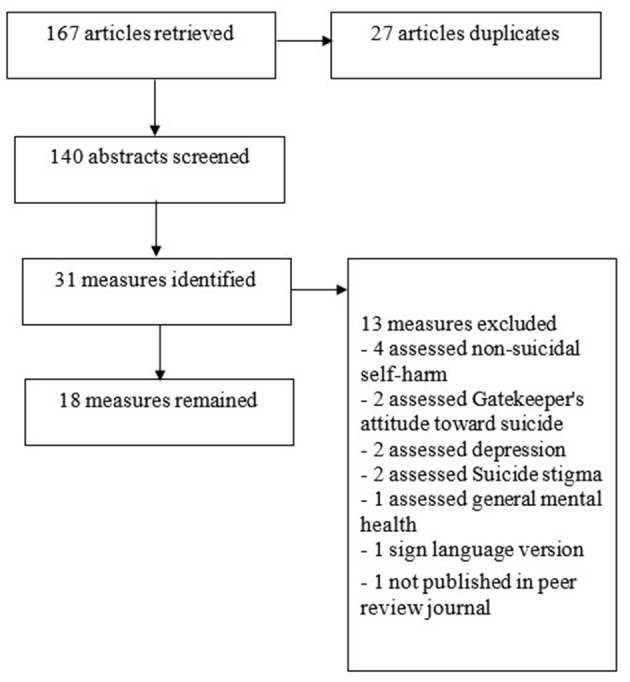
While there has been a slew of review studies on suicide measurement tools until now, there were not any reviews focusing on suicide assessment tools available in Korea. This review aimed to examine the psychometric properties of tools developed in Korea or the translated versions from the original tools in their foreign language and to identify potential improvements and supplements for these tools. A literature search was done using the Korean academic information search service, Research Information Service System, to identify the suicide measures to be included in this review. Abstracts were screened to identify which measures were used to assess suicide-related factors. Based on the established inclusion and exclusion criteria, 18 tools remained and we assessed their psychometric properties. The current review indicated several major findings. First, many of the tools did not report predictive validity and even those with predictive validity were based on past suicide attempts. Second, some of the tools overlooked the interactive component for the cause of suicide. In addition, information to supplement the self-reported and clinician-administered reports by collecting reports from the subjects' families and acquaintances is needed. It is also important to develop a screening tool that examines other aspects of an individual's personal life, including unemployment, bereavement, divorce, and childhood trauma. Moreover, tools that have been studied in more diverse groups of the population are needed to increase external validity. Finally, the linguistic translation of the tools into Korean needs to consider other cultural, social, and psychological factors of the sample of interest.
到目前为止,虽然已有大量关于自杀测量工具的综述研究,但尚未有针对韩国可用的自杀评估工具的综述。本综述旨在研究韩国开发的工具或外语原版工具的翻译版本的心理测量特性,并确定这些工具的潜在改进和补充之处。使用韩国学术信息搜索服务“研究信息服务系统”进行文献检索,以确定本综述中要纳入的自杀测量工具。对摘要进行筛选,以确定哪些测量工具用于评估自杀相关因素。根据既定的纳入和排除标准,保留了18种工具,并对其心理测量特性进行了评估。当前的综述表明了几个主要发现。首先,许多工具未报告预测效度,即使那些具有预测效度的工具也是基于过去的自杀未遂情况。其次,一些工具忽略了自杀原因中的交互因素。此外,需要通过收集受试者家人和熟人的报告来补充自我报告和临床医生管理报告的信息。开发一种筛查工具来检查个人生活的其他方面,包括失业、丧亲、离婚和童年创伤,也很重要。此外,需要在更多样化的人群中进行研究的工具,以提高外部效度。最后,将工具翻译成韩语时,需要考虑目标样本的其他文化、社会和心理因素。