Dutta Anushree, Schürmann Robin, Kogikoski Sergio, Mueller Niclas S, Reich Stephanie, Bald Ilko
Institute of Chemistry, Physical Chemistry, University of Potsdam, Karl-Liebknecht-Str. 24-25, 14476 Potsdam, Germany.
Department of Physics, Freie Universität Berlin, Arnimallee 14, 14195 Berlin, Germany.
ACS Catal. 2021 Jul 2;11(13):8370-8381. doi: 10.1021/acscatal.1c01851. Epub 2021 Jun 23.
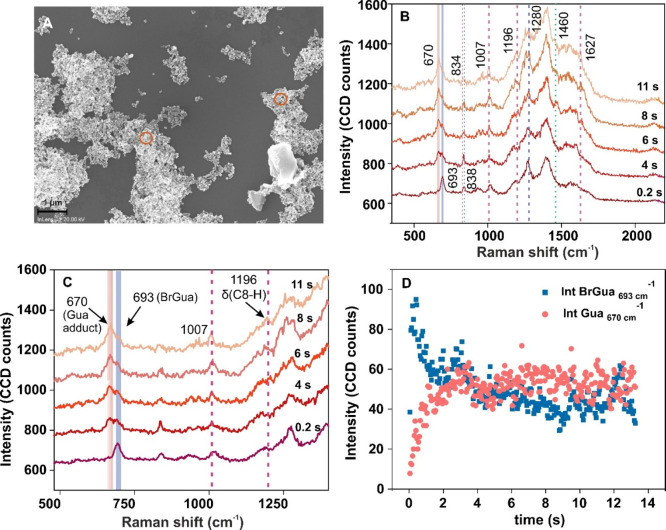
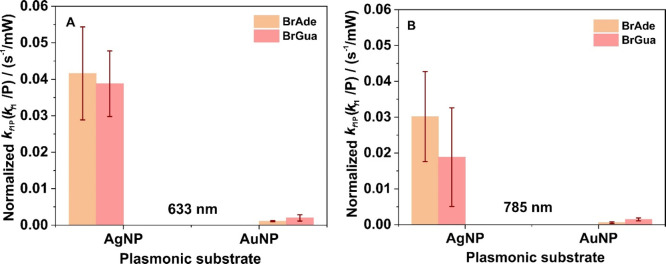
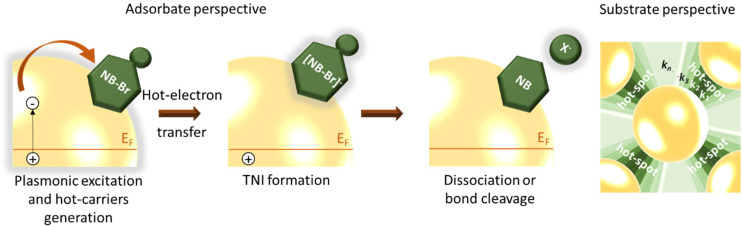
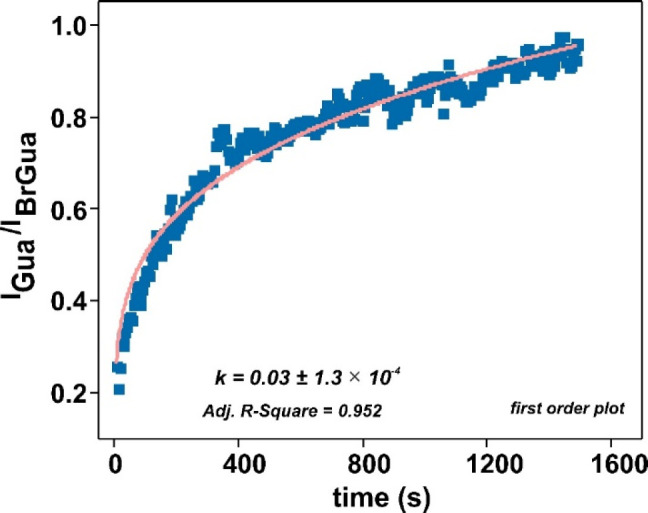
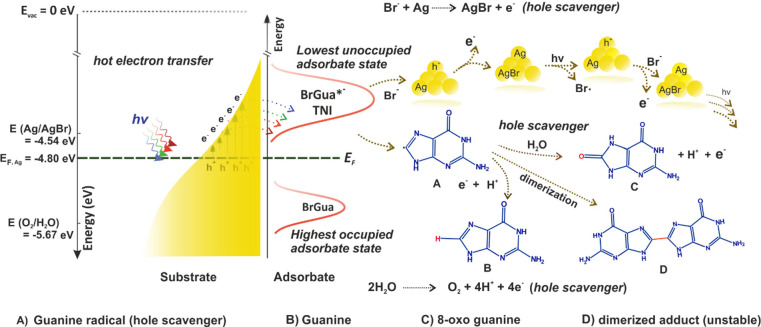
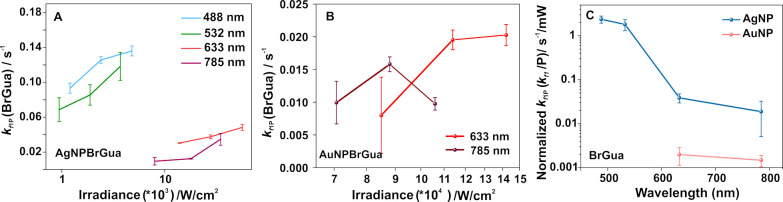
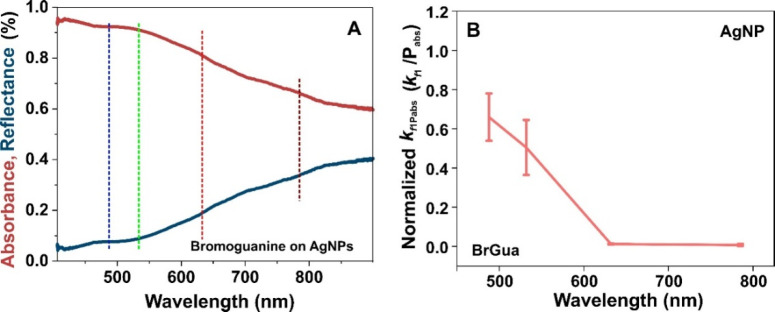
Plasmon-driven photocatalysis is an emerging and promising application of noble metal nanoparticles (NPs). An understanding of the fundamental aspects of plasmon interaction with molecules and factors controlling their reaction rate in a heterogeneous system is of high importance. Therefore, the dehalogenation kinetics of 8-bromoguanine (BrGua) and 8-bromoadenine (BrAde) on aggregated surfaces of silver (Ag) and gold (Au) NPs have been studied to understand the reaction kinetics and the underlying reaction mechanism prevalent in heterogeneous reaction systems induced by plasmons monitored by surface enhanced Raman scattering (SERS). We conclude that the time-average constant concentration of hot electrons and the time scale of dissociation of transient negative ions (TNI) are crucial in defining the reaction rate law based on a proposed kinetic model. An overall higher reaction rate of dehalogenation is observed on Ag compared with Au, which is explained by the favorable hot-hole scavenging by the reaction product and the byproduct. We therefore arrive at the conclusion that insufficient hole deactivation could retard the reaction rate significantly, marking itself as rate-determining step for the overall reaction. The wavelength dependency of the reaction rate normalized to absorbed optical power indicates the nonthermal nature of the plasmon-driven reaction. The study therefore lays a general approach toward understanding the kinetics and reaction mechanism of a plasmon-driven reaction in a heterogeneous system, and furthermore, it leads to a better understanding of the reactivity of brominated purine derivatives on Ag and Au, which could in the future be exploited, for example, in plasmon-assisted cancer therapy.
表面等离子体激元驱动的光催化是贵金属纳米颗粒(NPs)一种新兴且有前景的应用。理解表面等离子体激元与分子相互作用的基本方面以及控制其在非均相体系中反应速率的因素至关重要。因此,研究了8-溴鸟嘌呤(BrGua)和8-溴腺嘌呤(BrAde)在银(Ag)和金(Au)纳米颗粒聚集表面上的脱卤动力学,以了解由表面增强拉曼散射(SERS)监测的表面等离子体激元诱导的非均相反应体系中普遍存在的反应动力学和潜在反应机制。我们得出结论,基于所提出的动力学模型,热电子的时间平均恒定浓度和瞬态负离子(TNI)的解离时间尺度对于定义反应速率定律至关重要。与Au相比,在Ag上观察到总体更高的脱卤反应速率,这可以通过反应产物和副产物对热空穴的有效清除来解释。因此,我们得出结论,空穴失活不足会显著阻碍反应速率,这本身就是整个反应的速率决定步骤。将反应速率归一化到吸收光功率后的波长依赖性表明表面等离子体激元驱动反应的非热性质。因此,该研究为理解非均相体系中表面等离子体激元驱动反应的动力学和反应机制提供了一种通用方法,此外,它有助于更好地理解溴化嘌呤衍生物在Ag和Au上的反应活性,这在未来例如表面等离子体激元辅助癌症治疗中可能会得到应用。