Graduate School of Science and Engineering, Saitama University, Saitama, Japan.
Department of Plant Biology, Michigan State University, East Lansing, MI, USA.
Plant Cell Physiol. 2021 Dec 27;62(12):1858-1866. doi: 10.1093/pcp/pcab103.
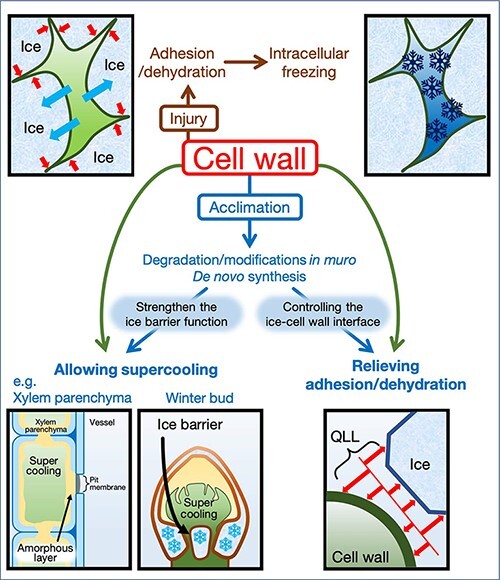
Our general understanding of plant responses to sub-zero temperatures focuses on mechanisms that mitigate stress to the plasma membrane. The plant cell wall receives comparatively less attention, and questions surrounding its role in mitigating freezing injury remain unresolved. Despite recent molecular discoveries that provide insight into acclimation responses, the goal of reducing freezing injury in herbaceous and woody crops remains elusive. This is likely due to the complexity associated with adaptations to low temperatures. Understanding how leaf cell walls of herbaceous annuals promote tissue tolerance to ice does not necessarily lead to understanding how meristematic tissues are protected from freezing by tissue-level barriers formed by cell walls in overwintering tree buds. In this mini-review, we provide an overview of biological ice nucleation and explain how plants control the spatiotemporal location of ice formation. We discuss how sugars and pectin side chains alleviate adhesive injury that develops at sub-zero temperatures between the matrix polysaccharides and ice. The importance of site-specific cell-wall elasticity to promote tissue expansion for ice accommodation and control of porosity to impede ice growth and promote supercooling will be presented. How specific cold-induced proteins modify plant cell walls to mitigate freezing injury will also be discussed. The opinions presented in this report emphasize the importance of a plant's developmental physiology when characterizing mechanisms of freezing survival.
我们对植物应对零下温度的反应的总体理解侧重于减轻质膜压力的机制。植物细胞壁受到的关注相对较少,其在减轻冻结损伤中的作用仍未得到解决。尽管最近的分子发现为适应低温的反应提供了一些见解,但降低草本和木本作物的冻结损伤的目标仍然难以实现。这可能是由于与适应低温相关的复杂性。了解草本一年生植物的叶细胞壁如何促进组织对冰的耐受性,不一定能理解分生组织如何通过细胞壁在越冬树芽中形成的组织水平屏障来防止冻结。在这篇综述中,我们概述了生物冰核的形成,并解释了植物如何控制冰形成的时空位置。我们讨论了糖和果胶侧链如何减轻在零下温度下基质多糖和冰之间形成的粘性损伤。将介绍特定细胞壁弹性在促进组织膨胀以适应冰的容纳和控制孔隙率以阻碍冰的生长和促进过冷方面的重要性。还将讨论特定的冷诱导蛋白如何修饰植物细胞壁以减轻冻结损伤。本报告提出的观点强调了在描述抗冻生存机制时,植物发育生理学的重要性。