Department of Animal Science, Iowa State University, 2356 Kildee Hall, Ames, IA, 50011, USA.
Reprod Biol Endocrinol. 2021 Jul 9;19(1):107. doi: 10.1186/s12958-021-00791-4.
Heat stress (HS) occurs when body heat accumulation exceeds heat dissipation and is associated with swine seasonal infertility. HS contributes to compromised oocyte integrity and reduced embryo development. Autophagy is a potential mechanism for the oocyte to mitigate the detrimental effects of HS by recycling damaged cellular components.
To characterize the effect of HS on autophagy in oocyte maturation, we utilized an in vitro maturation (IVM) system where oocytes underwent thermal neutral (TN) conditions throughout the entire maturation period (TN/TN), HS conditions during the first half of IVM (HS/TN), or HS conditions during the second half of IVM (TN/HS).
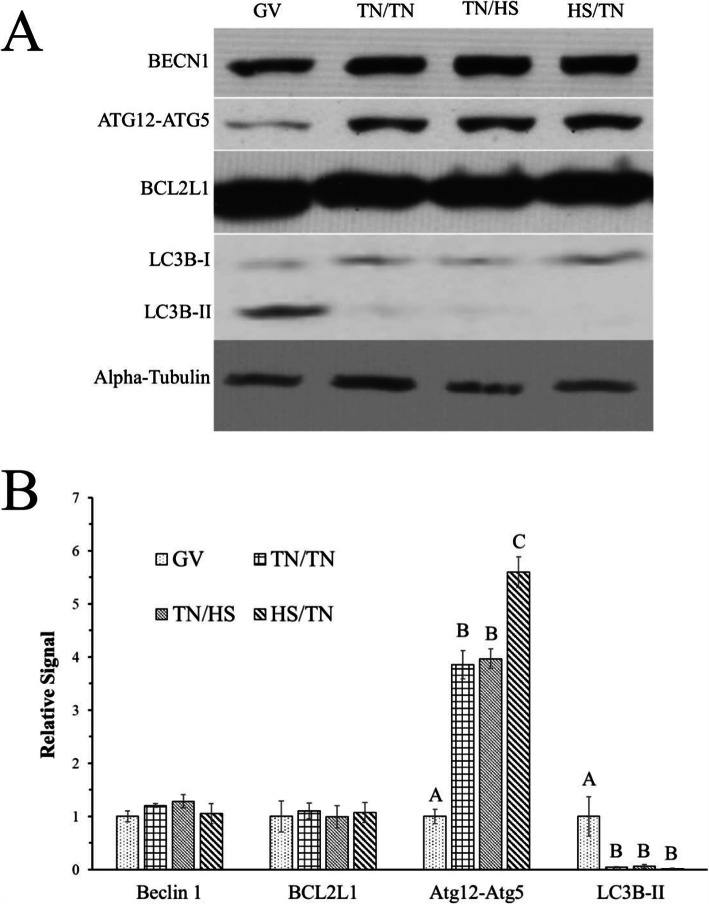
To determine the effect of HS on autophagy induction within the oocyte, we compared the relative abundance and localization of autophagy-related proteins. Heat stress treatment affected the abundance of two well described markers of autophagy induction: autophagy related gene 12 (ATG12) in complex with ATG5 and the cleaved form of microtubule-associated protein 1 light chain 3 beta (LC3B-II). The HS/TN IVM treatment increased the abundance of the ATG12-ATG5 complex and exacerbated the loss of LC3B-II in oocytes. The B-cell lymphoma 2 like 1 protein (BCL2L1) can inhibit autophagy or apoptosis through its interaction with either beclin1 (BECN1) or BCL2 associated X, apoptosis regulator (BAX), respectively. We detected colocalization of BCL2L1 with BAX but not BCL2L1 with BECN1, suggesting that apoptosis is inhibited under the HS/TN treatment but not autophagy. Interestingly, low doses of the autophagy inducer, rapamycin, increased oocyte maturation.
Our results here suggest that HS increases autophagy induction in the oocyte during IVM, and that artificial induction of autophagy increases the maturation rate of oocytes during IVM. These data support autophagy as a potential mechanism activated in the oocyte during HS to recycle damaged cellular components and maintain developmental competence.
当身体热量积累超过热量散发时,就会发生热应激(HS),这与猪季节性不育有关。HS 导致卵母细胞完整性受损,胚胎发育减少。自噬是卵母细胞通过回收受损细胞成分来减轻 HS 不利影响的一种潜在机制。
为了研究 HS 对卵母细胞成熟过程中自噬的影响,我们利用体外成熟(IVM)系统,在整个成熟过程中,卵母细胞处于热中性(TN)条件下(TN/TN),或在 IVM 的前半段处于 HS 条件下(HS/TN),或在 IVM 的后半段处于 HS 条件下(TN/HS)。
为了确定 HS 对卵母细胞内自噬诱导的影响,我们比较了自噬相关蛋白的相对丰度和定位。HS 处理影响了两种描述良好的自噬诱导标志物的丰度:与 ATG5 结合的自噬相关基因 12(ATG12)和微管相关蛋白 1 轻链 3 型β(LC3B-II)的裂解形式。HS/TN IVM 处理增加了 ATG12-ATG5 复合物的丰度,并加剧了卵母细胞中 LC3B-II 的丢失。B 细胞淋巴瘤 2 样 1 蛋白(BCL2L1)可以通过与 beclin1(BECN1)或 BCL2 相关 X,凋亡调节剂(BAX)相互作用来抑制自噬或凋亡。我们检测到 BCL2L1 与 BAX 的共定位,但没有检测到 BCL2L1 与 BECN1 的共定位,这表明 HS/TN 处理抑制了凋亡,但没有抑制自噬。有趣的是,低剂量的自噬诱导剂雷帕霉素增加了卵母细胞成熟。
我们的研究结果表明,HS 在 IVM 期间增加卵母细胞中的自噬诱导,并且人工诱导自噬增加了 IVM 期间卵母细胞的成熟率。这些数据支持自噬作为 HS 期间卵母细胞中激活的一种潜在机制,以回收受损的细胞成分并维持发育能力。