Department of Medicine, Cumming School of Medicine, University of Calgary, Calgary, Canada.
Dalla Lana School of Public Health, University of Toronto, Toronto, Canada.
Int J Equity Health. 2021 Jul 9;20(1):158. doi: 10.1186/s12939-021-01494-3.
Diabetes is a chronic medical condition which demands that patients engage in self-management to achieve optimal glycemic control and avoid severe complications. Individuals who have diabetes and are experiencing homelessness are more likely to have chronic hyperglycemia and adverse outcomes. Our objective was to collaborate with individuals experiencing homelessness and care providers to understand the barriers they face in managing diabetes, as a first step in identifying solutions for enhancing diabetes management in this population.
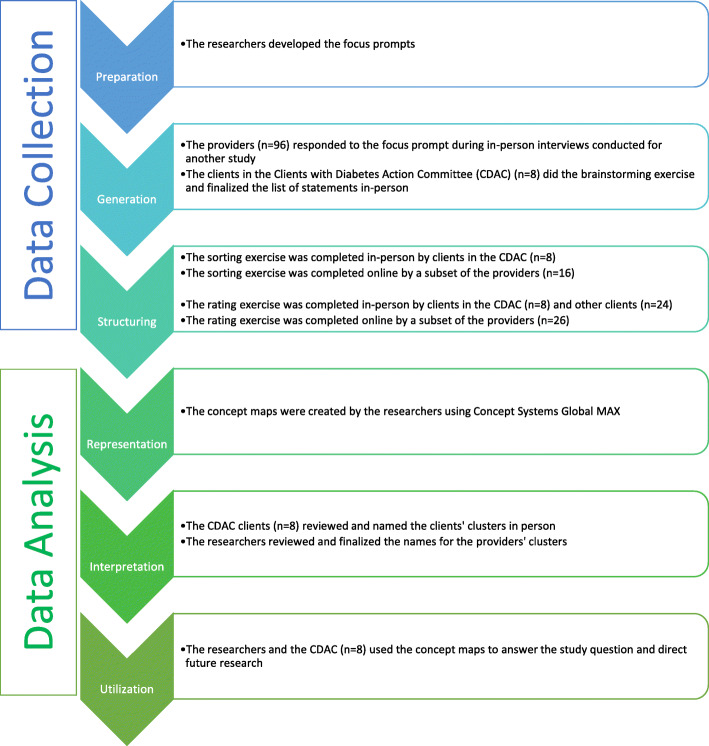
We recruited individuals with lived experience of homelessness and diabetes (i.e. clients; n = 32) from Toronto and health and social care providers working in the areas of diabetes and/or homelessness (i.e. providers; n = 96) from across Canada. We used concept mapping, a participatory research method, to engage participants in brainstorming barriers to diabetes management, which were subsequently categorized into clusters, using the Concept Systems Global MAX software, and rated based on their perceived impact on diabetes management. The ratings were standardized for each participant group, and the average cluster ratings for the clients and providers were compared using t-tests.
The brainstorming identified 43 unique barriers to diabetes management. The clients' map featured 9 clusters of barriers: Challenges to getting healthy food, Inadequate income, Navigating services, Not having a place of your own, Relationships with professionals, Diabetes education, Emotional wellbeing, Competing priorities, and Weather-related issues. The providers' map had 7 clusters: Access to healthy food, Dietary choices in the context of homelessness, Limited finances, Lack of stable, private housing, Navigating the health and social sectors, Emotional distress and competing priorities, and Mental health and addictions. The highest-rated clusters were Challenges to getting healthy food (clients) and Mental health and addictions (providers). Challenges to getting healthy food was rated significantly higher by clients (p = 0.01) and Competing priorities was rated significantly higher by providers (p = 0.03).
Experiencing homelessness poses numerous barriers to managing diabetes, the greatest of which according to clients, is challenges to getting healthy food. This study showed that the way clients and providers perceive these barriers differs considerably, which highlights the importance of including clients' insights when assessing needs and designing effective solutions.
糖尿病是一种慢性病,需要患者进行自我管理,以实现最佳血糖控制并避免严重并发症。患有糖尿病且无家可归的人更有可能出现慢性高血糖和不良后果。我们的目标是与无家可归的糖尿病患者和护理人员合作,了解他们在管理糖尿病方面面临的障碍,作为确定如何改善该人群糖尿病管理的第一步。
我们从多伦多招募了有过无家可归经历和糖尿病经历的个人(即客户;n=32),并从加拿大各地的糖尿病和/或无家可归领域的卫生和社会护理提供者(即提供者;n=96)。我们使用概念映射,一种参与式研究方法,让参与者集思广益,讨论管理糖尿病的障碍,然后使用 Concept Systems Global MAX 软件将这些障碍分类为集群,并根据其对糖尿病管理的感知影响进行评分。对每个参与者组进行了标准化评分,并使用 t 检验比较了客户和提供者的平均聚类评分。
头脑风暴确定了 43 个独特的糖尿病管理障碍。客户的地图上有 9 个障碍集群:获取健康食品的挑战、收入不足、服务导航、没有自己的住所、与专业人士的关系、糖尿病教育、心理健康、优先事项冲突和与天气有关的问题。提供者的地图上有 7 个集群:获取健康食品的途径、无家可归背景下的饮食选择、有限的财务状况、缺乏稳定的私人住房、在卫生和社会部门导航、情绪困扰和优先事项冲突以及心理健康和成瘾。评分最高的集群是获取健康食品的挑战(客户)和心理健康和成瘾(提供者)。客户认为获取健康食品的挑战评分明显更高(p=0.01),提供者认为优先事项冲突的评分明显更高(p=0.03)。
无家可归给管理糖尿病带来了诸多障碍,根据客户的说法,最大的障碍是获取健康食品的挑战。这项研究表明,客户和提供者对这些障碍的看法存在很大差异,这突出了在评估需求和设计有效解决方案时纳入客户见解的重要性。