Department of Biochemistry and Molecular Biology, Medical University of South Carolina, 86 Jonathan Lucas Street, Charleston, SC, 29425, USA.
Hollings Cancer Center, Medical University of South Carolina, 86 Jonathan Lucas Street, Charleston, SC, 29425, USA.
Sci Rep. 2021 Jul 9;11(1):14232. doi: 10.1038/s41598-021-93857-7.
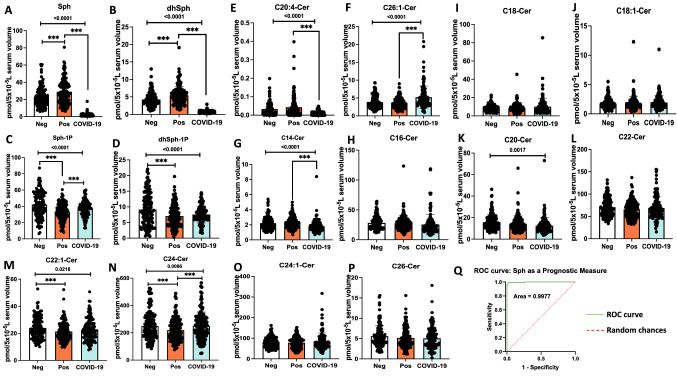
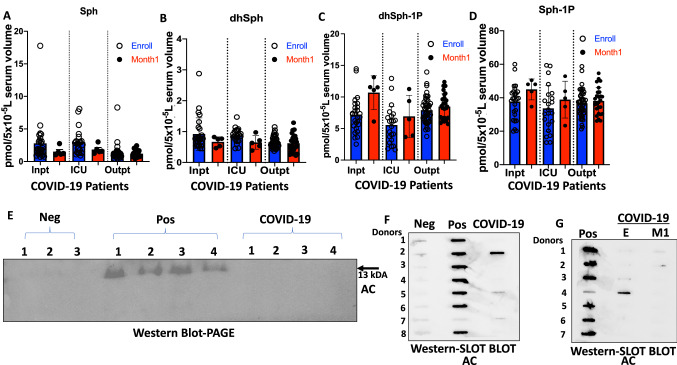
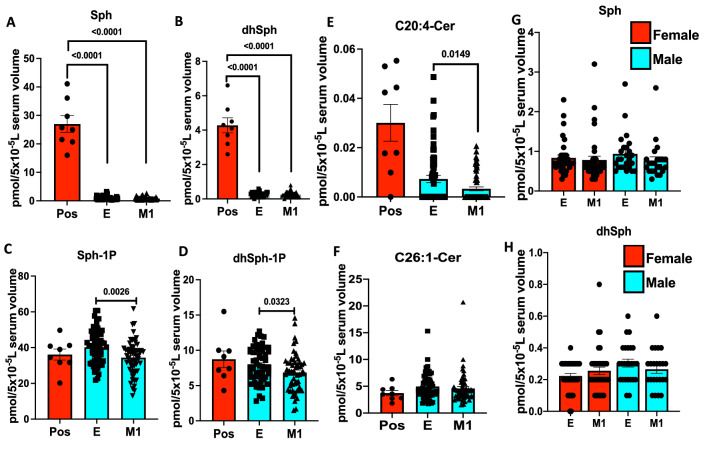
COVID-19 pandemic exerts a health care emergency around the world. The illness severity is heterogeneous. It is mostly unknown why some individuals who are positive for SARS-CoV-2 antibodies stay asymptomatic while others show moderate to severe disease symptoms. Reliable biomarkers for early detection of the disease are urgently needed to attenuate the virus's spread and help make early treatment decisions. Bioactive sphingolipids play a crucial role in the regulation of viral infections and pro-inflammatory responses involved in the severity of COVID-19. However, any roles of sphingolipids in COVID-19 development or detection remain unknown. In this study, lipidomics measurement of serum sphingolipids demonstrated that reduced sphingosine levels are highly associated with the development of symptomatic COVID-19 in the majority (99.24%) SARS-CoV-2-infected patients compared to asymptomatic counterparts. The majority of asymptomatic individuals (73%) exhibited increased acid ceramidase (AC) in their serum, measured by Western blotting, consistent with elevated sphingosine levels compared to SARS-CoV-2 antibody negative controls. AC protein was also reduced in almost all of the symptomatic patients' serum, linked to reduced sphingosine levels, measured in longitudinal acute or convalescent COVID-19 samples. Thus, reduced sphingosine levels provide a sensitive and selective serologic biomarker for the early identification of asymptomatic versus symptomatic COVID-19 patients.
COVID-19 大流行在全球范围内造成了医疗紧急情况。疾病的严重程度存在异质性。目前还不清楚为什么一些 SARS-CoV-2 抗体阳性的人无症状,而另一些人则出现中度至重度疾病症状。迫切需要可靠的生物标志物来早期检测疾病,以减轻病毒的传播,并有助于做出早期治疗决策。生物活性神经鞘脂在调节病毒感染和 COVID-19 严重程度相关的促炎反应中发挥着关键作用。然而,神经鞘脂在 COVID-19 发展或检测中的任何作用仍不清楚。在这项研究中,血清神经鞘脂的脂质组学测量表明,与无症状对照相比,大多数(99.24%)感染 SARS-CoV-2 的患者中,降低的神经鞘氨醇水平与有症状 COVID-19 的发展高度相关。通过 Western blot 测量,大多数无症状个体(73%)的血清中酸性神经酰胺酶(AC)增加,与 SARS-CoV-2 抗体阴性对照相比,神经鞘氨醇水平升高一致。在几乎所有有症状患者的血清中,AC 蛋白也减少,与纵向急性或恢复期 COVID-19 样本中降低的神经鞘氨醇水平有关。因此,降低的神经鞘氨醇水平为早期识别无症状与有症状 COVID-19 患者提供了一种敏感和选择性的血清学生物标志物。