INSERM U1128, Laboratory of Neurophysiology and New Microscopy, Université Paris Descartes, Paris, France.
Faculté de Médecine Dentaire, Université de Montréal, Montréal, QC, Canada.
Commun Biol. 2021 Jul 9;4(1):855. doi: 10.1038/s42003-021-02382-w.
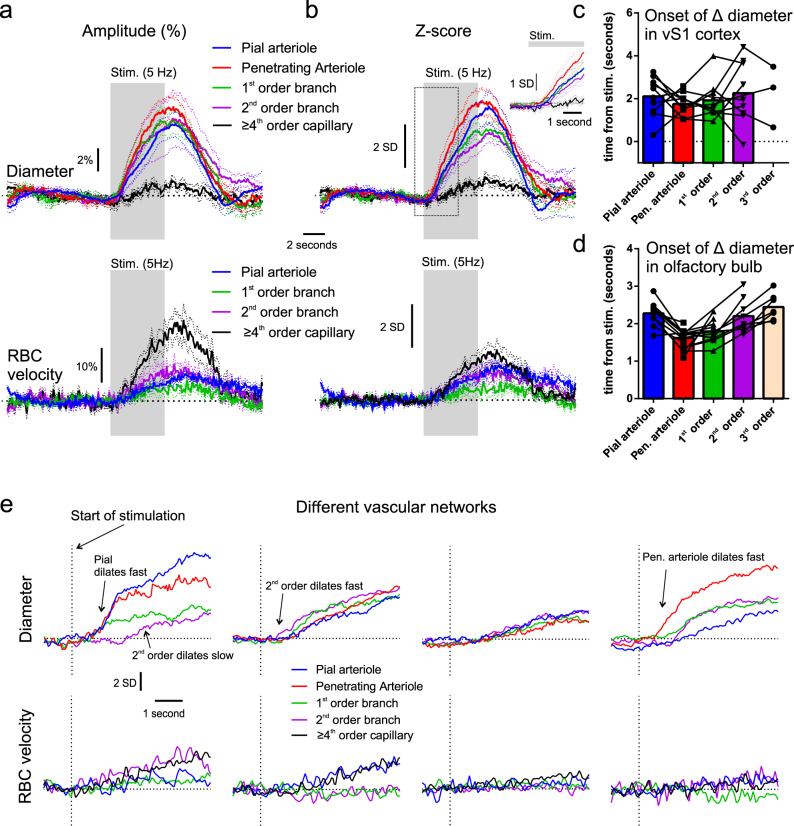
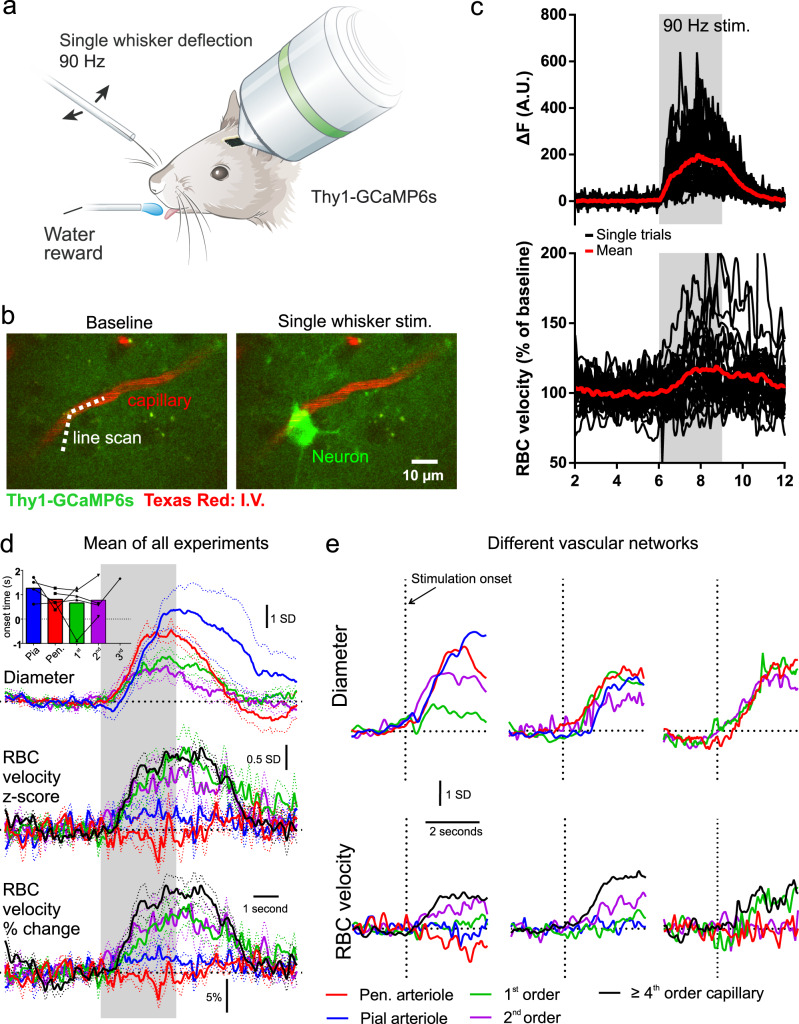
The spatial-temporal sequence of cerebral blood flow (CBF), cerebral blood volume (CBV) and blood velocity changes triggered by neuronal activation is critical for understanding functional brain imaging. This sequence follows a stereotypic pattern of changes across different zones of the vasculature in the olfactory bulb, the first relay of olfaction. However, in the cerebral cortex, where most human brain mapping studies are performed, the timing of activity evoked vascular events remains controversial. Here we utilized a single whisker stimulation model to map out functional hyperemia along vascular arbours from layer II/III to the surface of primary somatosensory cortex, in anesthetized and awake Thy1-GCaMP6 mice. We demonstrate that sensory stimulation triggers an increase in blood velocity within the mid-capillary bed and a dilation of upstream large capillaries, and the penetrating and pial arterioles. We report that under physiological stimulation, response onset times are highly variable across compartments of different vascular arbours. Furthermore, generating transfer functions (TFs) between neuronal Ca and vascular dynamics across different brain states demonstrates that anesthesia decelerates neurovascular coupling (NVC). This spatial-temporal pattern of vascular events demonstrates functional diversity not only between different brain regions but also at the level of different vascular arbours within supragranular layers of the cerebral cortex.
神经元激活引发的脑血流 (CBF)、脑血容量 (CBV) 和血流速度的时空序列对于理解功能脑成像至关重要。这一序列遵循着嗅觉第一中继器——嗅球中血管不同区域变化的典型模式。然而,在大脑皮层中,大多数人类大脑映射研究都是在那里进行的,活动诱发血管事件的时间仍然存在争议。在这里,我们利用单一胡须刺激模型,在麻醉和清醒的 Thy1-GCaMP6 小鼠中,从 II/III 层映射到初级体感皮层表面的血管树的功能充血。我们证明,感觉刺激会引起毛细血管床中部的血流速度增加,并扩张上游的大毛细血管、穿透性和脑皮层小动脉。我们报告说,在生理刺激下,不同血管树的不同隔室之间的反应起始时间变化很大。此外,在不同脑状态下,在神经元 Ca 和血管动力学之间生成传递函数 (TF) 表明,麻醉会减缓神经血管耦合 (NVC)。这些血管事件的时空模式不仅显示了不同脑区之间的功能多样性,而且还显示了大脑皮层颗粒上层不同血管树之间的功能多样性。