Department of Health Care Management, Berlin University of Technology, Berlin, Germany; European Observatory on Health Systems and Policies; Department of Health Care Management, Berlin University of Technology, Berlin, Germany.
European Observatory on Health Systems and Policies; London School of Economics and Political Science, London, UK.
Health Policy. 2022 May;126(5):382-390. doi: 10.1016/j.healthpol.2021.04.016. Epub 2021 May 4.
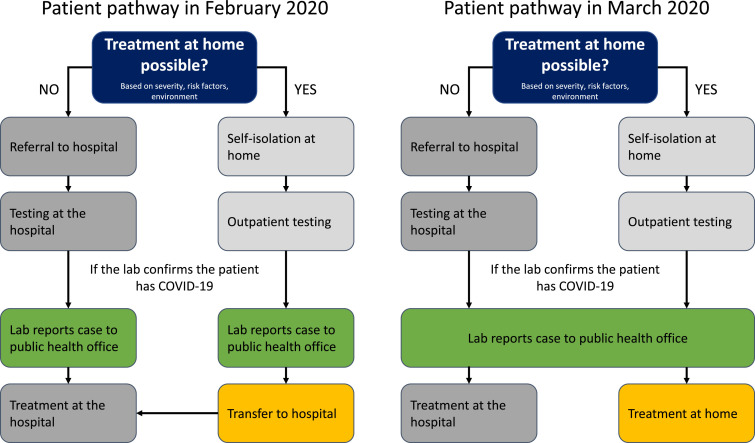
The COVID-19 pandemic triggered abrupt challenges for health care providers, requiring them to simultaneously plan for and manage a rise of COVID-19 cases while maintaining essential health services. Since March 2020, the COVID-19 Health System Response Monitor, a joint initiative of the European Observatory on Health Systems and Policies, the WHO Regional Office for Europe, and the European Commission, has documented country responses to COVID-19 using a structured template which includes a section on provision of care. Using the information available on the platform, this paper analyzes how countries planned services for potential surge capacity, designed patient flows ensuring separation between COVID-19 and non-COVID-19 patients, and maintained routine services in both hospital and ambulatory settings. Despite very real differences in the organization of health and care services, there were many similarities in country responses. These include transitioning the management of COVID-19 mild cases from hospitals to outpatient settings, increasing the use of remote consultations, and cancelling or postponing non-urgent services during the height of the first wave. In the immediate future, countries will have to continue balancing care for COVID-19 and non-COVID-19 patients to minimize adverse health outcomes, ideally with supporting guidelines and COVID-19-specific care zones. Looking forward, policymakers will have to consider whether strategies adopted during the COVID-19 pandemic will become permanent features of care provision.
COVID-19 大流行给医疗保健提供者带来了突然的挑战,要求他们在规划和管理 COVID-19 病例增加的同时,维持基本的卫生服务。自 2020 年 3 月以来,COVID-19 卫生系统应对监测系统(COVID-19 Health System Response Monitor)作为欧洲卫生系统和政策观察站、世界卫生组织欧洲区域办事处和欧盟委员会的联合倡议,使用包括护理部分的结构化模板记录各国对 COVID-19 的应对情况。本文利用平台上提供的信息,分析各国如何规划潜在的应急能力服务,设计确保 COVID-19 患者与非 COVID-19 患者分开的患者流程,并维持医院和门诊环境中的常规服务。尽管在卫生和护理服务的组织方面存在着非常明显的差异,但各国的应对措施有许多相似之处。这些措施包括将 COVID-19 轻症患者的管理从医院转移到门诊,增加远程咨询的使用,并在第一波疫情高峰期取消或推迟非紧急服务。在不久的将来,各国将不得不继续平衡 COVID-19 和非 COVID-19 患者的护理,以尽量减少不良健康后果,最好有支持性的指导方针和 COVID-19 特定的护理区。展望未来,政策制定者将不得不考虑在 COVID-19 大流行期间采用的策略是否将成为护理提供的永久特征。