Hsu Martin, Laaker Collin, Sandor Matyas, Fabry Zsuzsanna
Neuroscience Training Program, University of Wisconsin Madison, Madison, WI, United States.
Department of Pathology and Laboratory Medicine, University of Wisconsin Madison, Madison, WI, United States.
Front Cell Neurosci. 2021 Jun 23;15:683676. doi: 10.3389/fncel.2021.683676. eCollection 2021.
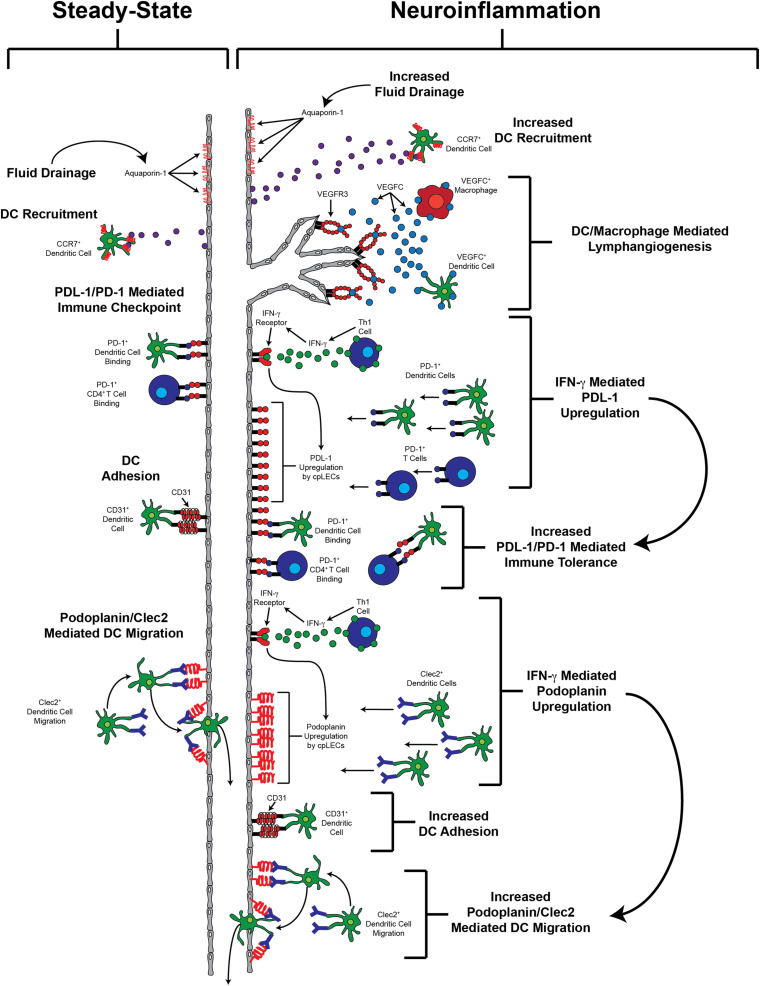
The central nervous system (CNS) undergoes immunosurveillance despite the lack of conventional antigen presenting cells and lymphatic vessels in the CNS parenchyma. Additionally, the CNS is bathed in a cerebrospinal fluid (CSF). CSF is continuously produced, and consequently must continuously clear to maintain fluid homeostasis despite the lack of conventional lymphatics. During neuroinflammation, there is often an accumulation of fluid, antigens, and immune cells to affected areas of the brain parenchyma. Failure to effectively drain these factors may result in edema, prolonged immune response, and adverse clinical outcome as observed in conditions including traumatic brain injury, ischemic and hypoxic brain injury, CNS infection, multiple sclerosis (MS), and brain cancer. Consequently, there has been renewed interest surrounding the expansion of lymphatic vessels adjacent to the CNS which are now thought to be central in regulating the drainage of fluid, cells, and waste out of the CNS. These lymphatic vessels, found at the cribriform plate, dorsal dural meninges, base of the brain, and around the spinal cord have each been implicated to have important roles in various CNS diseases. In this review, we discuss the contribution of meningeal lymphatics to these processes during both steady-state conditions and neuroinflammation, as well as discuss some of the many still unknown aspects regarding the role of meningeal lymphatics in neuroinflammation. Specifically, we focus on the observed phenomenon of lymphangiogenesis by a subset of meningeal lymphatics near the cribriform plate during neuroinflammation, and discuss their potential roles in immunosurveillance, fluid clearance, and access to the CSF and CNS compartments. We propose that manipulating CNS lymphatics may be a new therapeutic way to treat CNS infections, stroke, and autoimmunity.
尽管中枢神经系统(CNS)实质中缺乏传统的抗原呈递细胞和淋巴管,但仍会进行免疫监视。此外,中枢神经系统浸泡在脑脊液(CSF)中。脑脊液持续产生,因此尽管缺乏传统淋巴管,仍必须持续清除以维持液体稳态。在神经炎症期间,液体、抗原和免疫细胞常常会在脑实质的受影响区域积聚。无法有效排出这些因素可能会导致水肿、免疫反应延长以及不良临床后果,如在创伤性脑损伤、缺血性和缺氧性脑损伤、中枢神经系统感染、多发性硬化症(MS)和脑癌等病症中所观察到的那样。因此,人们对中枢神经系统附近淋巴管的扩张重新产生了兴趣,现在认为这些淋巴管在调节液体、细胞和废物从中枢神经系统排出方面起着核心作用。这些淋巴管位于筛板、硬脑膜背侧、脑底部和脊髓周围,在各种中枢神经系统疾病中都被认为具有重要作用。在本综述中,我们讨论了脑膜淋巴管在稳态条件和神经炎症期间对这些过程的贡献,并讨论了脑膜淋巴管在神经炎症中的作用仍存在的许多未知方面。具体而言,我们关注在神经炎症期间筛板附近一部分脑膜淋巴管的淋巴管生成现象,并讨论它们在免疫监视、液体清除以及进入脑脊液和中枢神经系统腔室方面的潜在作用。我们提出,操纵中枢神经系统淋巴管可能是治疗中枢神经系统感染、中风和自身免疫性疾病的一种新的治疗方法。