Pavlovic Jelena, Kostic Ljiljana, Bosnic Predrag, Kirkby Ernest A, Nikolic Miroslav
Institute for Multidisciplinary Research, University of Belgrade, Belgrade, Serbia.
Faculty of Biological Sciences, Leeds University, Leeds, United Kingdom.
Front Plant Sci. 2021 Jun 23;12:697592. doi: 10.3389/fpls.2021.697592. eCollection 2021.
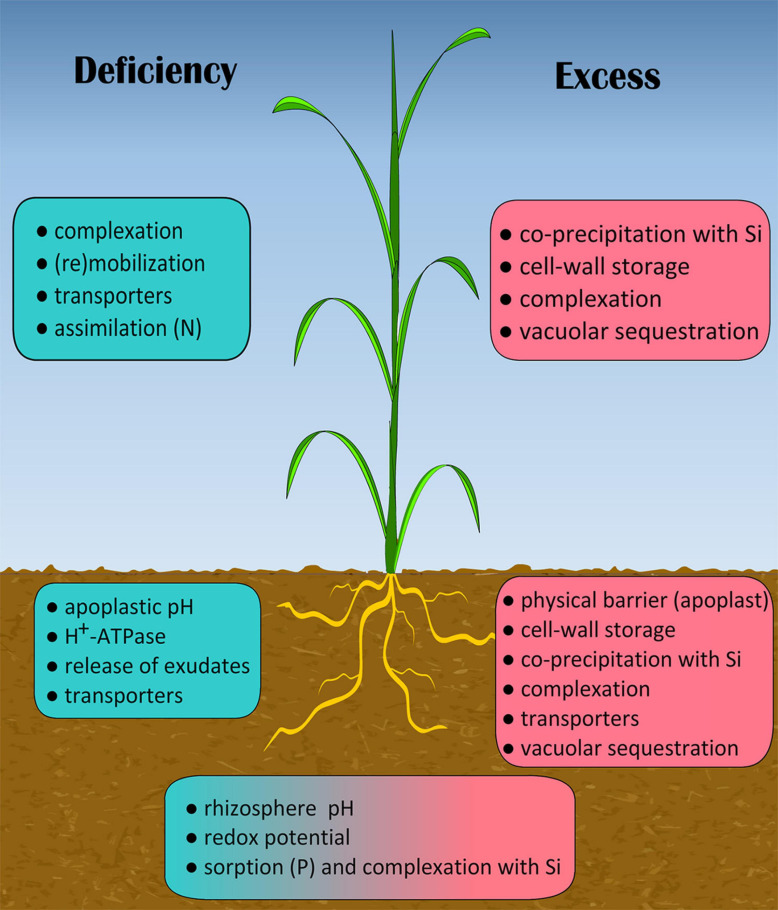
Silicon (Si) is not classified as an essential element for plants, but numerous studies have demonstrated its beneficial effects in a variety of species and environmental conditions, including low nutrient availability. Application of Si shows the potential to increase nutrient availability in the rhizosphere and root uptake through complex mechanisms, which still remain unclear. Silicon-mediated transcriptional regulation of element transporters for both root acquisition and tissue homeostasis has recently been suggested as an important strategy, varying in detail depending on plant species and nutritional status. Here, we summarize evidence of Si-mediated acquisition, uptake and translocation of nutrients: nitrogen (N), phosphorus (P), potassium (K), calcium (Ca), magnesium (Mg), sulfur (S), iron (Fe), zinc (Zn), manganese (Mn), copper (Cu), boron (B), chlorine (Cl), and nickel (Ni) under both deficiency and excess conditions. In addition, we discuss interactions of Si-with beneficial elements: aluminum (Al), sodium (Na), and selenium (Se). This review also highlights further research needed to improve understanding of Si-mediated acquisition and utilization of nutrients and nutrient status-mediated Si acquisition and transport, both processes which are of high importance for agronomic practice (e.g., reduced use of fertilizers and pesticides).
硅(Si)未被归类为植物的必需元素,但大量研究表明,在包括养分有效性低在内的多种物种和环境条件下,硅具有有益作用。施用硅显示出通过仍不清楚的复杂机制增加根际养分有效性和根系吸收的潜力。最近有人提出,硅介导的元素转运蛋白对根系养分获取和组织内稳态的转录调控是一种重要策略,具体细节因植物物种和营养状况而异。在这里,我们总结了在缺乏和过量条件下,硅介导的氮(N)、磷(P)、钾(K)、钙(Ca)、镁(Mg)、硫(S)、铁(Fe)、锌(Zn)、锰(Mn)、铜(Cu)、硼(B)、氯(Cl)和镍(Ni)等养分的获取、吸收和转运的证据。此外,我们还讨论了硅与有益元素铝(Al)、钠(Na)和硒(Se)的相互作用。本综述还强调了需要进一步开展研究,以增进对硅介导的养分获取和利用以及养分状况介导的硅获取和运输的理解,这两个过程对农艺实践(如减少化肥和农药的使用)都非常重要。