Tan Jiaqi, Zou Diyang, Zhang Xianlong, Zheng Nan, Pan Yuqi, Ling Zhi, Tsai Tsung-Yuan, Chen Yunsu
Department of Orthopedic Surgery, Shanghai Sixth People's Hospital, Shanghai Jiao Tong University, Shanghai, China.
School of Biomedical Engineering & Med-X Research Institute, Shanghai Jiao Tong University, Engineering Research Center of Digital Medicine and Clinical Translation, Ministry of Education, Department of Orthopaedic Surgery, Shanghai Key Laboratory of Orthopaedic Implants and Clinical Translational R&D Center of 3D Printing Technology, Shanghai Ninth People's Hospital, Shanghai Jiao Tong University School of Medicine, Shanghai, China.
Front Bioeng Biotechnol. 2021 Jun 24;9:675093. doi: 10.3389/fbioe.2021.675093. eCollection 2021.
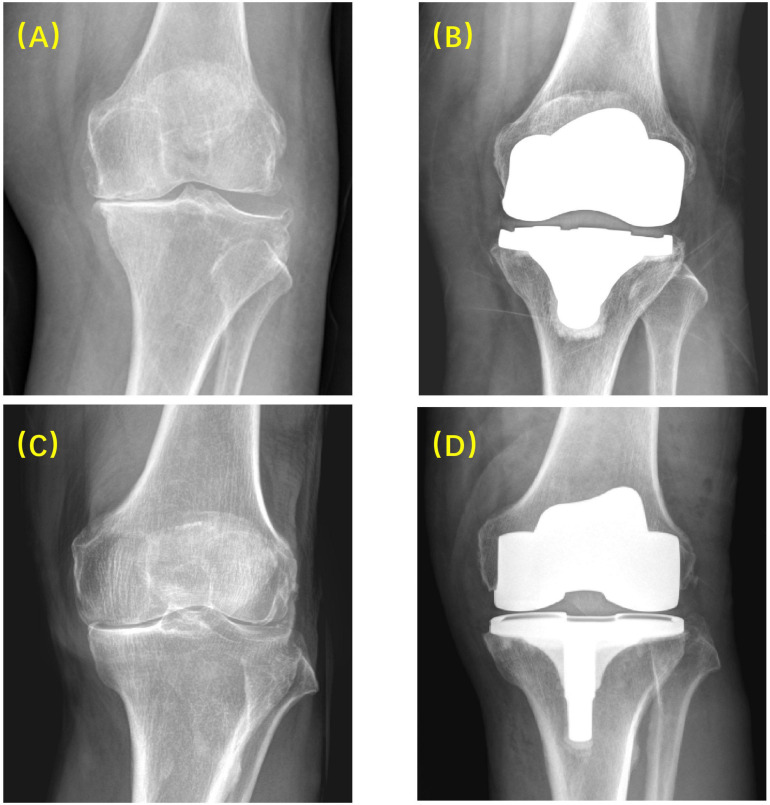
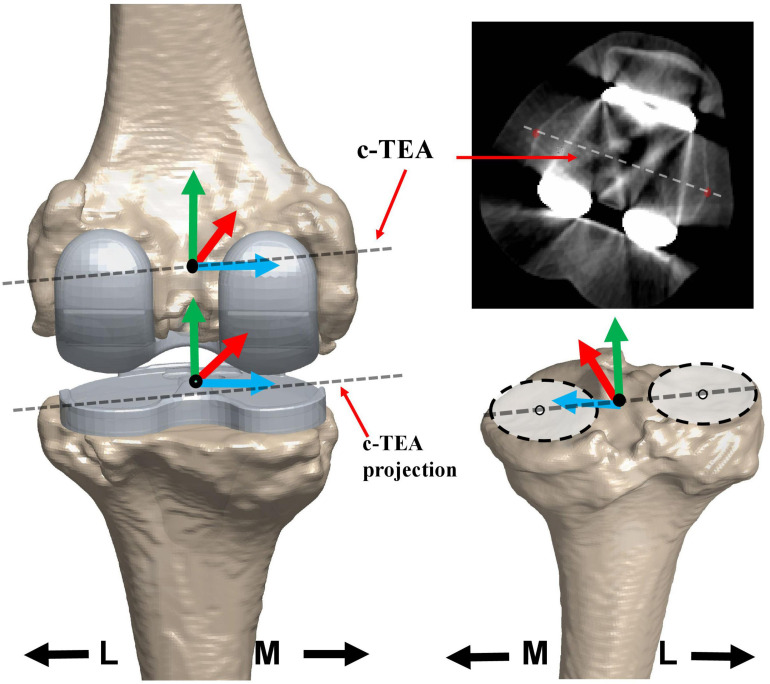
The medial-pivot (MP) prosthesis was developed to produce more physiological postoperative knee kinematics and better patient satisfaction than traditional prostheses, but outcomes are inconsistent in different studies of Caucasian patients. This study aimed to investigate the postoperative patient satisfaction and knee kinematics of the MP and posterior-stabilized (PS) prosthesis during gait activity in Chinese patients. A retrospective analysis of 12 patients was received for this study in each MP group and PS group. Patient-reported satisfaction level and Forgotten Joint Score (FJS) were evaluated with questionnaires. A dual fluoroscopic imaging system was used to investigate knee kinematics of MP and PS total knee arthroplasty (TKA) during treadmill walking at a speed of 0.4 m/s. Comparable promising patient satisfaction and overall FJS (MP 60.7 ± 15.35 vs. PS 51.3 ± 17.62, = 0.174) were found between the MP and PS groups. Peak flexion appeared at around 70% of gait cycle with values of 52.4 ± 7.4° for MP and 50.1 ± 3.6° for PS groups (no difference). Both groups maintained a stable position at the stance phase and began to translated anteriorly at toe-off with an amount of 4.5 ± 2.3 mm in the MP and 6.6 ± 2.7 mm in the PS ( = 0.08) group until late swing. The range of this external rotation motion was 5.9 ± 4.8 and 6.2 ± 4.1° ( = 0.79) for the MP and PS, respectively. A similar knee kinematics pattern characterized by a loss of early-stance knee flexion and femoral rollback during walking was observed in the MP and PS TKAs. Our study confirmed similar effectiveness of MP TKA compared to PS TKA in Chinese patients, while the change of knee kinematics of both implants during slow walking should be noted.
内侧旋转(MP)假体的研发目的是,相较于传统假体,使术后膝关节运动学更符合生理状态,并提高患者满意度,但在针对白种患者的不同研究中,结果并不一致。本研究旨在调查中国患者在步态活动期间,MP假体与后稳定型(PS)假体的术后患者满意度及膝关节运动学情况。本研究对MP组和PS组各12例患者进行了回顾性分析。通过问卷评估患者报告的满意度水平和遗忘关节评分(FJS)。使用双荧光透视成像系统,以0.4 m/s的速度在跑步机上行走时,研究MP和PS全膝关节置换术(TKA)的膝关节运动学。MP组和PS组之间的患者满意度和总体FJS相当(MP为60.7±15.35,PS为51.3±17.62,P = 0.17)。峰值屈曲出现在步态周期的70%左右,MP组为52.4±7.4°及PS组为50.1±3.6°(无差异)。两组在站立期均保持稳定位置,并在足趾离地时开始向前平移,MP组为4.5±2.3 mm,PS组为6.6±2.7 mm(P = 0.08),直至摆动后期。MP组和PS组的这种外旋运动范围分别为5.9±4.8°和6.2±4.1°(P = 0.79)。在MP和PS全膝关节置换术中,观察到相似的膝关节运动学模式,其特征为步行时早期站立期膝关节屈曲丧失和股骨后滚。我们的研究证实,在中国患者中,MP全膝关节置换术与PS全膝关节置换术效果相似,但应注意两种植入物在慢走时膝关节运动学的变化。